
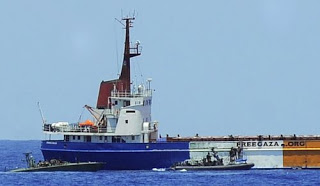
 This is the news report from the Jerusalem Post regarding the boarding of the Rachel Corrie.
The boarding of the Rachel Corrie containing activists and aid for Gaza was described by Prime Minister Binyamin Netanyahu on Saturday as a quiet operation. Netanyahu was quick to distinguish between the boat of Irish and Malaysian activists and the Turkish-sponsored Mavi Marmara which was boarded May 31 in an incident that left nine dead and scores wounded.There is no question that it is a good thing there was no violence, but what is left out of the analysis of the second flotilla that attempted to run the Gaza blockade is how successful the associated information operation was.
"The different outcome we saw today underscores the difference between peace activists who we disagree with but respect their right to express their different opinion and flotilla participants [on the Mavi Marmara] who were violent extremist supporters of terrorists," said Netanyahu.
I am not surprised the Irish sailors had no interest in an armed confrontation; there is a cultural element at play here. The crew made it clear there would be no confrontation through the media, which is distinctly different than the media comments made by the crews of the first flotilla that attempted to run the Israeli blockade of Gaza. With that said, I've also been observing the information strategy in play with the second attempt - a strategy that has been every bit as intricate and detailed as the first attempt.
Who is Rachel Corrie? No matter where I went, whether CNN or Newspapers, I was given a history lesson regarding who Rachel Corrie was - and I was repeatedly told her story. I was the target audience, one of billions, in the information campaign by the NGOs working against the Israeli blockade of Gaza that are masterfully manipulating the information space. I was told the story of a peaceful young woman who was bulldozed by the evil Israeli military. It is the story of a victim who died at the hands an aggressive state that doesn't care about human life. It is the story of suffering, with Israel in their crosshairs.
It is quite brilliant - and whether the story is accurate or not doesn't matter one bit - because the name is part of the information campaign to shape the perception for the audience. Consider the level of detail in information operations taking place against modern military powers - the ships very name became the object of political manipulation of information. When I see how organizations are manipulating every name, symbol, and message to align with their information operations - I begin to look around and question whether we are even bothering to compete.
We don't compete, and it is because we don't care what people think of us - despite a lot of hard working military folks telling us we should. We don't care because our leaders don't care - and make no mistake - the problem of not actually caring despite the rhetoric starts at the very top.
Secretary of the Navy Ray Mabus announced on April 23 that the 10th San Antonio class Amphibious Transport Dock ship would be named USS John P. Murtha (LPD 26). I remember it well, because my email filled up with people complaining. There were many critics of this decision, but to be honest I didn't really care. I have had some trouble thinking of a good reason why we should, or should not, name ships after politicians. That made me a fool.
I am not against the Navy naming a ship after A politician, I am against the Navy naming a ship after ANY politician - because names play right into the 21st century information campaigns developed against our armed forces. When we observe the early signs of the capabilities that exist for media manipulation, every single name, symbol, and message the military can control - the military should control.
NOT IF, BUT WHEN the USS George H.W. Bush (CVN-77) is launching aircraft to bomb some Middle Eastern target in the future - how does that play into the enemies information strategy for shaping the perceptions of the United States? Do we care? Should we? According to all of our military and political leaders - including Ray Mabus btw - these are the intricate details of the way the information age impacts military operations the military should be sensitive to recognizing. Nobody in the Middle East is going to care that the ship is named after Bush 41, because the media reports will be reminding everyone that the US military named their carrier "George H.W. Bush" - or said another way, the USA celebrated their leader whose biggest achievement was bombing Muslims.
The same will be true with John Murtha. There is nothing smart about naming the amphibious ship John Murtha just as there is nothing smart about naming an aircraft carrier George H.W. Bush. When you give a warship a political name, you are just asking for the name to be given a political context. In some distant future when the USS John P. Murtha (LPD 26) is landing Marines into some dangerous situation - an embassy evacuation perhaps - don't say you didn't see it coming when the local newspaper highlights how the USA named their ship celebrating the life of a Congressman primarily responsible for funding US military adventurism across the globe. Is that an accurate description of John Murtha? It doesn't matter.
When you give political name to a military operation, you are sending a political message - and you have no control over that message in the political context. The same is not true when you name ships after military heroes, cities, states, battles, or most importantly - values. A comprehensive approach to information operations is needed, and we will know when our approach is comprehensive when the details, like the name of a warship, is included in the overarching strategy. Until that day, we only pay lip service to our efforts.
Ship names don't matter huh? Then why do we name our hospital ships Mercy and Comfort? What is in a name? In the 21st century information environment - a lot more than there used to be.

No comments:
Post a Comment