
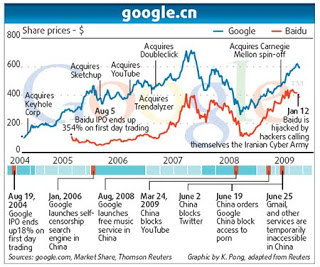
 If you did not catch it, I think anyone interested in either China or Cyber warfare should make sure they read in full the Google statement regarding their reevaluation of the Chinese market. The statement starts by giving a ton of details regarding specific attacks on the Google.cn servers with an implication that these are Chinese government sponsored Cyber attacks against their company - leading up to a statement likely to make any stockholder ponder their Google investment looking into the future.
We have taken the unusual step of sharing information about these attacks with a broad audience not just because of the security and human rights implications of what we have unearthed, but also because this information goes to the heart of a much bigger global debate about freedom of speech. In the last two decades, China's economic reform programs and its citizens' entrepreneurial flair have lifted hundreds of millions of Chinese people out of poverty. Indeed, this great nation is at the heart of much economic progress and development in the world today.The tech industry, of which I belong, is weird. We are generally nerds, often identified by our latest phone fetish and other pocket tech that we cling to like modern pocket protectors. Like everyone else, we often have odd political views that skew our opinions both right and left, and I find that particularly true among the tech media. The majority of opinion tech responses I have seen from this focuses on the moral and ethical debate (with the White House leading there) surrounding Google's decision. Other more business savvy tech types do what businessmen do, and follow the money. Feel free to chase down opinions on those matters elsewhere, because I don't actually care if you think Google is the virtual student standing in the Tienanmen square of free speech against the CCP tank or the Dread Pirate Roberts chasing a Buttercup overflowing with the peoples currency.
We launched Google.cn in January 2006 in the belief that the benefits of increased access to information for people in China and a more open Internet outweighed our discomfort in agreeing to censor some results. At the time we made clear that "we will carefully monitor conditions in China, including new laws and other restrictions on our services. If we determine that we are unable to achieve the objectives outlined we will not hesitate to reconsider our approach to China."
These attacks and the surveillance they have uncovered--combined with the attempts over the past year to further limit free speech on the web--have led us to conclude that we should review the feasibility of our business operations in China. We have decided we are no longer willing to continue censoring our results on Google.cn, and so over the next few weeks we will be discussing with the Chinese government the basis on which we could operate an unfiltered search engine within the law, if at all. We recognize that this may well mean having to shut down Google.cn, and potentially our offices in China.
Let us focus on other more interesting aspects of this development.
People like to point out that Baidu has a greater marketshare than Google.cn. While completely true, Google.cn has 35% of the market share among 338 million internet users in China, or roughly 118 million users. In the US Google has 70% of the marketshare, somewhere around 159 million users. To legitimately threaten to walk away from a marketshare roughly 75% the size of their US marketshare is a big damn deal, regardless where their position relative to Baidu is.
More importantly, Baidu doesn't have all those other services that have market share in China, services like GMail, Gtalk, Picasa, or Google Maps - all of which are wildly popular. With that said, it should also be pointed out that the Google revenue forecast for 2010 in China is between $250 million and $300 million, which would only represent 2% of Google's total estimated revenue for 2010.
What is my point? I am curious what people think this high stakes game of poker represents. For what amounts to only 2% of revenue, Google is threatening to disrupt the internet behavior of at minimum 118 million internet savvy Chinese and believes that fact alone has value in negotiations. In China that may not actually matter at all, but if it does, I will acknowledge 118 million is a lot of people in the business class of China to disrupt all at once.
Google is one of the worlds most powerful corporations - particularly in cyberspace - both in the US and in China. When a state attacks a company, it is espionage by definition. From the perspective of China, their actions represent politically motivated Cyber law enforcement activity by a nation state against an international corporation, not unlike when the US Treasury raids financial records of international companies involved in what US law deems to be criminal activities.
However there is always an alternative viewpoint in cyberspace. In this case Google is calling it cyber warfare, and in the 21st century we have some prerequisite when we say the US is at war with Al Qaeda, which isn't an international corporation but is a non-state actor. One question that raises is whether a corporation can be a non-state actor, and in a medium like cyberspace can a state "war" a corporation? Ponder that last, because what happens if Google pulls out of China, then decides one day (hypothetical scenario) to launch a cyber attack against The Great Wall, or even Baidu? Can a corporation 'war' a state? Does the term even matter when explaining the context of the conflict? As both our laws and international law are still relatively undefined regarding cyber warfare, the terms may matter a great deal even if they shouldn't.
We can theorize all day, which is part of the point of this post. The other part is to inform and encourage folks to keep an eye on this unfolding scenario. Cyber warfare is very different than traditional warfare (I would argue this isn't even cyber warfare, but others may disagree), and in the medium of cyberspace you really never know what will happen next. It has been said that in the future, political movements will organize in cyberspace to influence political change within countries. Some conservatives recently suggested this is possible with Iran. Some political progressives might say that future was actually 2008 in the US. I have often wondered if a similar future exists for China, and a disagreement about online freedom between a major international company with superior technology and the CCP could potentially be the catalyst. I'm not saying that is what this Google incident represents, but I do think this scenario model is one to consider possible.
One final thought. Considering other incidents in the news regarding China and the US right now, one might ask whether Google has more negotiating power and influence with China than our government does. Legitimate question I think, when one notes our frustrations in communication.

No comments:
Post a Comment