
 If only I had counted the number of times I have said I love Gene Taylor. He has this issue exactly right. From InsideDefense.
“Think about the tens of billions of dollars we left behind in Panama,” he said. “Think about the tens of billions of dollars in infrastructure we left behind in the Philippines. Think about the billions of dollars of infrastructure we left behind in Puerto Rico -- and those are our fellow Americans. What do all three have in common? They asked us to leave. If we would have built those missile sites in Eastern Europe, we are one election away from being asked to leave.”Right on, right on. So what needs to be done?
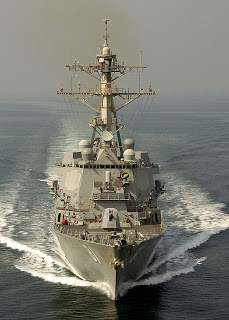
“So what’s wrong with this change? The president has said we’re going from land-based systems to sea-based systems, but he hasn’t asked for the ships to do it,” Taylor continued.It takes just about nothing to get talking heads on radio ginned up, so he isn't aiming very high, but the point is good. The decision to move ballistic missile defense to sea was absolutely the right one, for reasons we have previously covered in depth on the blog. While ballistic missile defense is less expensive at sea than on land, it is still expensive, particularly initially although the savings over time really pile up. The administrations BMD policy adds a great deal of pressure on the naval surface combatant force because it thins out the number of escorts, and requires the Navy to only build surface combatants that cost at least $2 billion each.
Taylor estimated that the United States will need to have three ships equipped for missile defense available for every location where it wants one of the ships posted continuously.
“With a 285-ship Navy, we don’t have it right now,” he said.
Taylor added, “I’m going to be the first one to say, ‘Mr. President, I’m with you on saying [we] shouldn’t have a land-based system, but if you don’t come back with the money to build the ships to put national missile defense out there, I will be the first one to get the folks on right-wing radio ginned up.’ ... Quite probably, that’s what it’s going to take.”
Ballistic Missile Defense now has at least 6, if not more, locations globally that must be supported. North Atlantic, Black Sea, Eastern Med, Persian Gulf, Sea of Japan, and the East China Sea. With a requirement of 3 ships per location to maintain a rotation, we are talking about 21 total ships.
If you look at Navy force structure, and begin counting the necessary escorts, a few conclusions can be reached. If we assume there will be no CG(X) replacement, then just treat all AEGIS ships as escorts.
10 CVNs each require a minimum of 4 escorts = 40 ships
11 ARGs each are matched with a minimum of 3 escorts = 33 ships
That quickly brings the number to 73. Now add 21 for regional BMD requirements, and you arrive at 94.
As of FY2010, the Navy will have 22 cruisers, 63 DDG-51s, and 3 DDG-1000s. That is only 88. The other problem is, the only surface ship left in the fleet to do EVERYTHING else is the Littoral Combat Ship. If the Navy plans to build 8 DDG-51s between FY2011 - FY2012, the Navy would achieve 96 major surface combatants. That doesn't leave much margin for error, and that plan does not address the necessity to replace the soon to be retiring cruisers.
The key here is that the administrations BMD policy is requiring the Navy to spend $14,779 billion for 8 DDG-51s over the next 5 years, and probably more in the out years. Instead of adding new funds, that $14,779 billion is coming out of the existing shipbuilding budget. The effect is the reduction of amphibious ships (the workhorses of the 21st century fleet) which makes no sense at all at a time we are expanding the Marine Corps to 202,000. It is also taking money from the Virginia class submarine program, the program Congress has been busting ass for a decade to fix on the industry side (very successfully I might add). This problem is going to get much worse when it comes time to replace the Ohio class SSBNs.
Gene Taylor is doing exactly what the House Armed Services Committee chairman is supposed to do, which is to find balance for administration policy and the national strategic infrastructure necessary to support defense, specifically the shipbuilding industry. The Navy has been given a new task that requires a lot of ships, but that task will require more money for more ships.

No comments:
Post a Comment