
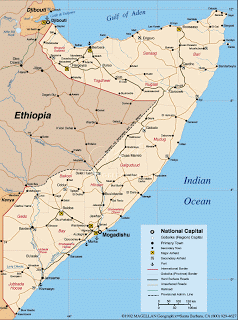
 As piracy around the globe stays steady, the expected increase in piracy this week off Somalia didn't happen. In 2008, there were attacks every day the first 15 days of September, and nearly a dozen ships were hijacked in the first two weeks following the end of the monsoon season last year. Despite improved weather conditions, the seas are quiet in terms of piracy off Somalia. The number of attacks reported over the last week in the Gulf of Aden was exactly ONE.
While things could change at any moment, the press reports suggest events on land have overtaken events at sea. To put it mildly, Somalia is a mess.
This week the AU authorized the 5,000 peacekeepers in Somalia to operate with and in support of the Somalia Army supporting the government. The Somalia Army is actively engaged with Al Shabab, the Islamic extremist group attempting to overthrow the Somali President Sheikh Sharif Sheikh Ahmed and his Transitional Federal Government (TFG). Three signs suggest the government may be close to falling.
First, Ethiopia made an incursion this week into Somalia to root out folks they believe supporting unrest in Ethiopia. This suggests Etheopia may be thinking it necessary to create a buffer zone along their border in the near future. The troops reportedly have withdrawn, but these types of actions tend to suggest the Ethiopians think the end is near.
Second, President Sheikh Sharif Sheikh Ahmed reached out to Sheikh Hassan Dahir Aweys, his primary political opponent (who happens to be on the US terror watch list). Sheikh Hassan Dahir Aweys, currently in the United Arab Emirates, has been critical of Al Shabab for fighting during the Ramadan holiday. Sheikh Sharif and Sheikh Aweys are former allies, and developed an opposition party together in Eritrea before Sheikh Sharif became President. If Sheikh Sharif is reaching out to his former political rivals who have been exiled, it doesn't mean anything good for the current viability of the Transitional Federal Government (TFG).
Finally, Djibouti is sending 500 soldiers to Somalia to serve with the African Union peacekeeping force in Mogadishu. The US and Fracne have been working with Djibouti for years now, and these 500 soldiers have almost certainly been training with the western nations. France is facilitating the move of the troops to Mogadishu. There are about 800 Somali soldiers in Djibouti currently getting training from French military advisers.
The Transitional Federal Government (TFG) held a press conference this week claiming the first 500 members of their marine force (read: Coast Guard) will finish training soon. This Coast Guard is in Mogadishu, and absent any vessels will likely remain in that area and serve as a maritime security force in the south. There is very little chance this tiny force of 500 will have any influence on the piracy coming from Puntland.
Speaking of Puntland, the crisis group has a very interesting policy brief on the rising turmoil in Puntland. I found the information more enlightening than the analysis, but it is interesting nonetheless.
With war raging across Somalia, the refugee problem and the consolidation of power on land may give shipping companies a reprieve from piracy this fall, contrary to expectations otherwise. Then again, pirates may be doing what Al Shabab choose not to do, and is taking the Ramadan holiday off this year. Either way, with the monsoon season over, even if piracy doesn't increase we can expect to read more terrible stories like this, as there will be no shortage of refugees fleeing Somalia anytime soon.
The semi-autonomous north-eastern Somali region of Puntland, once touted as a success of the “building blocks” approach to reestablishing national stability and widely viewed as one of the most prosperous parts of Somalia, is experiencing a three-year rise in insecurity and political tension. At its roots are poor governance and a collapse of the intra-clan cohesion and pan-Darood solidarity that led to its creation in 1998. Intra-Darood friction has eroded the consensual style of politics that once underpinned a relative stability. The piracy problem is a dramatic symptom of deeper problems that, left untreated, could lead to Puntland’s disintegration or overthrow by an underground militant Islamist movement. A solution to the security threat requires the Puntland government to institute reforms that would make it more transparent and inclusive of all clans living within the region.
BTW, keep an eye on Eritrea. The Obama administration has adamantly criticized Eritrea for its military assistance to insurgent groups in Somalia, and a December UN report claimed Eritrea is now making monthly contributions of between $200,000 and $500,000 to Al Shabab. If a power struggle takes place between clans in Puntland, Eritrea will be a player. I think it is worth keeping in mind the Iranian Navy that is supposedly out fighting pirates spends a great deal of time around Eritrea, which currently serves as the logistics base for Iranian naval forces "fighting pirates" in the pirate free waters around the mouth of the Red Sea.
It has long been suspected that the IRGC conducts a good deal of their smuggling operations through Eritrea, including the smuggling of military equipment for Hamas and Hezbollah, among others.

No comments:
Post a Comment