
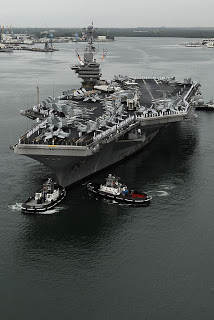
 From the September Proceedings comes this one from Captain J. Talbot Manvel, U.S. Navy (retired):
The Obama administration is planning a risky and unwise move to cut the Navy's aircraft carrier force during wartime. If the force is reduced to ten by not refueling the USS Abraham Lincoln (CVN-72) in a couple of years, it will save billions of dollars, especially if the Navy also eliminates the ship's air wing...The CVN folks are doing what the rest of the Navy has been unable to do - they are attempting to make the case for seapower as it connects to national strategy, and describing the availability of aircraft carriers as the safety net for maintaining the United States as the global superpower. As the primary contributors of the naval force actively engaged in the wars of the 21st century (carrier aviation provides ~50% of the total fixed wing sorties over Afghanistan today), the carrier crowd can demonstrate their flexibility and purpose to the nations security better than any other group of the naval service today.
Twelve is a good number of carriers to have. To maintain a force of 12 whose service life is 50 years, each should be replaced every 4.5 years. But in 2008 we pushed our luck and reduced the force to 11. In doing so, the Navy stretched out the new construction replacements. It delivered the USS Ronald Reagan (CVN-76) in 2003, the USS George H. W. Bush (CVN-77) in 2009, and plans to deliver the Gerald R. Ford (CVN-78) in 2015.
Once a carrier is cut from the force it is not easily regained. It takes at least 12 years to increase the force by one with a new carrier while it takes only one year to reduce it by one or more. And that's assuming no war losses.
The carrier crowd has a problem though. Aircraft carriers are an enormous national investment, and while there is clearly no threat today to aircraft carriers anywhere on the scale of what carriers faced by the Soviets in the cold war, there are trends in maritime surveillance, precision weapon range, and saturation techniques of low cost unmanned systems that suggest the future of aircraft carriers is uncertain. Where are the discussions inside the Naval aviation community what the future of naval aviation looks like? I don't find the Joint Strike Fighter argument particularly convincing.
Every think tank in Washington believes the future of naval aviation will be determined by the success or failure of unmanned armed combat systems, and I'm in full agreement with them. The significant jump in endurance and range offered by unmanned systems over their manned alternatives allows aircraft carriers to significantly expand not only their reach to the bad guy, but their operating environment from which to conceal their position from the bad guy. The range of the FA-18 models is not sufficient for the future in the face of emerging trends, and despite a small increase in endurance and range, the F-35 is not a significant enough step to justify enormous investments for aircraft carriers that may or may not be relevant in 50 years. If the Navy replaces every Nimitz class carrier with a Ford class carrier, that design must remain relevant into the 22nd century. While I am fairly confident seapower will be just as relevant to the United States in the 22nd century as it is today, I am not convinced the big nuclear aircraft carrier will be the relevant platform of that era, indeed the way the Navy drags ass on supremely critical systems like the E-2D and has no answer for fixed wing ASW and Tanker replacements, I'd settle for just getting a realistic view of 2025.
Building a single platform for what amounts to 75% of a total fiscal year shipbuilding budget is a hard pill to swallow when naval aviators today are hesitant to even discuss what the future of naval aviation looks like other than fielding the Joint Strike Fighter. It should be an easy for the naval aviation community to begin discussing how unmanned aircraft will change carrier aviation, because the changes will undoubtedly be significant. True, that discussion will require naval aviators to admit they are no longer individually king of the hill, BUT, it was naval aviators who once proved to the battleship Admirals that their time had passed, so the real question is whether the naval aviation community is going to mimic the battleship Admiral and stand in the way of evolution, or embrace the evolution necessary to insure carrier aviation remains the dominant combat power at sea the rest of this century.
---
If you ever get a chance, ask Captain Manvel to see his CVN-21 models, particularly the stealth aircraft carrier carrier model they looked at when evaluating designs for CVN-21. Even though it was probably completely unaffordable, I was taken in by it, until he noted how the design (like all aircraft carriers) really wasn't stealthy at all - from the top. He has several models of various designs looked at, and they are very interesting.
Also, if you get a chance to hit the library or simply have an old copy, a good review on the CVN-21 development process is available in Captain Manvel's Better Big and B(u)y the Dozen article from the June 2006 Proceedings.

No comments:
Post a Comment