
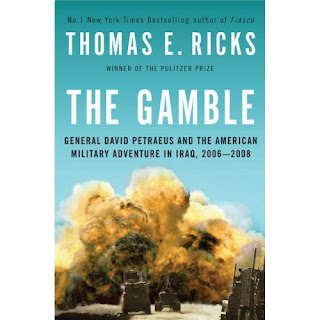
 I have read Tom Rick's new book The Gamble twice, and I highly recommend it. Both times I read the book, I paused when I read the following paragraph.
“But Fallon prided himself on being a strategic thinker, a sense he may have developed because there was little competition in that arena in the Navy, which in recent years has tended to be weak, intellectually, aside from its elite counter-terror force in Special Operations, which is practically a separate service. It is difficult, for example, to think of a senior Navy officer who has played a prominent role in shaping American strategy since 9/11, or of an active-duty Navy officer who has written a book or essay as influential as those produced by the Army’s Col. H.R. McMaster, Lt. Col. Paul Yingling, and Lt. Col. John Nagl.”At the United States Naval Institute Blog, Steeljaw Scribe posts this paragraph, and offers up some comments by Peter Swartz of CNA as a counter argument. For the record, Peter Swartz is a friend of mine, a reader of this blog, and someone whose opinion I respect a lot. The question is whether Tom Ricks is right, that there is little competition as a strategic thinker in the Navy, and if he is accurate to suggest where strategic thinking exists the competition is weak intellectually.
I think Peter Swartz makes a good argument that there are several brilliant folks part of the broader maritime strategy discussion contributing ideas, but I don't find his argument in regards to competition in the strategic thinking community of the active duty Navy compelling at all. I don't think he is as well supported by the argument he presents as he does, and I would add, Peter doesn't even address the institutional cultural nature of the Navy that works to prohibit competition in strategic thinking.
I am a believer that we are entering a new maritime age, and have actually been in that age since the end of the cold war. There was a point at the end of the 20th century where a healthy strategic debate was taking place, and Captain Hughes fit the mold exactly of a Navy officer who has written a book or essay as influential as those produced by the Army officers mentioned. How did that work out? The streetfighter debate was rejected in favor of a risk averse big Navy that led to a 14,500 ton stealth, littoral 'destroyer' and a 3000 ton mothership, and worse these ideas were perverted into suggesting they somehow matched the prevailing streetfighter debate ideas.
The Navy has produced what they call a Maritime Strategy, but is actually another perversion of the truth. No strategic thinker in the Navy, including Peter Swartz, will defend the "A Cooperative Strategy for 21st Century Seapower" as a complete strategy. The Navy still has not aligned their strategic concept with force structure, and FY 2010 doesn't look to change these conditions. Even worse, the Navy neither explains or defends any decisions made with billions of taxpayer money, operating without any communication to the public or explanation for Congress. How many letters have Senators and Representatives sent to Navy leadership with questions that explain the Navy's decisions have gone unanswered? I've lost count.
While I am a supporter of ADM Mullen as Chairman of the Joint Chiefs of Staff, let us not ignore the DDG-1000 and the Littoral Combat Ship fall squarely on his resume, and in the end it took the Secretary of Defense to make the DDG-1000 to go away, thus discard the flawed strategic thinking that led to those platforms in the first place.
Even with such a comprehensive list of names, Peter only names one active duty officer who has written an essay that forwards a counter idea to the status quo, CDR Jerry Hendrix, and it is still yet to be determined if CDR Jerry Hendrix's work will have any influence on naval thinking. CDR Jerry Hendrix is in fact so unique he is the only active duty officer to forward a shipbuilding strategy alternative to the 313-ship plan since its release.
The culture issue is real, and Peter ignored it. There are 2 Navy officers who have posted in that USNI thread, and I note neither used their real names. When Bryan McGrath posted his one year reflection since leaving the Navy, he offered up some strategic ideas counter to existing Navy direction and culture. I for one am not surprised it was taken down, and when I asked him why, he said he couldn't talk about it. Since the post (which I still have a copy) had nothing to do with his job, it suggests the pressure came from the Navy to remove it.
The number of active duty naval officers who use their real name when posting on this blog number three over nearly 2 years, and I average nearly 8000 individual visits a day, a portion of those visits from a .mil domain. Nobody wants to be known by name as even participating in a discussion outside the Navy, because the culture of conform, or culture of copy, is in effect a culture of fear for career for today's naval officers. I am asked by several naval officers I know not to give evidence I know them, because they believe even an association is dangerous to them. This is the culture of the Navy regarding an idea or opinion counter to the prevailing direction of the Navy, a culture Peter either ignores or is ignorant to.
Today's Navy is spinning in circles in shipbuilding. The Navy has demonstrated being so unable to tactically solve piracy that ADM Gourtney's first response was to tell mariners to protect themselves, and worse I have read comments by officers who believe the Maersk Alabama incident highlights the strategic value of the Arleigh Burke class. Recent news articles had suggested the strategic thinking in NAVAIR was to cancel the unmanned systems like UCAS, right up until the SECDEF gave his opinion regarding how bad an idea that was. All the while, the unrefueled range of today's aircraft carrier squadrons is roughly the same as the unrefueled range of squadrons in 1945.
When was the last time someone in the Navy defended the role of the submarine in public?
Where is the NOC anyway?
We are building a Littoral Combat Ship for irregular warfare problems, and yet the ship as designed has almost nothing in common with a warship, nor is it well matched for what strategists call the ugly littorals. If strategic thought is so competitive, and we recognize the littorals is a very ugly place for warfare, how did the best ideas produce a littoral warfighter as a barely armed ship with the survivability standard of a logistics ship?
Peter may see things differently inside the halls of the Center for Naval Analysis, but I don't think a majority of mid-level naval officers would agree with him. This isn't whether there are strategic thinkers in the Navy, I can name a list like Peters (and many on his list would make mine), but that doesn't prove Tom's point wrong. The culture doesn't allow for competitive ideas, and Peter ignores the disconnect regarding the Navy's current strategic concept and the public, while also ignoring the reasons why naval officers conform to insure Tom Rick's statement is correct. It is outright embarrassing to note the number of active duty officers who aren't Admirals in Peter Swartz's list.
I agree with Tom Ricks, for reasons mentioned and many, many more. I don't think anything will change soon, but I do know Ray Mabus and Bob Work are aware of this specific issue, and it will be interesting to see if any implementation by them to change this culture generates friction. I bet it does, this culture takes it personally when you suggest they might be wrong.
Finally, I can think of several hundred reasons why a naval officer shouldn't comment on a blog. I can't think of very many good reasons why an active duty naval officer would ignore that conversation. My suggestion, unless you are an Admiral, if you disagree with Peter use an alias. I don't even have to explain why.
Update: LT James Rushton reminds me that there are actually 2 active duty officers who have proposed force structure changes since 313-ship plan. His article is subscription only at Proceedings here, previously discussed on the blog here. It should be noted that LT Rushton is a SWO with 25 years of experience.

No comments:
Post a Comment