
 Robert Kaplan's narrative of the US Navy's elegant decline has been nagging at the Admiralty since the narrative was published just prior to the official announcement of the US Navy maritime strategy in 2007. Kaplan's continuing narrative, as he applies it to the Somalia piracy situation is another brilliant contribution.
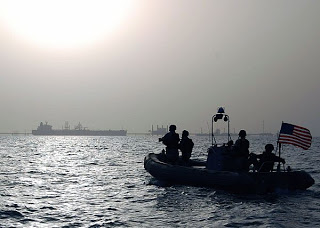
So we end up with the spectacle of an American destroyer, the Bainbridge, with enough Tomahawk missiles and other weaponry to destroy a small city, facing off against a handful of Somali pirates in a tiny lifeboat. This is not an efficient use of American resources. It indicates how pirates, like terrorists, can attack us asymmetrically. The challenge ahead for the United States is not only dealing with the rise of Chinese naval power, but also in handling more unconventional risks that will require a more scrappy, street-fighting Navy.The Kaplan narrative continues to attack the Navy on two specific points. First, the Navy decision process driving the way the Navy has looked into the future in the past has primarily been based upon the theory on dominance, and I think Kaplan is attempting to inject a different strategic theory, indispensability, as a way for the Navy to inject itself as a balancing force for international maritime challenges that will require multinational solutions in a multipolar world.
In a sense, America needs three navies; yet, as this pirate crisis reveals, it may have only two. It has a blue-water force for patrolling the major sea lines, thus guarding the global commons. It packs enough precision weaponry on its warships to project power on land against adversaries like North Korea and Iran. But it still does not have enough of a sea-based, counterinsurgency component to deal with adversaries like Somali pirates and Iran’s Islamic Revolutionary Guard Corps Navy. (The latter’s force features speedboats loaded with explosives hidden in the many coves of Iran’s coastline, which could ram ships on suicide missions.)
Second, the Navy tends to focus its force development on the capabilities theory, which has a tendency to drive ever increasing requirements into the design and procurement of ships and equipment. Kaplan on the other hand is hitting hard with a theory of resources, challenging the necessity for redundant high end capabilities when it is in fact the reduction in total available resources to meet global demand for problems that is primarily contributing to what he calls the US Navy's elegant decline.
Given that Kaplan brings up the LCS, I can imagine many will go straight to that issue completely ignoring that when thinking about naval power in terms of resources instead of capabilities, options like the LCS makes some sense when compared to options like the DDG-1000, even as both clearly highlight the problem with a capabilities driven requirements process that eventually ends up gold plating naval vessels.

No comments:
Post a Comment