
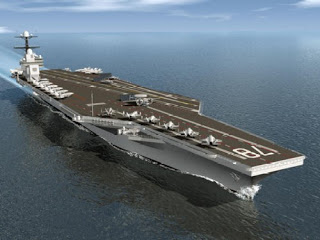
 Geoff Fein has an article on EMALS in Defense Daily (subscription only) discussing the decisions moving forward with the Ford class aircraft carriers. The article lays out the history since about September 2008, and goes into how in January Sea Stackley was not very pleased with the scheduling slip and increased cost of the system.
The entire article is excellent, because it lays out step by step what happened. I think this is what it comes down to.
While Mahr acknowledges there have been some minor technical glitches, such as replacing blown diodes, the Navy has not identified any technical problems other than the normal "putting things together for the first time."The system is currently said to be around 60 days behind schedule, which sounds odd since in the same article Capt. Randy Mahr, program manager for aircraft launch and recovery equipment, suggests "We lost some schedule...between August and December." So he lost four months but made up for 2 months with a new schedule?
Phase I of the high cycle tests was very successful and Mahr is now preparing this week to start Phase II.
Phase II "puts together one full power train with the exception of the launch motor itself...the catapult part...and we’ve been running that and commissioning testing now for several months. I can’t say it’s been flawless, but the things [that have occurred]...we blew a diode the other day," he said. All the folks that have looked at it from a technical perspective...nobody has found anything that isn’t going to work."
Still, the loss of schedule and the increased cost to build EMALS worried some people, Mahr said.
EMALS will not actually launch an aircraft at its land facility until the end of 2010, if there are no more schedule slips. The way I see it, we are soon to learn about a very substancial cost increase for the first Ford class carrier, but the Navy is going to push ahead hoping there are no more schedule problems with the launching system.
Given the track record, General Atomics needs to instill some confidence into EMALS. This may happen if a detailed, fixed cost contract is reached between the systems builder and the Navy.
I continue to hear serious experts suggest this system will eventually work, but they fully expect there will be more problems in the future. Essentially the combination of a very complex technology being built for the first time by a builder who has no experience developing large, complex systems for ships in an elixer for trouble, but the alternatives to EMALS are no better than moving forward.
EMALS and the new recovery system on the Ford class carriers are seen as critical technologies for moving naval aviation into the 21st century. The big challenge facing aircraft carriers is not the ship itself, but the limited range of naval strike aircraft. Sure you can refuel naval aircraft in the air, but the fundamental truth no one likes to discuss is that the unrefueled range of a squadron of F-18 Super Hornets is about the same range as a squadron of aircraft in 1945.
The calls often heard regarding the vulnerability of aircraft carriers are often absent context. At 250nm from an enemy coast, suggesting an aircraft carrier is vulnerable is legitimate. If aircraft carriers can operate at 1000nm from an enemy coast to conduct strikes, the vulnerability argument loses quite a bit of steam.
Everyone is probably aware of the X-47B develoment, but I was encouraged this week to learn the Predator C is still moving ahead. Bill Sweetman noted the Predator C comes features:
The aircraft was designed from its inception so that the wing could be folded at the point where it cranks for storage in hangars or for aircraft carrier operations. The UCAV also comes with a tailhook, which suggests that carrier-related trials are planned.Check out the rest of Bill's article, and btw, read the note at the bottom. I look forward to those photos.
The inner section of the cranked wing is deep, providing structural strength for carrier landings and generous fuel volume while maintaining a dry, folding outer wing.
While no one is really talking about it, the improvements included in the take off and landing technologies of the Ford class will be very useful for adding unmanned aircraft to carrier strike wings, because they are a lot less violent on the airframes than the current launch and recovery technologies. The Navy needs the range that comes with unmanned systems, because without better range for strike, the vulnerability of the aircraft carrier raises questions whether these enormous investments of state treasure are worth the cost.

No comments:
Post a Comment