
 With the arrival of Standing NATO Maritime Group ONE to the Horn of Africa region, the number of nations now actively fighting piracy off the coast of east Africa has reached its highest level of participation yet. The list of countries now includes the United States, Canada, Great Britain, France, Germany, Denmark, Spain, the Netherlands, Portugal, Italy, Turkey, Greece, India, Saudi Arabia, Malaysia, China, and will soon include Russia, Japan, and South Korea.
In essence, that leaves only 6 nations of the top 20 global economic powers listed by GDP not currently involved in anti-piracy operations off Somalia. Australia has a ship deployed to the region, although Australia's naval presence is in the Persian Gulf supporting Iraqi interests. Of the top 20 economic powers, only Brazil, Mexico, Belgium, and Indonesia have yet to commit a naval vessel to the Somali theater, but with Indonesia successfully conducting anti-piracy operations in the Straits of Malacca, not to mention helping when they can off Somalia, their full time presence is not justified for Somalia. Belgium is expected to contribute to the EU Atalanta deployment later this year, leaving only Brazil and Mexico among major economic powers to sit out the international effort among the top 20 economic nations based on GDP. With 18 of the worlds 20 top nations by GDP committed, representation of international commitment is 90%.
Using the 19 nations that make up the G-2o, only Australia, Mexico, Brazil, Argentina, and South Africa have not committed any ships to the Somali piracy issue. The EU makes up the 20th member of the G-20, so with their commitment it can be noted 75% of the G-20 has committed to the anti-piracy effort.
What the statistics highlight is a rare unified international political commitment against piracy, and there are more than 2 dozen warships active in one of the various international and unilateral efforts active towards the protection of commercial shipping to prove the commitment is real. Despite this rather extraordinary political and military commitment, it should be noted that pirates are still enjoying tactical success at sea. With the 4th hijacking of a commercial ship this year occurring earlier this week, piracy in the region is still very high and despite the massive number of international warships patrolling the seas, hijackings are double in 2009 compared to the same point last year. Like all statistics, this one doesn't tell the full story.
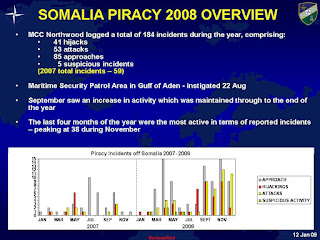
In the first quarter of 2008 there were 13 incidents but only 2 hijackings by Somalia pirates. So far in the first quarter of 2009, there have been 33 pirate incidents off Somalia, but only 4 hijackings. This weekend an Indian ship was hijacked, then released 8 hours later. Earlier this week the Turkish Navy protected one of their ships from attack. The US Navy reported an incident this week of two attacks, one against the Bison Express and the other against the MV Sea Green, resulting in the capture of 6 pirates. The pirates were later released due to lack of evidence. I'm not even counting the hijacking of an Iranian dhow reportedly illegally fishing in Somali waters. There are 8 more days left in Q1 of 2009, if 6 attacks occur the number of piracy incidents will be up 3x higher than last year, despite the greater naval presence, and assuming no more hijackings this quarter the total will still be double over last year during the same quarter.
What makes this particularly interesting is that Q1 is historically low number of attacks due to bad weather, and this year there have been plenty of high seas to match the bad weather condition, but it has not stopped the number of incidents increasing.
As we approach April it is important to keep in mind that this is when the sea conditions have historically improved, and the number of pirate incidents has gone up. In 2007 for example, there were only 6 incidents in all of Q1, but there were 4 in April of 2007, one a successful hijacking. In Q1 of 2008 there were 13 pirate incidents as previously mentioned, but in April of 2008 there were 21 incidents for the month, 2 of which were successful hijackings. In other words, next month historical trends suggest that pirate activity off the coast of Somalia will increase substantially if they follow historical trends.
That suggests that next month we will find out to what extent the enormous coalition of naval forces is having an impact on piracy off the Horn of Africa. With good luck, the courts in Kenya will be very busy.
This is why NATO intends SNMG 1 to spend most of the month fighting pirates. The planning for number of warships involved in the security operations is developed using historical trends.

No comments:
Post a Comment