
 Yesterday we were intentionally critical of the process the US Navy has used to date in creating a conversation with the country. The Navy must do better. While we are critical of the way the Navy attempted to connect to the American people, we firmly believe that having the conversation is very important. Originally we were going to make the case why, but in reading today we came across this absolutely brilliant article in Joint Forces Quarterly that makes the case better than we ever could.
Why a Conversation with the Country? A Backward Look at Some Forward-thinking Maritime Strategists (PDF) by Karl F. Walling is probably the best thing I have read on the topic of maritime strategy since the release of the Navy's maritime strategy. It is nothing short of absolutely fantastic.
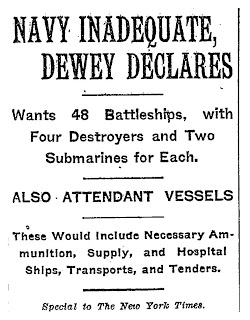
Sid, a frequent contributor to the blog, posted a link in the comments yesterday to this 1914 New York Times article which reports on Admiral Dewey's strategy to build 1 battleship for each state, a total of 48 battleships at the time. Each battleship would also have 4 destroyers, 2 submarines, and a number of other supporting ships which would insure the US Navy was prepared to meet the challenges of WWI. Admiral Dewey was a student, indeed a believer in what Mahan was saying in that era: the key to sea control was the battleship, and only with a fleet of battleships would the US Navy protect commerce, deny trade to enemies, and blockade enemies into surrender. Mahan was a great communicator of the time, and was convincing in his arugment. However, as Walling's article notes...
But Mahan was so successful at generating public support for his strategy that his critics were generally ignored, at least in America. The result was that when the United States entered World War I, it had the wrong navy. There were no decisive fleet engagements in that war, only might-havebeens, like the Battle of Jutland. This was not a war to be won through decisive battles, but attrition, with the U-boat threat coming close to winning the war for Germany. When the United States entered the war, it had many battleships but few destroyers to convoy merchant, supply, and troop ships across the ocean. It also had the wrong strategy to win the war, but fortunately it had just enough spare industrial capacity to adapt quickly and enable the Allies to win by transporting over 2 million American doughboys to fight in France. So ironically, the future war that Mahan had expected to win in fleet engagements on the sea was won on land by using the ocean as a highway to project American ground forces to Europe.Something to think about. Karl F. Walling's article is just fantastic, because it frames the discussion to be had with the American people in the right context and asks the right questions. After reading it, we are left thinking about the challenge facing the US Navy in any conversation with the country.
Globalization may connect America to others by sea, but at no time in history have Americans been less connected to the sea itself. Part of Mahan's popularity was that travel during his era was by sea/ If you were traveling to Europe, you were traveling by boat. Today Americans fly when they travel, if Americans are on a boat today it is on a river or lake, and if you talk to an American about the wind blowing around them while riding fast on water, they are more likely to think Kid Rock than NECC. Just saying...

No comments:
Post a Comment