
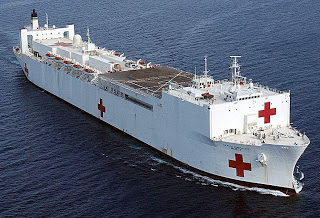
 Captain Wiley of the USNS Mercy (T-AH 19) weighs in on resources for medical diplomacy. As captain of both humanitarian deployments of the USNS Mercy (T-AH 19) to the Pacific, including Pacific Partnership 2006 and the current Pacific Partnership 2008 by which we follow through Captain Wiley's blog here, he strikes us as without question as having the most qualified, most important opinion on how to resource for medical diplomacy missions.
Much thanks to Lee Whaler and Captain Bob Wiley for such interesting fodder for discussion. With Captain Wiley's permission, we share these insightful comments, which he fully represents as his own. These thoughts leave us with much to consider.
The difference between the hospital ship’s traditional role (Combat Trauma/Life Support) and her role in humanitarian or disaster relief missions is the need for organic expeditionary capabilities. In the latter mission, the ship is required to move forces (medical forces) ashore; keep them logistically supported; and communicate with them. There is also the need to bring patients to and from the ship safely and comfortably. Trouble is, when you say “expeditionary” to a naval officer, what immediately comes to mind is amphibious operations. Personally, I don’t believe the Phib model to be the right model to use. While certainly capable and flexible, it is also very expensive and man-power demanding.So in thinking strategic about medical diplomacy for the future, what metrics go into planning for a replacement hospital ship? Based on this the short list is lighterage, operational costs, and vehicle space, aviation support facilities, and cargo seem high on the list.
It all boils down to economics. What is the most cost effective method of doing these missions? Personally, I believe we are better “building from scratch” a new breed of hospital ships. Although a little more expensive in up-front capital, in the long run they will pay for themselves in reduced operating costs. Especially if the plan is to use these ships regularly and not just have them sitting around as “contingency” platforms. By building new you can exploit new technology for diesel engines (better fuel economy); unmanned engine room and single-manned bridge (for reduced crewing economy); bow and stern thrusters as well as new mooring winches (for reducing port charges). By keeping the operational costs down, you make for better prospects of doing these medical missions long into the future.
Lastly… If there is one thing I have learned during the two missions I have commanded Mercy: Only a hospital ship can open the doors to many of places we would like to go. Furthermore, a hospital ship must ONLY be a hospital ship; she must only have BEEN a hospital ship; and she must always STAY a hospital ship…NOT some multi-transforming thingamajig that goes from Florence Nightingale to Rambo and then back to Florence Nightingale. Won’t work… Sends the wrong message…
We think that last paragraph belongs on the first page of the first PPT that mentions Milestone A for the next hospital ship replacement. Said another way, this never needs to see the light in future hospital ship discussions. If you want to build another LPD-17 hull to capitalize on costs, build it for a mothership, a command ship, ballistic missile defense cruiser, or new amphibious ship.
One final thought. We do not see these comments as an indictment of the deployments of the LHDs by SOUTHCOM to South America, in fact quite the opposite and it is important to highlight two different types of medical diplomacy deployments are being discussed here. Pacific Partnership is a pure humanitarian deployment, it really is singular in task and specific to a single purpose. The LHDs carry with it a security mission with it, and the use of a hospital ship by SOUTHCOM for a deployment that carries with it a security purpose as well as a humanitarian purpose would be an inappropriate use of a hospital ship.

No comments:
Post a Comment