
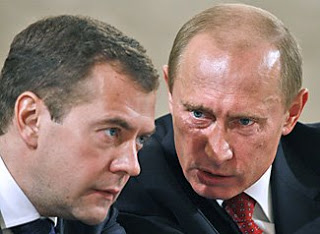
 Following last weeks meetings in Germany, the media was all over the map reporting what Medvedev had apparently suggested regarding treaty arrangements. The British media, never to be outdone with its sensationalism by the American press, got the ball rolling with headlines similar to this Telegraph article titled Russian president Dmitry Medvedev calls for Europe peace treaty. Some of the key remarks that told the story:
Speaking at the end of a day of talks with Angela Merkel, the German chancellor, he called for a "regional pact" to replace Cold War peace treaties.This is how most of the western media covered the story, but in the west opinions and commentary was added to the hard story facts with opinions along these lines:
"In the current conditions, with no one wanting war in Europe and with all of us having the experience of the 20th century, such an accord would have all the chances of success," Mr Medvedev said.
"He wants to neutralise Nato expansion, forging agreements between the EU and Russia on many issues, with America not included," said Alexander Rahr, Russia expert at the German Foreign Policy Society.What is interesting about this is that opinions like these from outsiders have essentially been driving the western headlines. In other words, the skepticism became the news. It is very interesting to see the enormous differences between the western and eastern media in reporting this story. From all indications, including a copy of the transcript we took a look at, it appears the real news of the story was different than what the Telegraph reported. True, Medvedev expressed concern over the missile shield, but the alliance was in regards to the Atlantic, and appears to include the United States and Canada. EUobserver carried a different version of the exact same story, the story told in Russia btw...
"But he is also reaching out. He was attentive, not aggressive. He does not want confrontation at the beginning of his presidency.
''But that reminded me of Putin at the beginning of his presidency, so we shall have to see how his term ends."
Russian president Dmitry Medvedev in Berlin on Thursday (5 June) called for a new EU-US-Russia security treaty in a conciliatory speech, even as EU diplomats landed in Georgia to help avert the risk of armed conflict on Europe's fringe.From what we have read, this is the accurate report regarding what Medvedev suggested in Berlin. Clearly there is a lot to negotiate, and we have no interest in commenting on the particulars, but we are a bit concerned that the reporting in the United States mostly omitted the aspect of the United States being included in Medvedev's suggestion.
The new deal - a "legally-binding European Security Treaty" - should cover arms control, illegal immigration and poverty, on the model of the 1928 multilateral Kellogg-Briand Pact, which renounced war as a foreign policy tool.
The agreement would be negotiated at a European summit including Russia, the EU, all of Europe's non-EU states, the US and Canada in order to embrace "the whole Euro-Atlantic space from Vancouver to Vladivostok."
It may well be just a political ploy, but there is no question there was a political ploy taking place in the reporting, creating a climate of Russia vs the US with Europe in the middle forced to choose sides. We note that type of media coverage plays directly into the public perception that would most benefit Russia, giving the perception to Europeans that the US is the wild child hell bent on eternal war, a perspective sold based on the military operations in Iraq.
More perspectives instead of propaganda from the EUobserver story.
But he struck a milder note in Berlin than his predecessor, Vladimir Putin, did in his famous "Munich speech" of February 2007, where he denounced US attempts to create a unipolar world order.Medvedev understands soft power in staying focused on building broader economic ties, but it appears he will have trouble getting his message out in the West. The media can sell the tension, so even if Medvedev is different than Putin, which we think is unlikely, we will probably not know for years given the way the media sells the tension message right or wrong.
"If I may use the language of [Cold War era spy novelist John] Le Carre, Russia has come in from the cold," Mr Medvedev said on his first state trip to Europe since his appointment in May.
He called for more European-Russian consortiums to operate gas and oil pipelines in future and tried to soothe German investors' worries over Russia's scary corporate ownership track record.

No comments:
Post a Comment