
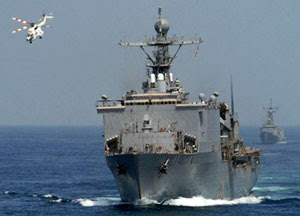
 My friend Mike Burleson is the sharp end of the spear when it comes to submarine advocacy, he understands the power of submarines in the long war better than most, and few have a record of support like Mike for the submarine. He is also an expert on precision weapons for offensive operations. When it comes to surface fleet constitution though, the two of us only find common ground in one place, we both believe it is past time for the US Navy to invest in small surface combatants.
Where our opinions differ though, we really disagree. He advocates against large carriers, I advocate for large carrier forces. Today Mike takes on the amphibious fleet suggesting that the time of the amphibious ship has past, which we find very ironic, because in our opinion the time for the amphibious force has finally arrived.
Except for the new helicopter carriers, which is a major increase in capability, plus fast hovercraft replacing slower landing craft, the US Marines follow basically the same tactics as their forbearers in World War 2. The Navy justifies the continued existence of such expensive and vulnerable warships on the success of numerous bushfire wars during the Cold War, and ongoing into the current War on Terror. With the exception of the Inchon Landings in 1950, occurring previous to the Missile Age, America has yet to launch a single major amphibious landing on a defended beach. Without exception the enemies she has faced during this time period have been Third World foes who had little in the way of sea forces and in which the USN had unchallenged air superiority.Mike is not advocating the dismantling of the Marine Corps, far from it, he is advocating a reorganization of force structure of the amphibious force because he does not believe an amphibious landing will occur based on the emerging conditions of naval warfare. It is an interesting argument, but in making the argument Mike focuses in on the utilization of amphibious forces during the cold war for military operations, and while acknowledging the utility of amphibious forces for operations other than war (see below), discounted this capability as a necessary tool of American military power. We have a different take entirely.
It is difficult to understand why even in this very desirable environment the opportunity wasn't taken to test our superior and extremely costly amphibious fleet on any occasion. We don't think this is a matter of timidity on the part of our warriors (My Gosh! These are US Marines!). Perhaps, though, it is an acknowledgment by our naval leadership of the vulnerability of this strategy in modern high-tech warfare.
We observe the conditions of the cold war defined the utilization of amphibious forces during the cold war, and explains their utilization. In the cold war, amphibious forces were used as a defensive force, not an offensive force as in WWII or Korea. As a responsive force, the amphibious force operational use focused on reinforcement to areas that required additional defense. There are few cases in the cold war where a Marine force would have been used as an assaulting offensive force, and in dealing with peer competitors in the nuclear age, a Normandy scenario becomes extremely unlikely.
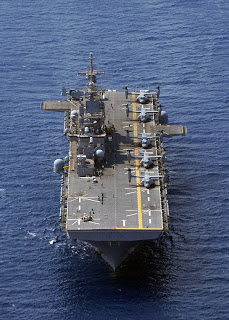 This is why there is a good case to be made there was too much focus on amphibious forces during the cold war, a time when the major platform for power projection was the Aircraft Carrier. However, today the conditions have changed, and we observe the necessity for amphibious ships is much greater now than it ever was during the cold war. We are in an expeditionary maritime era, and the expeditionary capabilities of military forces of all services needs extra attention in dealing with the conditions of this era, and that increased focus includes the amphibious forces.
If we consider a moment that the challenge regions emerging in the expeditionary era are what Thomas Barnett calls the Non-Integrated Gaps, the regions from South America to Africa to Southeast Asia, and we believe it is likely this is where extremism is likely to breed and disruption to the global system is most likely to occur, we first observe there is a serious lack of military basing in those regions. This means the US military is going to require a force shaped for gaining access and sustaining operations to remote regions far away from sustained ground support presence. Even for Iraq, assistance came from very small nations, with only Kuwait offering access for ground forces.
How badly do we need amphibious forces today in the expeditionary era? If you combine the Army, Army National Guard, and Marines the US Military has around 32 divisions today. Of those forces, the US military only has 4 airborne brigades and 2 Marine Expeditionary Brigadess for forcible entry operations, or roughly 2 divisions of 32 total for forcible entry. That means for the hardest part of war, the forcible entry operation, the US military can only utilize 6% of its entire force to the initial engagement. Furthermore, airborne brigades are light, don't have rapid deployment options and packaging without regional basing, and only the Marines have heavy weaponry.
We note these measurements contrast with what was required for WWII, when the nation operated 90 total divisions, 13 of which were Marines and 5 were airborne. In other words, during WWII nearly 19% of the total US military force had forcible entry capability, and of that the heavy to light ratio of forcible entry forces was over 2:1 in favor of heavy forces. Heavy forces are critical in the long war, it is a lesson from the current wars.
When factoring in the lessons of Iraq, we observe equipment is getting heavier, not lighter, whether you are talking about Strykers or MRAPs or the new armored HUMVEE, the Army has already mostly outgrown the most abundant strategic airlift platform (C-130) and the Marines are getting dangerously close to outgrowing their own amphibious ships. When the 24th MEU deployed to Afghanistan, they took a FSS, not amphibious ships, the reason being the FSS could actually take all the MEU equipment while the amphibious ships could not.
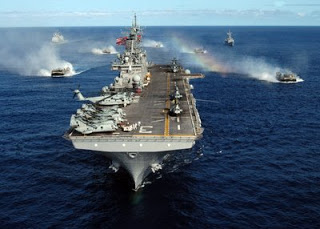 We observe 6% forcible entry capability to be ridiculously low in an era where the nation has fewer forward bases and disruption from remote, lesser powers is the most likely scenario. Taking a strategic view, we observe this combination advocates for larger, more capable amphibious platforms for forcible entry and an increased number of sea based modern logistics support platforms for follow on echelons. The MSC has great ships and great crews, why the Navy appears to be shifting major lift responsibilities to TRANSCOM in an expeditionary era simply makes no sense at all to us, and should be something Congress should have the Navy explain. If we accept this is an expeditionary maritime era, as the Navy's own strategy makes the case, the Navy is in the process of making some very questionable decisions with its focus on more battleships, no frigates, and unrated mini-motherships for fleet constitution while downsizing amphibious forces, supporting logistics forces, standing up token sized green water forces, and outsourcing important expeditionary supporting roles to TRANSCOM.
Mike concludes with this point.
We have, then, this magnificent and greatly underutilized Gator Navy. Oh, we might be assured of the advantage such a capability gives us for disaster relief operations, showing the flag, or humanitarian missions, but couldn't such important but sundry duties be performed as effectively and at far less a cost for our stretched-thin shipbuilding budget by Navy frigates, gun boats, or hospital ships? Warships are built to fight and if they can't perform this essential function for our country then all else is useless.First of all, "underutilized" is the wrong word, the amphibious forces are deployed at the highest tempo of any surface ship in the fleet inventory outside the MSC. In our opinion, Mike is mixing good points with bad here. Operations other than war are critical to maritime strategy, Mike understands Corbett well enough to know the value of maritime strategy during peacetime, and is too keen an observer to miss the value of Global Fleet Stations, Humanitarian deployments. and disaster response capabilities like we see from the Essex ESG today. Amphibious ships have the most utility during peacetime of any commissioned warship type, and with 60 straight years of virtual perpetual peace in the maritime domain giving up the most utilized platform seems a bit odd.
The point Mike hits home on is that amphibious ships need to be ready to fight, and to those ends armed up to do so for their purposes. The LPD-17 is able to support VLS, which is a step in the right direction, but until the VLS is actually on the platform it is a step too short. What really needs to be looked at in our opinion is getting the AGS on the LSD(X) rather than the DDG-1000. Put naval fire support where it belongs, on the ships supporting the troops who will need it. We have this incredible fleet of 86 planned battleships, the next to retire being in 2025. It is designed to protect the fleet from all methods of air attack, surface attack, and submarine attack. That would be great if the challenge facing the Navy today was massive air attack, an enemy fleet of frigates, or an enormous armada of fast attack nuclear submarines, but that era ended in 1992. It is time for the Navy to match resource priorities with the challenges of our time, which includes truck mounted missile launchers, littoral submarines, and small boat swarms. Amphibious ships can deploy the tools to counter these threats and have the shallow draft to operate in those contested littoral areas, arm them up to counter the most likely threats.
We completely disagree with Mike regarding the need for a Gator Navy. While he suggests shifting expeditionary forces to Navy frigates, gun boats, or hospital ships we go the opposite direction. We believe the DDG-1000 needs to be canceled completely, and the Navy needs to build as many LPD-17s as possible up to either a total of 17 or 25, and retiring the LSD should be put off as long as possible this century. Also important, the MSC can't be neglected because as an armory at sea the MSC is the force multiplier for all manners of sea power. We live in an era of the submarine and amphibious ship, and we live in a time when shipbuilding would traditionally be focused to reconstitute the amphibious force, logistics force, submarine force, and small combatants. Why does the Navy dedicate so little to these priorities when it is clearly their time? Until a potential peer competitor shows itself as an adversary, which China, Russia, and India have NOT done, or until our surface fleet approaches retirement age the necessity of large surface combatants is reduced.
How in the world is anyone supposed to believe the Navy is serious about the expeditionary era or serious about littoral warfare if the best the Navy can support isn't even 2 brigades in offensive operations from the sea in a time where this becomes a more likely scenario due to conditions? It is time to match resources and budgets with the requirements of the era.

No comments:
Post a Comment