
 From the April 16 list of contracts for the D0D.
BAE Systems Norfolk Ship Repair, Norfolk, Va., is being awarded a $33,765,946 modification to previously awarded contract (N00024-05-C-4403) to exercise an option for the USS Wasp (LHD-1) FY08 drydocking phased maintenance availability. There are 80 plus work items that are repair/replace/preserve/install/clean in nature. The following ship alterations will be accomplished: LHD1-6 SCD 3263 - fuel oil compensation stability improvement modifications (requires drydock), LHD1-0248K - install additional A/C plant, LHD1-0270K - install nitrogen generator, LHD1-0274K - accomplish MV-22 service and shop modifications, LHD1-0283K - accomplish MV-22 topside modifications, and S/A 71265K - low light flight deck surveillance system. Work will be performed in Portsmouth, Va., and work is expected to be completed by Nov. 2008. Contract funds in the amount of $33,765,946 will expire at the end of the current fiscal year. The Mid-Atlantic Regional Maintenance Center, Norfolk, Va., is the contracting activity.
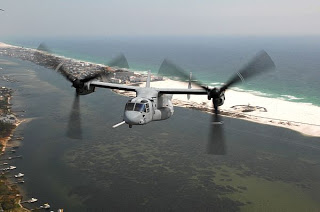
Is $33 million a lot for a DPMA? Not sure, the DPMA for the USS Bataan (LHD 5) cost around $22 million in FY04. I can't find what work was done though. The reason for this new work for the USS Wasp (LHD 1) is clear, they are "those other costs" for the LHDs to support the MV-22.
When I saw this contract it reminded me of something Bob Work wrote in his December 2005 (PDF) assessment on Sea Basing.
Although the MV-22 can go faster over longer ranges than the CH-46, it carries the same number of troops—or potentially less. Therefore, the Marine Corps medium lift plans have long assumed that the future MV-22 squadron will require the same 12 aircraft as the current CH-46 squadron. This has unfortunate ramifications for the sea base, because as was mentioned earlier, the MV-22 is twice as big and twice as heavy as the CH-46. Indeed, the aircraft’s size is the primary cause for the dramatic increase in the number of CH-46 equivalent parking “spots” needed to sea base a MEB’s worth of rotary-wing aircraft. While four, 12-plane, CH-46 squadrons require 48.0 shipboard spots, four, 12-plane MV-22 squadrons require 106.56 spots. In essence, then, a two-MEB forcible entry operation supported by MV-22s requires three more LHDs than an operation supported by the CH-46...
Indeed, the $3.4 billion shipbuilding costs associated with these three ships can be properly viewed a shipbuilding premium that should be added to the price of every MV-22. For an aircraft buy of 360 MV-22s, this equates to a $9.7 million shipbuilding premium per aircraft, on top of its current fly-away cost of over $70 million.
I don't know why the MPF(F) has been delayed in planning, but if I was guessing I'd say the problem isn't the logistics, it is aviation. Maybe we could have bought 3 more LHDs in 2005 for 3.4 billion, but I doubt it.
Using Bob Works math, 48 MV-22s to support 1 MEB require 106.56 spots. 48 CH-46 to support 1 MEB only required 48 spots. That means in order to make up for expected shortcoming of just transitioning to the MV-22 from the CH-46, the Marines needed at least 59 more spots per MEB.
That is why the LHA(R) doesn't have a well deck. Just to make up for what was lost in deck space on the LHDs to support medium lift aviation in the form of the MV-22, the Marines designed the LHA(R), which can support up to 28 MV-22s (28x2.22 deck space per MV-22 = 62.16).
What is going to carry all the Marine aviation of the current LHA fleet if the LHA(R) is being built just to fill the gap created by the MV-22? No idea, the Marines are spending that money to build their MPF(F), while stealing LHDs/LHA(R)s to carry the aviation. It is incredible how much influence the MV-22 has on the shipbuilding acquisition programs for the Marine Corps.
Those other costs of the MV-22 amounts to billions in shipbuilding, and there is a lot of quantity in both Marine aviation and Marine shipbuilding sacrificed to the alter of the MV-22. It better be worth it.

No comments:
Post a Comment