
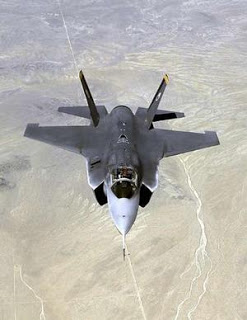
 Defense News is talking about the fighter gap discussion sure to be a big topic in the FY10 budget battle next year, and some of the comments are interesting.
The Navy is definitely looking at another buy of F-18s and both accelerating or slowing down F-35, and we have run some numbers to help them answer their questions," said Air Force Maj. Gen. C.R. Davis, the F-35 program executive officer. "Any time there is a discussion of a service or country pulling out airplanes from the program, the other service leaderships get very concerned. But we have told the Navy that buying them sooner at greater rates gives you a lower cost and more capability on your decks than any other buying profile."
First of all, accelerating the F-35 is a bad idea. There is a golden rule in defense procurement, you pay for speed. If your going to accelerate an acquisition program, make sure the product isn't very expensive. For a program as expensive as the Joint Strike Fighter, it would add billions. Think in comparative terms for a second, even the combined speed of buying 2 LCS at an incredibly fast rate for warships design and construction has resulted in combined total cost increases of less than $1 billion. For something like a fighter, the added cost of even $35 million per (which is generous, it could be much higher) for early buys could mean the ~70 or more fighters needed to fill the gap could add $2.5 billion (or more) to the JSF program. That is a bad idea.
To fill the gap, the Navy is looking at options that include upgrading some older planes to delay their retirements, buying from 50 to 282 more F-18s, and either speeding or delaying JSF.I've spoken to several people who know every angle of the F/A-18C/D program, and all of them are clear on one point, those early Hornets were not built to be life extended or upgraded. The F/A-18E/F program did actually factor the potential to be life extended and upgraded, but not the early models. I'm still waiting for this missing detail to enter the discussion, but the cost of upgrading planes that were originally built cheap and be tossed aside when their end life came would be very high, might as well build new.
Navy leaders worry that upgrading older F-18s may not make financial sense. Yet buying more JSFs earlier may be tough, because initial batches of the more capable Lockheed Martin jet will cost more than Boeing's F-18.
The article has some good depth, and reviews purchases for naval fixed wing fighters.
The Navy, the only apparent customer for the carrier variant, intends to buy about 25 aircraft annually starting in 2014. Current service plans call for buying a total of 360 of the carrier variant and 320 of the short-takeoff and -landing (STOVL) variant for the Marine Corps.
Meanwhile, the Navy has bought 332 F-18 Super Hornets and plans to buy another 161. And Boeing has just introduced a new version of the F-18, dubbed the 4.75 version, and is eager to land more Navy and international orders.
In general, I think the way the services discuss aircraft costs is in fact a disservice to the American people, as it is too confusing for most people to understand what the real cost is. I'm specifically talking about how R&D costs get thrown in as aircraft cost. For example, in FY07 dollars all the newspapers ran around talking about the F-22 price as $338 million per aircraft. That is such bull. To buy just 1 F-22 new in F07 the F-22 costs only $137 million. A lot yes, worth it, no idea... but very smart people I respect tend to think so. It would be nice if we knew how much the cost of 1 new F-18 4.75, and have that compared to the estimated cost of 1 F-35C in 2014. Seems to me the picture would be clear for what to do.
I'm not in favor or against the Joint Strike Fighter, but I do believe there is a requirement for a manned stealth naval aviation platform. If you were to look at my resume, you would see I spent several years working on artificial intelligence, and I know a thing or two about that industry. Anyone who believes the N-UCAS will replace the manned fighter is wrong, we simply aren't there yet with AI, and we aren't as close as some pretend. There will be a man in the loop for the next several decades.
With that said, Loren Thompson's analysis doesn't strike me as either strategic, or even intellectual.
"Naval aviation will not survive beyond the next 20 years unless it fields the carrier version of the F-35 in large numbers," Thompson said. "Without the F-35, the Navy has little future in littoral warfare."Littoral Warfare? Buzzword mania at its best. Lockheed Martin is still paying the bills for the Lexington Institute I see. Sorry, but the Navy needs a Joint Strike Fighter for successful littoral warfare like the Navy needs a DDG-1000 for defending the US coastline. So if the Navy doesn't buy the Joint Strike Fighter, naval aviation will be dead by 2030? Somehow I think the words "Lockheed" and "Martin" are missing from his sentence, because I don't think either Boeing or Northrup Grumman would agree, and I'm pretty sure everyone in naval aviation would disagree with Mr. Thompson's analysis.
If littoral warfare is the real justification for the Joint Strike Fighter, then I'm not a supporter of the Joint Strike Fighter. Still, while the industry (IE Lockheed Martin) is trying to raise the panic, it still looks to me like the Navy wants the F-35C, but they want it at a managed cost thus they aren't in a rush for it. From my perspective, that is called smart.

No comments:
Post a Comment