
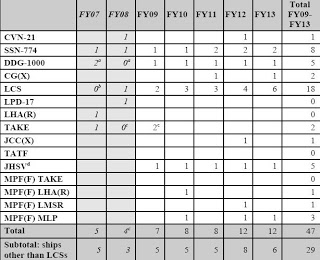
 This week we intend to take a close look at the Fy09 Navy budget, but before we do we think it is appropriate to take a long look at the Navy's overall shipbuilding budget plan first. If there is anything the FY09 budget will be remembered for, it will be how the Navy increased its 30 year shipbuilding budget by a full 40%, without adding any ships and intentionally ignoring an entire class. Ronald O'Rourke clarifies.
The Navy this year has increased its estimate of the average annual cost to fund the 30-year plan by about 40% in real (inflation-adjusted) terms. This 40% figure excludes the cost of 12 replacement ballistic missile submarines (SSBNs) that are shown in the plan. If the cost of these 12 ships is included in the calculation, the increase in estimated cost becomes roughly 49% to 57%.
The Navy’s new estimated cost for implementing the 30-year plan is similar to estimates issued over the last two years by the Congressional Budget Office (CBO). The Navy downplayed CBO’s estimates in 2007, referring to them in testimony as “worst-case analysis” or as an “extremely conservative” estimate.
The increase in the Navy’s estimated cost for implementing the plan is so large that the Navy no longer appears to have a clearly identifiable, announced strategy for generating the funds needed to implement the 30-year plan, at least not without significantly reducing funding for other Navy programs or increasing the Navy’s programmed budget in coming years by billions of dollars per year.
The report goes on to detail the changes. For FY2009 - Fy2020 the average of the shipbuilding budget has increased to $15.8 billion per year in FY2007 dollars, roughly 9.7%. For FY2021 - FY2038 the average of the shipbuilding budget has increased to $22.9 billion per year, roughly 59% according to the reports estimate. he combined average over the 30 year period if $20.2 billion. There are no significant changes to the 313-ship plan, in effect all this money is the new adjusted estimates for the fleet costs of the existing 313 ship plan. As it was quoted, these figures ignore the 12 replacements to the Ohio SSBNs. It is noted that the reason there will be 12 replacements for the 14 Ohio's in service today is because the 12 SSBN replacements will not require a mid life nuclear refueling.
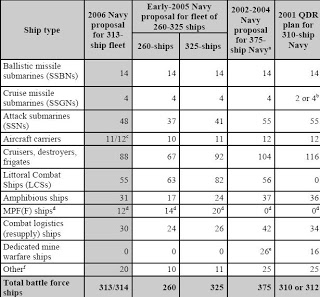 Even though the Navy raises the expenses associated with future ships, it is noteworthy the first 12 years (FY2009 - FY2020) only raises 9.7%. This figure is lower primarily because the Navy still believes the DDG-1000 is budgeted properly. We continue to believe this is unlikely. The CBO still maintains the first two DDG-1000s, which have already been purchased, will cost $3.9 billion more than the Navy estimate, and the remaining 5 DDG-1000s will cost an additional $7.9 billion more than the Navy estimates. We will cover the DDG-1000 in more detail later this week, but if the CBO is right the average for the next 12 years will be over $16.7 billion, almost a full billion more per year for the 12 years, just for 7 ships.
We are talking about billions and billions of dollars here, but I keep wondering if the high numbers are a bit deceptive. If we are going to look at everything going forward in 2007 dollars, I would like to see how that compared with a historical look back to FY1982 in FY2007 dollars. It seems that historical look would be very relevant, not only in how we look at the 313 ship plan but also how we this Congress compares historically in putting the shipbuilding budget in perspective to Congress in the cold war, and post cold war. Since dollars today aren't the same as dollars in previous eras, it is very difficult to produce quality analysis with a historic context.
Taking the long view towards the fleet size, it isn't just about money. Compare two prior eras of fleet construction. Between FY1993 - FY2008, which is essentially the Clinton and Bush years, the Navy has built a total of 85 ships. Over a 16 year period, that amounts to 5.3 ships per year average. In FY09, the Navy expects to build 1 SSN, 1 DDG-1000, 2 Littoral Combat Ships, 2 T-AKEs, and 1 JHSV for a total of 7 ships. Congress has discussed canceling the two Littoral Combat Ships and the DDG-1000, and building other ships including 1 LPD-17, 2 T-AKEs, and replacing the DDG-1000s with more DDG-51s.
As we look at these alternatives, we find that they highlight the bigger problem in shipbuilding. The alternative options are enormous ships, the DDG-51s go for around 9300 tons, the LPD-17s go for 25,000 tons, and the T-AKEs are around 35,000 tons. The smallest alternative ship design to the current plan is the 9,300 ton DDG-51s, and they are the most expensive ships of the three options. Because the DDG-51 class is the only one among the options that could built at Bath Iron Works, Congress has very few options for building quantity into the fleet, particularly as the costs of the first pair of Littoral Combat Ships continues to rise.
We have broken the discussion down into two views, the Navy view of quality for the fleet vs the Congressional view of quantity for shipbuilding. While this is simplistic, these are the stated positions represented by the Navy and Congress. Later this week, after we focus on the individual programs of shipbuilding, we intend to take a different approach, the view most often taken on this blog: the strategic view. Our intention is to explain why under Grand Strategy we believe the way ahead is a combination of both, but to go down that road is to realize there is a division of labor among the services, and is the view most likely to create friction in the services regarding roles in that division of labor.
Tip: Click images for better resolution.

No comments:
Post a Comment