
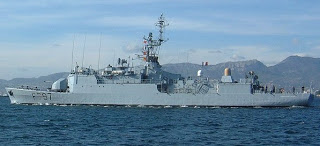
 AFP has an update on the piracy off Somalia. The hijacking of the French cruise ship has been confirmed, verified by helicopter, and it is a pretty good bet naval vessels have begun shadoing the vessel.
French authorities were working Saturday to free a luxury cruise yacht and its 30-member crew taken hostage by pirates off the coast of Somalia.
"The defence and foreign affairs ministries are working to act as quickly as possible, I hope in the minutes or hours to come, to try to obtain the release of the hostages," French Prime Minister Francois Fillon said late Friday.
"We have relatively large military means in the area," he added.
Yes, you do, but that isn't really the issue is it? This is going to be an interesting case study regarding the posture of the French Navy and French forward deployed forces. In this situation the majority of the hostages are French, the base in Djibouti is French, there are several French warships in the area, and a French flagged ship hijacked by pirates. All of the pieces necessary to take action would appear to be available, the missing element is the political will. Thus we have a test.
I do have a question for my French readers. Would the FS Jeanne d'Arc (R97) be routed from the training cruise to support this type of operation? It is the perfect ship and appears to have the right equipment if France was to take action, but it is unclear if it would deviate from schedule.
France, which has its largest foreign military base in nearby Djibouti, flew a helicopter over the ship on Friday.
French military forces in the area and a Djibouti-based United States-led multinational force, Combined Task Force 150, "were able to confirm the situation and are following its evolution," said Prazuck.
Pirate attacks are frequent off Somalia's 3,700-kilometre (2,300-mile) coastline, prompting the International Maritime Bureau to advise sailors not to come closer than 200 nautical miles to its shore.
Somalia has a long coast line. We recently posted a map from late last year that illustrated just how widespread piracy is in the area, and despite the extra military attention by US and coalition ships, there is very little evidence that the pirates feel the deterrence from the increasing size of the naval presence.
It needs to be noted the pirates are not some simple gang of thugs, they are sophisticated and given they almost always get their random money, they are very well funded and organized.
"You're looking at a powerful maritime mafia," said Olivier Hallaoui, of French security specialists Secopex.
"Most are fishermen-turned-bandits, with links to clans, local militias who realise this is a lucrative business because in almost every case ransoms are paid.
"They are equipped with GPS satellite and modern communications systems as well as heavy arms. Above all, they open fire without warning," he added.
This is textbook irregular challenge at sea. As the pirates continue to have success they will only continue to grow, expand, and get tougher as money improves their capability. The questions are how serious is the threat? In modern naval history, piracy was often looked at as background noise, criminal, and thus not a strategic priority due to a major peer competitor like the Soviet Union. However, right now there is no major peer competitor. Another question that needs to be asked is whether or not the coalition is waiting on a big disaster before it takes action? There is also the argument that taking action could create that big disaster, something we are sure is on everyones mind.
It is a tough call. Clearly presence alone doesn't work. Are pirates worth the exercise of hard power? This scenario will answer that question in regards to the French. It leaves us a question that we are not sure the answer to, if the ship was flagged US, would the US Navy take action? If it was up to the naval commanders I would say yes, but if it was up to political leadership, I'm not so sure.

No comments:
Post a Comment