
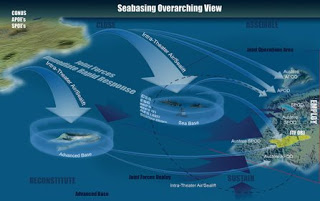
 Apparently last year the Navy and Marine Corps completed two MPF(F) studies. Inside the Navy (subscription) has an interesting article up with some insights of those studies, and word that a third study is underway.
The first study was designed to assess MPF(F) alternatives in the context of a mature campaign. It examined operations under three alternatives: the MPF(F) program of record; a similar collection of ships without organic big-deck amphibious shipping; and an MPF(F) with legacy Maritime Prepositioning Squadron-capabilities “enhanced with the means to conduct in-stream offloads/transfers at a distance of 25 [nautical miles] from the shore,” he said.
“The [first] study concluded that campaign objectives were met by all alternatives with varying levels of risk,” Doyle said.
The second study was designed to help determine how to distribute large-deck aviation ships between the amphibious force and MPF(F), he said. The effort assessed nine different amphibious/MPF(F) force mixes in 29 events across a range of military options -- including aggregating to support a major-combat operation.
The study concluded that “several” -- but not all -- of the alternatives “were capable of satisfying the majority of requirements generated by the 29 discrete events over a two year period,” Doyle said.
However, he noted, “there was insufficient residual capacity to support increased forward presence requirements (e.g. increased numbers of deployed expeditionary strike groups, global fleet stations, etc.) as envisioned in the Maritime Operating Concept.
What are we learning from this report? Easy, Sea Basing is not simple, will not be simple, and the desire to rush into it has finally been set aside. It was claimed early in the process Sea Basing will be at least as difficult as it was to bring aviation to sea in the early 20th century, so what is wrong with taking the time to get it right with so much money at stake? I think the slow down is a good thing. Here are the details provided on the third study.
Doyle said the third MPF(F) study -- the one under way now -- was designed to develop a baseline model for a specific major-combat-operation scenario. The baseline, he said, will serve as the initial assessment of the joint-force capability required for the scenario.
This third study looks at two MEB assault echelons working with an MPF(F) program of record and a legacy Maritime Prepositioning Squadron in support of forcible-entry operations, he said.
Build a base at sea or use the sea as a base? That is the question. Is anyone asking that question, or are we concerned with the specific metrics as determined by Rumsfeld's bunch following Turkey? The very last sentence of the article appears to highlight why Sea Basing needs to take it very slow.
Yet he noted that the Marine Corps’ perspective is “that other unresolved issues remain that are outside of the scope of these three studies, to include how crews for MPF(F) shipping will be trained/sourced and specifics as to how maintenance of the ships and embarked equipment will be conducted.”
Please don't spend $14-18 billion on this program until very difficult questions like this have very good answers. I still believe both the Navy and Marine Corps would be better off taking the slow approach. Build Forward Operating Bases at Sea to support the Long War, and take the time to mature the technologies that allow a joint service approach that allows everyone to utilize the sea as base.
While it is unclear what will be decided from the studies, that a closer look is taking place is a good thing. Sea Basing is an important future capability, but we believe it will be more if the Turkey example is seen as the exception, and not the rule. The fact is, the Sea Base needs to be designed to best utilize traditionally loaded vessels of which is most of the commercial shipping fleet worldwide, and hopefully not try to create some new limited capability that lacks backwards compatibility with legacy platforms.

No comments:
Post a Comment