
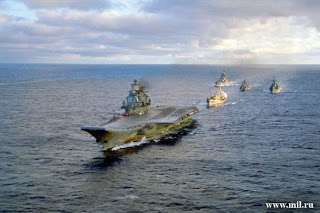
 The Russian Navy Carrier Task Force to the Atlantic and Mediterranean returned to Russia over the weekend, and some of the comments following the deployment are interesting. We observe Admiral Vladimir Vysotsky's comments, which suggests the longing for sustained presence in the global maritime environment for the Russian Navy.
"We have no capabilities thus far to keep a permanent grouping there. But this does not mean it will not be there," the admiral said.
"On a periodic basis - yes, it will. And we'll do all we can to build up a presence where Russia has strategic interests. Whatever one may say, we'll be there," Vysotsky said.
"We are thinking today of more serious endeavors than those already carried through. Perhaps, they will not be so abundantly covered by the press, but they will be even more momentous," he said.
"We'll undertake various missions once in six months - not necessarily in this form [a strike groups' entry into the ocean zone.] We have ample opportunity to demonstrate Russia's naval might," Vysotsky said.
Emphasis ours. It is difficult to know for sure, but I get the impression from his comments that he is speaking about submarines, including ballistic missile submarines, not surface naval forces. While the Admiral Kuznetsov represents an impressive capability, since WWII the Russian Navy has built its prestige on its submarine force capabilities, not the capabilities of its surface force.
However, surface forces create more visibility, and the image of the Navy is important in Russia right now, so we do believe we will soon see another major Russian surface ship deployment, and we believe it possible the ship will be heading to the Middle East.
Pirates captured a tugboat off the coast of Somalia as it sailed from St. Petersburg to Russia's Sakhalin Island, the U.K. Foreign & Commonwealth Office said.
The captain of the Svitzer Korsakov is a British citizen and the crew mostly Russian nationals, the Foreign Office spokesman, who declined to be identified in accordance with government policy, said in a telephone interview today.
``We are monitoring the situation and liaising with the Russian authorities,'' he said. The boat was seized Feb. 1, the Foreign Office spokesman said.
While we acknowledge another ship taken by pirates off Somalia is hardly a big deal, we noted this comment at the end of the Bloomberg article.
Russia's Navy should return to patrolling the world's ocean and work with the North Atlantic Treaty Organization to fight piracy, naval spokesman Captain Igor Dygalo said in remarks broadcast on state television channel Vesti-24.
One of the major reasons that the large Carrier Task Force didn't stay at sea longer than a few months is due to the lack of logistics. We see Task Force 150, within the context of the NATO structure, as an ideal place for Russia precisely for that purpose. Task Force 150 has a logistics tail that is well established and supported by not only the nations that participate, but also with loose affiliation with the United Nations.
The international aspect of Task Force 150 is probably appealing to the Russian Navy. It not only gives them a visible presence in one of the most important maritime environments in the world, but it allows the Russian Navy the strategic opportunity to wave the flag among regional partners like Iran and India. It also offers an opportunity to the Russian Navy to operate in a hostile environment with international partners for an extended period of time, experience the Russian Navy needs to build a future officer corp.
Finally, while some will disagree, we see it as a good thing for the US to have the Russian Navy involved in a visible partnership. You have to start somewhere.

No comments:
Post a Comment