
The first article in Proceedings (subscription only), by Lieutenant Jim Dolbow, calls for a fleet of 15 hospital ships divided into 5 groups of 3 ships per theater. The article makes a couple of interesting points, starting with the fact building the ships would be good for shipbuilding, but also pointing out that building the ships would cost less than a single day in Iraq. We note this comment.
The potential dividends would be similar to the huge favorable swing in public opinion enjoyed by the United States after the Mercy's 2005 humanitarian mission. According to Kenneth Ballen of Terror Free Tomorrow, "nationwide polls of Indonesia and Bangladesh conducted in August 2006, following the Mercy's visit, suggest that a remarkable 85 percent of Indonesians and 95 percent of the people of Bangladesh were favorable to the Mercy's mission." No small feat indeed.
One of the biggest challenges facing the Navy measuring results of soft power. For clarification, the USNS Mercy (T-AH 19) mission in 2005 was in response to the Tsunami. We note that Indonesians appear to be receptive to future hospital ships, which is very important. Prior to the USNS Mercy (T-AH 19) mission in 2006, the favorable rating for the United States in Indonesia was 15%. In 2006 the USNS Mercy (T-AH 19) spent six months in Indonesia, treating 61,000 patients. Most of the Indonesians received medicine or dental work. Only about two percent involved surgery. The Indonesians were getting American quality medicine ats the average cost of $280 per patient. At the conclusion of that mission, the favorable rating of the United States was measured at 30% nationwide, double than prior to the mission. While not as grand as the numbers reported in the article, it does indicate success, but also indicates there is more work to do.
This strikes us as a metric that can be leveraged in a discussion with Congress. We hear often about the decline of prestige of the United States as a result of wars in Iraq and Afghanistan. I would argue those wars have greater effect in certain areas and less so in other, and ultimately don't explain the lost of prestige in places like South America, but that is another topic.
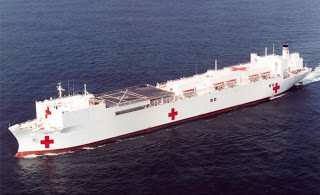 We believe there is still work to be done in developing metrics for success in these types of missions. However, the question for the single metric defined as favorable rating is interesting, and we would ask whether $17.1 million dollars is worth the 15% increase in the popularity rating of the United States in Indonesia? We think so, but if I was asking the question, I would ask it to the Secretary of State, and have the State Department determine how much money they have invested in Indonesia, and how the State Department measures their results. I'm willing to bet the Navy is getting more mileage per dollar in diplomacy with their hospital ships than the State Department and their traditional methods.
The second interesting article in Proceedings (subscription only) is by Commander Wayne M. Gluf, MedicalCorps, U.S. Navy, called From Warrior to Lifesaver, which calls for the Navy to replace the existing, aging pair of hospital ships with the current Tarawa class LHAs. We really like the idea of using LHAs as soft power platforms. The LHAs will soon be retired, replaced by the LHA(R), and instead of allowing them to be sunk in weapons tests like virtually every other retired platform, we would love to see the LHAs preserved and reused.
The primary mission of the hospital ship is to provide rapid, flexible, and mobile acute medical and surgical services to support military forces ashore and afloat. Their secondary mission is to provide mobile medical and surgical hospital services for use by U.S. government agencies in disaster or humanitarian relief or for limited humanitarian care incident to peacetime military operations. In fact, it is the secondary mission that has been the primary assignment for the hospital ships since first providing tsunami relief in Indonesia in 2005. Additionally, the LHA-similar general-purpose LHD amphibious assault ships have been used in such roles over the past two years, recognizing the superior capabilities of the large amphibious carrier in these challenging missions.
There are people who say this is a waste of money, would be too expensive, and the LHA represents the wrong platform. We disagree. We observe if the United States commits to the purpose of Medical Diplomacy, the need for platforms with heavy aviation and even a well deck will exist as they providevery different capabilities than a traditional hospital ship.
Last year, Pacific Partnership 2007, was centered around the USS Peleliu (LHA 5). We have heard it argued that the USNS Mercy (T-AH 19) could have just as easily executed that mission. Perhaps, but not in the same way. We note that the USS Peleliu (LHA 5) was able to distribute widely leveraging aircraft in places like the Philippines that a traditional hospital ship would not be able to do.
We observe amphibious type ships to be better suited for places like the Southeast Pacific, have more capabilities for adapting while on a deployment, and are better suited for roles like disaster response. We observe the large traditional hull hospital ships are better suited for the precisely planned 6 month deployment missions like the upcoming Pacific Partnership 2008 mission for USNS Mercy (T-AH 19).
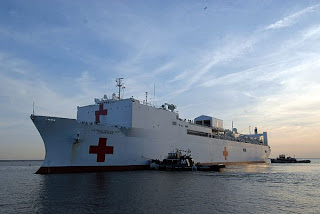 We see value in Medical diplomacy with platforms that are not full hospital ships, although reconfigured for humanitarian and security rather than major war requirements. The LHA is a good candidate for that role. We also believe the LHA makes an excellent platform to utilize for the Homeland Defense role, operating with a joint Navy, Coast Guard, and Marine crew able to bring the full spectrum of requirements to the humanitarian role for a scenario like Katrina, but also including major terror attacks.
Regardless of the platforms, that there are ideas getting traction in this space is an important shift in strategy. Thomas Barnett had a great phase to describe this discussion, From the Sea coming home, and he makes an excellent point.
There is a cluster of admirals who moved the Navy in this direction and they're all highly linked inter-personally: Gary Roughead (former PACFLT and now Chief of Naval Ops), Harry Ulrich (just retired, last position was NATO naval head), Mike Mullen (former CNO, now Chairman), and John Morgan (now N3/5, or head of Navy policy).
Obviously, I couldn't be happier to see this sort of thinking emerge. ... From the Sea finally coming home.
The leadership appears to be there, and we believe the mission aligns itself well with the Cooperative Maritime Strategy. The near term issues that need to be asked include defining metrics for measuring success, allocating resources for sustainment of Medical Diplomacy, evaluating and identifying what role the private sector should have, and insuring the approach addresses the concerns of the medical NGOs that have enabled operations to date to be successful.

No comments:
Post a Comment