
 Frequent contributers RickUSN and B Smitty should take note, someone has been reading our old public memos. Some background.
Starting as far back as 2006, several defense analysts and naval observers traded quite a bit of correspondence both public and private regarding the evolving Sea Basing ideas that were being developed at the time, we contributed to those discussions. Specifically discussed was the current industry driven concepts that focused on a 14+1 ship MPF(F) for a 2 MEB Marine assault from the sea, and alternatives that would shape themselves to address the irregular warfare challenges instead being focused around the LCS. In public our internet conversations heated back up again in April of 2007 upon the announcement of the Global Fleet Station as a subset of Sea Basing in the 2007 Guidance.
In those discussions, we made a number of inquiries, including several industry analysts and academics including Capt. Wayne Hughes, to contribute to the concepts and development. It was at that time we were encouraged to incorporate our ideas into the future looking frameworks developed by Thomas Barnett. Eventually the ideas discussed evolved into what we believed to be the best approach for the Navy to take in addressing irregular challenges at sea, a concept termed the "Littoral Strike Group." I have discussed the Littoral Strike Group Concept some in the past, but never really dived into the details, because these are still evolving concepts dependent upon current events and directional choices the Navy is still yet to make. Our last public listing centered around a LSD style mothership, a T-AKE style logistics support ship, and a HSV supported by different types of surface combatants in the role to combat piracy. These concepts have evolved as part of the purpose of this blog, which began in June of 07.
On this blog I loosely discuss Sea Basing, and many times my broad use of the term has triggered comments claiming I am either confused or ignorant. From the readers perspective, sometimes including very professional readers, what I was terming "Sea Basing" didn't jive with the definitions appropriated to the concept in media reporting that surrounded the 2 MEB approach. I note that if you look back, you will not find an actual Navy definition for Sea Basing, including in Seapower 21, rather a collection of buzz words describing the conceptual approaches. All definitions assigned to Sea Basing concepts originated from the Defense Science Board, not the Navy. Sea Basing is still evolving, and a recent article in Defense Daily notes the evolution continues. (download here [doc format] #10.)
While the Navy and Marine Corps won't begin actual sea base operations until the 2020 time frame, when they take delivery of all the required platforms, the services have been demonstrating, in real world conditions, their sea basing concept.
From the tsunami relief efforts in Indonesia to last year's disaster relief in Bangladesh, the two services have shown the ability to deliver assistance from the sea without leaving a footprint ashore.
"Some of things we are doing today...the operations...I don't [think] these were ever intended to go out as sea basing...to prove sea basing...but it has kind of happened that way," Maj. Gen. Thomas Benes, director, Expeditionary Warfare, told Defense Daily in a recent interview.
Defense Daily cites an example, specifically the "mini" Sea Base used to combat pirates late last year off the coast of Somalia.
Off the coast of Somalia, using assets from the 5th Fleet and working along with fleet commanders from the Horn of Africa, the Navy has established a sea base operation focusing on anti-piracy, Benes said.
"What the Navy is able to do is remain at sea without a footprint ashore and they are able to deny sanctuaries, pass intelligence and deter some of these attacks and not always using kinetic effects either," he said. "Using the ships they have, an LSD as a mother ship, a DDG, and a T-AKE for sustainment, [they have] a mini sea base operation that's going on there."
The article goes on to highlight Global Fleet Stations., including with news of the next Global Fleet Station mission to be started in Spring 08.
The global fleet station idea came out on paper a year ago, Benes said. "Now there are three of them active, which is amazing. This was a white paper, probably well over a year ago. In actual practice, this just started. It's going well."Finally, the article reports the Navy is finally answering the call for a Joint Sea Basing solution, as opposed to what has been proposed up to this point, a Navy/Marines centric capability.
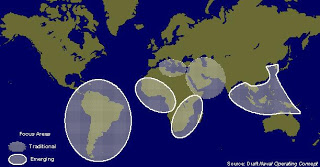
According to the Navy, the notional plan is one for the east coast of Africa--Gulf of Guinea, one off the Horn of Africa, and the third for southeast Asia--Straits of Malacca, Indonesia, Philippines.
The first global fleet station experiment was off South America and there is another scheduled for spring off of East Africa. These experiments don't include the Mercy, which has been administering medical care throughout southeast Asia, the Navy added.
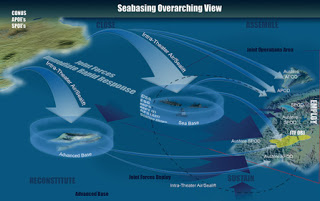
There are also joint sea basing concepts maturing, Benes said. The Joint Staff is currently consolidating all of the sea basing visions of the different services, the different entities they are working with, he added.
"What they want to do is come up with a common joint vision. There is going to be a JSAW...Joint Sea Base and Analysis War gaming event that we will participate in, in early 2008, to develop that," Benes said. "[Joint Forces Command] is involved, the Joint Staff is running it, the services are all involved. They built on the Joint Integrating Concept and Joint Capability Analysis work that has been done. Some of that stuff is coming together. A year ago it probably was still a little bit vague, [but] now we are actually doing some of those things, so the joint world is embracing this."
 The article is an interesting update on the various current events involved with Sea Basing, and includes much more than is highlighted in my quotes here.
"Joint Sea Base and Analysis War gaming event" sounds like it can go a number of ways, but like the Sea Basing concept itself, we would encourage the Navy to take a very open approach to the development of these scenarios. Sea Basing is rooted in US Naval History going back to WWII, and concepts like Global Fleet Stations are rooted in US Naval History going back to at least 1815, if not before. Indeed we believe a number of historical concepts should be evaluated under the banner of Sea Basing in this joint analysis, and encourage the Navy to include a broad historical approach that modernizes these concepts in their evaluation.
In Scourge of the Seas, Angus Konstam discusses flexible fleet stations (also known as "forward stations" in other readings on the time period) utilized by the early US Navy as the navy developed into a commerce defense force in the 19th century. Except during the Civil War, between 1815 and until around 1905 the Navy operated out of several forward stations, although not all were maintained simultaneously or continuously. The most important of these stations was the East India Station in the Western Pacific, a Pacific Station off the West Coast of South America, a West India Station operating in the Caribbean Sea, a Brazil Station to support operations in the South Atlantic, an Africa Station off the West Coast of Africa, a North Atlantic Squadron/Station, and the Mediterranean Station all of which logistically supported a number of deployments and operations in protection of American maritime commercial traffic in those regions.
These stations were critical to the maritime strategy of the era, a strategy that mostly dealt with small war conflict including piracy and riverine operations.
Some believe Sea Basing is about major war though, the 2 MEB approach. Well, if the Navy is taking a joint approach to sea basing we would encourage to recognize the Navy has plenty of experience landing the Army on the beach. Operation Mulberry comes to mind, those Mulberry Harbours were very successful and contain lessons for the Navy as it evaluates its own Mulberry Harbour requirement for the 21st century. However, we believe the best approach to Sea Basing starts from the bottom up, not the top down, in other words the concept should work from irregular warfare to major war, because we believe mastering the logistical models of disperse sea basing and persistence will be a more difficult challenge than the logistical model that focuses on one area with the largest possible force. After all, the Sea Base is not likely to be used to invade China with only 2 brigades, but the Navy might have to put 5 battalions in 5 different places on the globe at some point in the future.
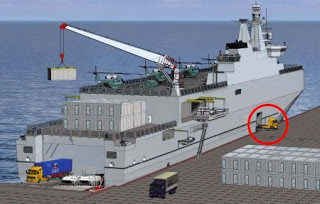 This blog has highlighted a number of suggestions that we believe should be investigated. How significant is the contribution of a CVN to the aviation requirements of Sea Basing? Instead of LHA(R)s, have the Navy/Marines considered Forward Operating Bases (FOB) at sea? The previously discussed Littoral Strike Group consisting of motherships and corvettes as a regional logistical and security force that establishes MDA at sea, using platforms that emphasize manpower for the irregular warfare challenges at sea, including the Global Fleet Stations framework, but includes unmanned platforms empowering the force to scale to conventional warfare requirements in the littoral. While we haven't discussed it, we certainly hope the JSAW takes serious consideration of the potential of airships as an MDA contributor to the GFS, and also the potential of submarines as undersea Sea Basing of SOF.
Sea Basing is evolving, the 2 MEB assault concept is an innovative concept, particularly in sealift although it appears the concept falls short on air lift capacity. We believe Sea Basing needs to be evaluated for full spectrum, including most likely warfare scenarios to include irregular warfare, but also including least likely but necessary requirements that include forcible entry... something the industry driven current design does not do.
We do not believe it makes sense to focus the design of Sea Basing procurement funding only around the 2 MEB requirement, rather we see the existing USNS Gunnery Sgt. Fred W. Stockham model and even the potential SSGN undersea model for Sea Basing that represents a Global Fleet Stations model and Forward Operating Base at Sea model as a more appropriate starting place for evaluating Sea Basing in the context of irregular operations. In other words, the current operation models as described in the Defense Daily article is an excellent starting place.
It is a lot easier to start small and evolve than to go big, fall short of funding half way into the process, and salvage the problem with an incomplete solution. I hope the Navy maintains an open approach and truly evaluates the full range of ideas in developing joint concepts, and doesn't get caught up in potential inter service political or industry distractions.

No comments:
Post a Comment