
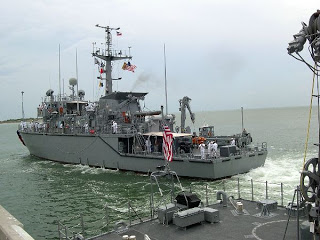
 No one wants minesweepers until they don't have any. In 1987, when Iranian mines started popping up all over the Persian Gulf, the US Navy struggled to deal with the problem. It is a really good thing the media was distracted and the internet didn't exist, because no one would have been happy about the Navy using 100,000 ton super tankers as escorts for US Navy warships, but in fact that is what happened. At the time of those reflagged Kuwaiti tankers, the Navy didn't really have any way to detect mines, so the answer was to follow the supertankers and allows the double hulled beasts take hits rather than the Navy take hits. Only 1 tanker hit a mine, specifically on the first escort mission, but nonetheless it exposed a major weakness in the US Navy arsenal.
This past week, the Navy retired the last of the Osprey class minesweepers. These ships retire without replacement.
A lone bugler played as Union Jacks and national ensigns were lowered marking the end of service for the final four Osprey-class coastal mine hunters.
USS Kingfisher (MHC 56), USS Cormorant (MHC 57), USS Blackhawk (MHC 58) and USS Shrike (MHC 62) were decommissioned Dec. 1, during a ceremony aboard Naval Station Ingleside, Texas.
...
These ships' mission is to clear harbors, coastal and ocean waters of acoustic, magnetic, pressure, and contact type mines, using reconnaissance, classification and neutralization tactics. The ships' design integrates mine countermeasures technology into a uniquely designed platform with exceptionally low magnetic and acoustic signatures to protect again mine detonations during minehunting operations.
These are the final four of the 12 Osprey-class ships to be decommissioned.
We aren't going to oversell the Osprey class capabilities. For example, they have to be loaded onto another ship to be deployed to a forward theater, which we acknowledge as a weakness. However, MIW is one of the cheapest and easiest forms of warfare at sea, and requires a special skill to counter. The capability of the US Navy to counter mines is questionable, with the Littoral Combat Ship program still yet to produce any results, and the mission modules of the Littoral Combat Ships which includes the future MIW capability is facing budget cuts in Congress. There is evidence the Navy is exposing itself to considerable risk in countering mines, particularly as we note sea mines are preferred weapons of North Korea, Iran, and China... three nations that represent potential future adversaries of the US Navy.
The Osprey class did serve one very important purpose that one wonders how it will be replaced. It provided a series of platforms for training in mine warfare and mine removal. While there is simulation software available for training, it is hard for a computer program to mimic the real thing at sea. It is striking no one in Congress is asking the Navy about the risk here, instead accepting the further reduction of MIW capability as a way to save money. Weighed against the cost of a single port shutdown like Long Beach or New York due to usage of cheap sea mines, the cost savings are disproportionate by several factors of ten to potential financial loss.
Previous decommissionings
June 15, 2006: USS Osprey and USS Robin
June 30 2006: USS Falcon and USS Oriole
Jan. 7: USS Cardinal and USS Raven
March 16: USS Heron and USS Pelican
Dec. 1: USS Kingfisher, USS Cormorant, USS Black Hawk and USS Shrike

No comments:
Post a Comment