
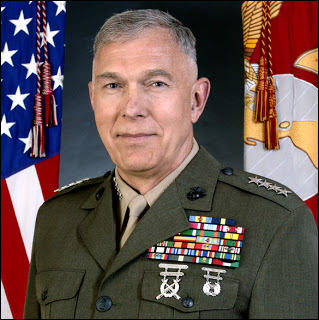
 I have a few favorite Generals and Admirals, one of them being General James T. Conway, USMC Commandant. His speech in San Fransisco earlier this year on the Long War is one of the great speeches of our time.
This past week General Conway personally gave the press briefing at the Pentagon, where he touched on a number of subjects, too many to cover in one post. There were a few key points worth discussing though, starting with MARSOC and Afghanistan.
Q I think there are a significant number of Special Forces. Did your plan envision MARSOC returning to Afghanistan? And are they ready for that?
GEN. CONWAY: Yes. You may not know this, but after the first MARSOC came home, we very quickly put another one in there, and we have had MARSOC in Afghanistan now -- we're on the third rotation, probably about a four-month rotation of those folks. They're coming off the MEUs as the MEUs deploy. And so ship movement times and so forth cuts it back from a full seven-month deployment in Afghanistan to something less than that. But because they're Special Forces, I won't say much, except that they're having huge success in conjunction with the Army teams that they operate with and the other coalition force nations whose sectors they serve in.
Q Are you concerned that MARSOC may be taking some of your best people? And what does that do to your ability to have experienced officers and very skilled people in the Marine Corps?
GEN. CONWAY: Yes, 2,500 Marines with the qualifications that these guys have to have is painful, but the determination has been made that we will be players -- full players, as much as our numbers will allow -- in MARSOC. We have -- we have found that our investment is paying off already to a degree, based on the reputation these folks are achieving in Afghanistan.
But if you simply set that aside and say go do great things, there is a price to pay. When I was a MEF commander, I had an entire First Reconnaissance Company that I could deploy long range. These guys were very good at what they did. They were -- they were our equivalent of Special Forces inside the corps, and they were -- they were just tremendous. Now we have a First Reconnaissance Platoon.
And it is helpful and healthy to the degree that someone with the MOS, someone that is highly trained and highly qualified, has yet another place that he can go and not feel like he's sort of reached the pinnacle after once he leaves the First Reconnaissance Company and then maybe change services and goes on to join Army Special Forces. General Jones once said that if he met another Marine in Army Special Forces who said he would have stayed if there was someplace to go, said he was going to jump off a bridge somewhere because he just -- it was happening to him all the time.
We don't have that problem now. We got another problem, and that is, what do we do with our own internal requirements when so many highly qualified people are now finding their time in MARSOC?
What I have reached agreement on with both General Hejlik and Admiral Olson is that those highly, highly qualified folks will spend a four- or five-year tour in MARSOC and they rotate back into the corps in some capacity, and then maybe go back to MARSOC later on in a more senior billet and rotate in and out, unlike what happens in the Army once you have the designation and I guess even the Air Force, although I'm less familiar.
So we can -- we can regenerate some of that talent, but it hurts to have those number of highly qualified people off doing something else.
Q So are you competing -- I mean, are they exclusively recruiting within the Marine Corps, or can they recruit elsewhere?
GEN. CONWAY: Well, for -- it's not really a competition or a recruitment effort. We have monitors now that have a special eye -- I mean, they monitor that population of people with those special credentials, and they're continuing to fill the ranks as we start to see rotation out.
And they're keeping -- there's also a growth factor. I mean, we didn't do it all at once. We're growing that capability and -- I couldn't tell you exactly where we are, but I think it's in the -- in the teens of hundreds against about a 2,500-man requirement. So we're not -- we're not fully staffed yet, but we will be. And then, once we are, we'll continue to rotate those people as available back into the Marine Corps, and in some cases new people into the special operations.
That is good stuff, more detail than we usually get regarding MARSOC. I also think this is a very smart approach. By rotating Marines in and out of SOCOM, the Marines offer substantially more opportunities at the recruiting level for Marines to not only get special forces opportunities, but additionally offer advancement options to bring that experience back into the Marines. The intention to rotate Marines in and out of special forces raises the total pool of special forces, and really changes the game when the time comes for a large scale Marine operation.
Given the nature of the Long War, I think the possibility of an assault from the sea is higher under the conditions of the Long War than it is in conventional major war. There is no prospect of the Marines conducting a major amphibious assault against China or Russia, but one can imagine a scenario like the one conducted against Somalia in late 1991 in any number of regions, from the South Pacific to another location in Africa. We never know where the next major terror network will take hold.
General Conway discusses other topics like MRAP, Iraq, and proposals for the USMC to shift from Iraq to Afghanistan. He also points out there are Marines who have a ton of combat experience that have never deployed on a ship, and how the Corp intends to handle that in the future. The whole transcript is a good read.
One other thing, in the press conference General Conway points out that the Marines have war funding under the current bill that will last through March 24th. The law requires employees and union presidents to get a 90-day advance warning about possible furloughs. As he points out, do the math, 90 days prior to March 24th is December 24th, meaning for Christmas the Marines intends to issue 20,000 pink slips if the Iraq war funding bill has not passed.
General Conway didn't write the law, Congress did, so Congress can't exactly blame the Marines for following the law... except we can expect exactly that should the war funding bill lead to that point.

No comments:
Post a Comment