
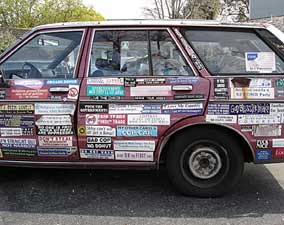
 I found myself stuck in traffic today behind that hippy with 10,000 bumper stickers, you know the type, the 60s white afro hair lady who owns a foreign car with 100 catchy phrases on how to improve America. Of the several dozen I was able to read, only one really made a lot of sense to me.
Mass Media Contributes to Ignorance.
Perhaps, but mass media also empowers the individual like never before, and provokes thought. Ultimately, I see mass media as empowering, not restricting, to the pursuit of knowledge and wisdom. In the end the bumper slogan does what all bumper slogan's do, they make a lot of sense if you live in a world without personal responsibility.
The availability of information isn't the problem, the problem is more individual. The real effect on a society of the information age is the lack of discernment between what is entertaining, and what is important. Reading the dailykos or redstate can be entertaining, but I almost never find either place focusing in on the information that is important to me individually. The same is true for most of what passes for news these days.
Thinking along these lines, Thomas P.M. Barnett linked to this article the other day. I emailed the article to CDR hoping to get his take, he sounds a lot smarter than I do on these topics, but I can't resist the urge to discuss it.
MTV Arabia, a new 24-hour free satellite channel, will begin broadcasting in Arabic across the Middle East on Nov. 16. The Viacom-owned network's flagship show, Hip HopNa ("my hip-hop"), will be co-hosted by Saudi rapper Qusai Khidr and Palestinian-American producer Farid Nassar, aka Fredwreck, who has worked with Snoop Dogg, 50 Cent, and other marquee names. The show will visit 10 cities across the Middle East in search of talent, giving would-be Arab rap stars an international platform. Noujaim won the show's first competition, and Fredwreck has produced one of his tracks. "This is a music genre that is bubbling underneath the surface here, and we want to claim it as our own," says Bhavneet Singh, head of emerging markets for MTV Networks International.
That is step one.
For Viacom, MTV Arabia is just the beginning. The region is attractive because it's awash in petrodollars and two-thirds of the population is under 25. Viacom has signed a 10-year licensing deal between MTV Networks and Tecom Investments, controlled by Dubai's ruler. On Oct. 12, Viacom planned to announce another decade-long licensing deal with Tecom for children's channel Nickelodeon Arabia. That's set for the second half of 2008, and the company reckons an Arabic version of Comedy Central won't be far behind. Also under discussion: Paramount Pictures productions in the region and licensing of Nick's characters for clothing, toys, and games. "The Middle East may be the world's most underappreciated growth story," says Viacom Chairman Sumner M. Redstone.
When people ask me what I do, I tell them I'm in the information business, which is my twist on the information technology business. Sure we are in the category of IT, but I believe my value comes from being able to discern the information as well as empower it through technology. I believe most IT companies are driven by the latter and don't account often enough for the former. My philosophy is where the name of this blog comes from.
The important thing about information is understanding the value of it, whether it is important or not. Viacom is going to spend a fortune promoting and profiting from information that is ultimately not important, or is it? As I said above, I see mass media as a good thing for empowering the individual, and in a place where media access to alternatives is largely limited, Viacom is certainly opening new doors to new ways of thought.
There is irony here. Americans (particularly on the far right) opine on how destructive the influences of mass media can be on a value centric culture. The irony is, the Middle East is largely a value centric culture as well, much like America was in the early to mid 20th century, the only difference is what the values are. Clearly that last part is loaded with inferences, intentionally, since Americans are people who stereotype other societies, and I have no intention to engage the debate on what Middle East morals are. However, do the same people who see MTV in America as an enabler of destructive influences to our youth support Arabia MTV in the Middle East knowing that it is almost certain to have a similar effect on their culture and society? Would that be the same as wishing what they see as our evil on our enemies? Just pondering out loud...
Personally, I see this as a good thing for the Long War. I was on my couch when 'Video Killed the Radio Star' and again last night, I was on the couch with my 12 year old daughter reading my book while she played with "music choice" on the digital cable. Ya, I would agree most of the music of her generation sucks (just like my parents didn't like my grunge stuff I'm sure) but watching her hold her guitar trying to learn some of the songs was worth putting up with crappy tunes, and when she was able to pull off "Aerials" by "System of the Down," while I thought the video was uhm, strange..., her talent made me proud nonetheless. At least she wasn't playing Justin Timberlake! My daughter is typical of girls her age though, she likes the music of her generation and observes its culture. I make a point to highlight where that culture can influence, as any good parent should. My parents hated MTV, I watched it all the time. Was I influenced by the culture of MTV, Nick at Night, or comedy on TV? Ultimately, I'm sure I was, cable TV is among many factors that influenced GenX, of which I'm a member.
Will "Nick on Arabian Nights," the "Arabian Daily Show," or "Real World Riyadh" be to the long war what "Levy Jeans" and "Rock Music" was to the cold war? I don't know, but in 2001 I worked with two Russian programmers who had made their way out of Russia following the cold war, and when I asked them if they listened to rock music as a kid in Russia, one of them answered "Yep, Motley Crew, and I wore Levy Jeans too."
Food for thought.

No comments:
Post a Comment