
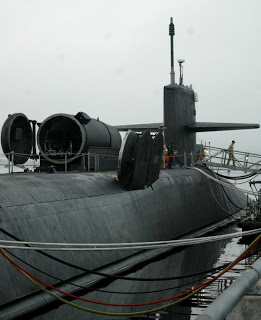
 The USS Ohio (SSGN 726) began its first deployment on Sunday with its "blue crew" under the command of Capt. Chris Ratliff. The USS Ohio (SSGN 726) will not return to Kitsap Naval Base in Bremerton, Washington for 15 months, and will rotate to its "gold" crew at an undisclosed forward location halfway through the deployment.
Several of the news services reporting the deployment focus in on the 154 Tomahawk number as the main capability of the SSGNs, but the USS Ohio (SSGN 726) is not deploying with that many cruise missiles, in fact for this deployment we have been told so much information leading up to the deployment we can speculate a bit.
A few details about the SSGN conversion. The reason the first 4 SSBNs were so easily agreed to for retirement by Bill Clinton back during the nuclear reduction treaty talks is because the first 4 SSBNs (Ohio, Michigan, Florida, and Georgia) were originally designed for the C-4 Trident Missile, not the D-5 in service today. This is also why the cost to convert more SSBNs to SSGNs than the 4 planned would be higher, the tube designs of the SSBNs are slightly different so there would be new work involved.
The SSGN conversion program supports the use of missile tubes as lockout chambers, for SOF stowage, and for Multiple All-Up Round Canisters (MACs), which each contain seven Tomahawk cruise missiles. Missile tubes 1 and 2 have been permanently converted to lockout chambers. The remaining tubes (tubes 3 through 24) are modified to accept MACs. Of these 22 tubes, 8 (tubes 3 through 10) can also accommodate SOF stowage in place of MACs. Because of the lighter weight of MACs and SOF stowage in comparison to ballistic missiles, permanent ballast cans are installed in all tubes except tubes 9 and 10. Thus, tubes 9 and 10 can provide the longest usable length for new payload systems. Additionally, tubes 9 and 10 (as well as tubes 5 and 6) have 30 in. diameter access hatches on the first platform. Access hatches in 5, 6, 9 and 10 allow for payloads that might require personel access to the payload tubes.
 Additionally, in several speeches during the conversion the Navy has made it clear they intend to fully explore the capabilities of the SSGN as a base under the sea, giving credibility to assumptions that tubes 3 through 10 will almost certainly carry payloads other than missiles, including everything from large and small UUVs, test equipment, SOF stowage, UAVs, and other items and perhaps weapons unlikely to be discussed in the media. That leaves 14 tubes, specifically 11 through 24 available for Tomahawk missiles, or 14 x 7 = 98. Given the capabilities of the SSGN in operations other than war, and no clear need for a large number of Tomahawks at sea today against a potential adversary, 98 Tomahawks is my estimate for payload on its first deployment.
One thing is absolutely certain, we will not get a definite answer on payload of SSGNs for deployments from the Navy. We will also probably not hear from the USS Ohio (SSGN 726) except during a rare port visit or until the gold crew rotates in. While a lot of people probably assume the USS Ohio (SSGN 726) will set course for Iran, my guess the US Navy will want to keep it in the 7th Fleet until required elsewhere, and probably send it to where it can do the most good as a SOF platform in the South Pacific where it can put the hurt on Al Qaeda operations in that theater.

No comments:
Post a Comment