
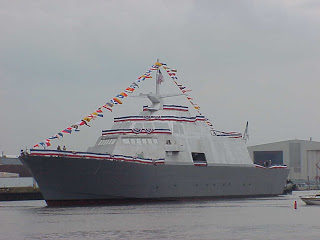
 There are so many questions without answers for the LCS program, and as time goes on, new questions continue to pop up. Congress has at one time or another funded up to 4 LCS ships up until now, but in the last year one of those 4 ships was canceled and the other appears to be canceled in the latest budget. The latest budget also appears to underfund any new LCS platforms, although that is unclear.
First problem, the FY 2008 budget. The Navy, like the rest of the entire US government, is operating under a stopgap spending bill that is designed to keep the government running until November 16th. The intent of this for the Defense Budget was to put aside the Iraq debate. There is no news when the Senate and the House will get together to work out differences in their bills, but there is a lot to work out, and some of it has to do with the LCS.
For example, the Senate Appropriations Committee approved cutting the entire $910 million requested for the Navy’s Littoral Combat Ship program. The House bill would appropriate $339 million for the ships in 2008, which isn't enough to buy a new LCS but would finish off existing orders (1 through 4). The panel also suggests a rescission of $300 million of 2007 funding for the program, which would cancel plans for a third and fourth ship. As things stand right now, the best the Navy can do after FY08 is come out with 4 LCS hulls, either 1-4 or 1, 2, 4, and 5, depending upon funding and negotiations. The worst case is 2 hulls total, and no new ones.
Meanwhile, while we wait to see what Congress decides to do, we are getting news on Freedom (LCS 1).
LCS 1 PROBLEMS ARE ALL IN THE DESIGN.I imagine the Aussies are feeling good for choosing Navantia over the Gibbs and Cox design. That news came out the day before the Washington Post ran an article on Navy shipbuilding, which had this little nugget at the end.
Following a week of tests and inspections on LCS 1 in Marinette, reliable sources tell me that the Navy personnel taking part felt that the shipyard had done a superb job: all the problems are in the design. Despite the fire a few months ago, the mess decks and galley are apparently all fully and properly finished. Everything was exceptionally well laid out and organized. One quote was "Every US Navy ship should have cableways as well arranged and tightly run as this." The negative comments concerned the Engineering spaces, which were described as "a design nightmare", "far too crowded", "inexcusably badly designed", "providing insufficient work space", "cramming far too much stuff into every compartment" and "a maintenance nightmare". So who's responsible for this mess? Well, obviously not the shipyard. As everybody in the industry knows, our best second-tier shipyards, such as Marinette and Bollinger, are far superior to the big yards in terms of productivity, reliability and quality. The fact is that the LCS is a design screw-up: look no further for villains than the Navy itself, which, as usual, is trying to fit a quart into a pint pot; Lockheed Martin, which knows absolutely nothing about shipbuilding and never did; and Gibbs and Cox, who should be ashamed of themselves. October 9, 2007. (H/T CDR)
Once the Navy selects a prototype, it plans to hold a new competition for rest of the ships in 2010.
But Loren Thompson, a military affairs expert at Alexandria-based Lexington Institute, said the Navy has a reputation for building a few test ships and then moving on to another program.
"It seems as though all these programs are a way station en route to the next bright idea," he said. He noted that the littoral combat ship was the product of former defense secretary Donald Rumsfeld and his deputies. "It may not have the support in the Pentagon to keep it on track," he said.
It appears that others are seeing this possibility as well. Mike recently added comment thinking that the LCS might be the last chance for reformed thinking inside the DoD. I think I prefer that perspective to the one of Senator McCain, who is not concerned with the shrinking Navy and Air Force, but is concerned over the cost of the LCS.
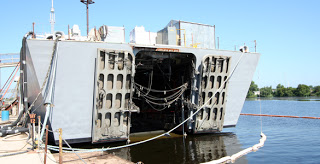 But how bad is it really for the LCS? Consider this, Lockheed Martin has only put out two news items so far on their official LCS homepage, one in June to discuss their new LCS training software, and the other with the tag line "Automated Stern Ramp and Side Launch Doors Will Offer Unprecedented Launch & Recovery Access For Ship’s Waterborne and Special Operations Missions." Apparently, having either side and stern access capability for small boats is considered unprecedented at Lockheed Martin.
The final strange news out of the LCS program is a new contract to Alcoa.
Alcoa, one of the world’s largest aluminum manufacturing and technology companies, finally has gotten a foot in the door in the U.S. Navy’s Littoral Combat Ship program.
An $8.3 million contract was awarded to the company Sept. 27 to “provide engineering services in support of the redesign of existing aluminum structures” on the LCS, according to the Pentagon’s contract announcement.
Both competing designs in the LCS program have substantial aluminum components. Lockheed Martin’s design uses a steel hull with an aluminum superstructure, while the General Dynamics ship uses an all-aluminum hull and superstructure with steel stiffening added into the hull.
Some thoughts here... either this is earmarks in action, which is possible, or someone sees the need to reduce the weight of the aluminum in the LCS, which would be yet another disappointment for the LCS program if true.
Recent news and events tell the story, the LCS is still in big trouble, we are still a long way from good news, and as bad news piles up we have no idea if the program will ultimately survive.

No comments:
Post a Comment