
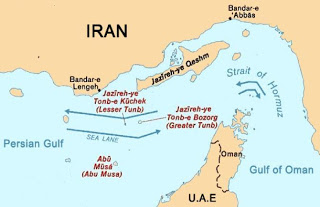
 In early August I began observing a new approach developing regarding the US policy for Iran which I labeled the Diplomatic Surge. The details of the diplomatic surge remain hidden in negotiations, but it began a diplomatic window for the State Dept to resolve the Iranian nuclear program. The Diplomatic surge has a number of elements that require action on a number of fronts.
The State Dept is to build a coalition in confronting the Iranian nuclear program through established bodies, including the United Nations. The US Military in Iraq would begin breaking down Iranian networks, and highlight the role of Iran in Iraq to Congress and the public (which Petraeus ultimately did). Congress would also take action and attempt to apply economic pressures on Iran to bring them to the table to answer the serious questions that are outstanding on the nuclear issue. Ironically, Bush gets blamed for this, but those tuned in know the action was actually required in the law Landos and Lieberman helped get passed. All of things have ultimately come to pass.
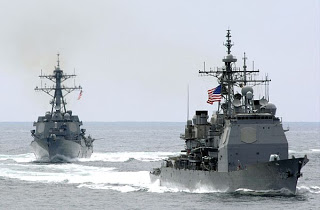 November brings a new stage to rhetoric of the Diplomatic Surge, shifting from a quiet discussion among the US and its allies to a broader public discussion regarding Iran, which will have the effect of building a rhetoric within established international bodies and the media for military action by the United States against Iran. The only peaceful resolution to the Iranian nuclear situation is negotiations, however, many strategic thinkers believe that the for negotiations to be successful, current events surrounding Iran will look like they are descending into chaos immediately prior. Others believe this ends with war and has been planned that way all along. I tend to believe if Iran chooses to defy the international community on the nuclear issue, there will be a critical moment where Bush could choose to order the strike or not, and if he chooses not, Israel will strike anyway, furthering the implied catch-22 the US finds itself in.
As we have all observed, the Iran discussion in October was certainly muted in relation to the tone of the Iranian discussion leading up to Petraeus in Congress in September. The reason for the change in tone is because of Admiral William "Fox" Fallon.
"This constant drum beat of conflict is what strikes me which is not helpful and not useful," Fallon said in a half-hour interview with Al-Jazeera television broadcast Sept. 23.
"I expect that there will be no war and that is what we ought to be working for," added Fallon, whose comments were translated into Arabic. "We ought to try and to do our utmost to create different conditions."
I have observed Admiral Fallon for years and find him to be one of the most impressive military leaders of the current generation. While some have attempted to tarnish his image, they are usually people claiming questionable capabilities like mind reading, and produce questionable facts in related discussion. In other words, misinformed morons driven by partisanship.
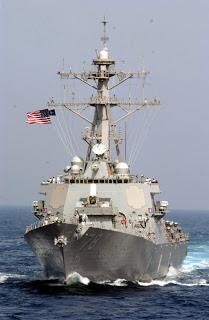 It is interesting when you look at the recent Naval events making the news. First we hear about the USS Porter (DDG 78) , attached to the Kearsarge Expeditionary Strike Group, sinking a few pirate skiffs. Then we hear about the USS Arleigh Burke (DDG 51), attached to the Enterprise Strike Group, shadowing the hijacked tanker. The next day we hear about USS James E. Williams (DDG 95), attached to SNMG1, assisting another hijacked vessel. This news comes right after the new Maritime Strategy is produced that focuses on addressing regional disruptions, which occurred off Somalia just last week in the form of a major increase in piracy when the USS Carter Hall (LSD 50) pulled out of the region.
In other words, US naval assets from 3 different task forces found themselves directed to the Somalian coast with the intention to produce results which has generate headlines. This is one example why Admiral Fallon is nicknamed "Fox." While Iran was probably breathing easier noting the movement of the US Navy away from the Iranian coast, I imagine the latest naval news doesn't sit as well.
Nearly 7,500 sailors will leave their East Coast homeports Monday when the Norfolk-based aircraft carrier USS Harry S. Truman's strike group deploys.
The Navy announced the regularly scheduled deployment "in support of maritime security operations" on Wednesday.
If I was able to make observations regarding its composition, it is almost certain the Iranians can. As I observed in August, the Truman Strike Group appears to be built to fight in major war, and has with it the most advanced electronics in the fleet to coordinate offensive and defensive operations in such a major war. Going back over my notes, I am unable to find a larger deployment of naval strike firepower from the Atlantic fleet that didn't ultimately participate in a war; whether Gulf War I, Kosovo, or Gulf War II. The Truman Strike Group consists of:
USS Harry S. Truman (CVN 75)
USS San Jacinto (CG 56)
USS Hue City (CG 66)
USS Carney (DDG 64)
USS Oscar Austin (DDG 79)
USS Winston S. Churchill (DDG 81)
HMS Manchester (D95)
HMCS Charlottetown (FFH 339)
USNS Artic (T-AOE 8)
USS Montpelier (SSN 765)
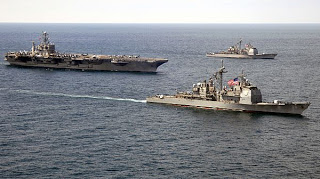 I don't know if the Navy put together the task force under instruction to prepare for war with Iran, but I do know, and if myk sees this I'd appreciate his thoughts, that if I was designing a simulation for a strike against Iran, I'd design a strike force with a similar composition. The Navy has to have a cruiser defend the Iraqi oil terminals, and would require an additional cruiser to defend the CVN itself. If possible, you want the Canadians and British specifically if you believe you will need assistance in ASW and MIW. When you take consideration into the details of that CSG, the signal is fairly blunt.
In fact, I'm sure at some point down the road someone at State will bundle the implication as part of the negotiation. As I have said in the past, military deployments make horrible tea leaves for reading, and this is a development that has been scheduled for months (obviously since I have been noting them for at least that long), but even the most skeptical regarding a war between the US and Iran have to acknowledge that the composition of the Truman CSG is at minimum, notable for reasons noted above. I'm not playing the role of alarmist, I'm playing the role of a realist.
As best I can tell there is a government policy unfolding in slow motion and the Navy is putting itself in the best position possible to deal with the final policy decisions either way. On one side we have the State Dept trying to negotiate a solution, although whether those negotiations are in good faith or not is questionable. On the other side we have Admiral Fallon and the US Navy, trying to stabilize the region and set a tone of regional cooperation while preparing itself for the possibility of being called to action by the President, or forced into action by Israel. I don't know if a war between Iran and the US is unfolding in slow motion or not, but I do recognize that the US is stuck between a bad situation and a bad situation regarding the Iranian nuclear program, and it will be men like Admiral Fallon that will ultimately have to manage the military consequences of political decisions made in the US, Iran, and Israel. When the rhetoric of war drums gets louder, fasten your seat belts, the road gets bumpy from there.

No comments:
Post a Comment