
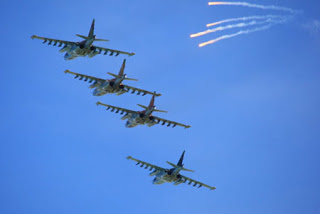
 Unless you are following closely, you might get distracted by the flares and fireworks of the Shanghai Cooperation Organization (SCO). Formed as a partnership, specifically as a block interested only in keeping the United States out of the affairs of central Asia, SCO is made up of the six central Asian nations of Russia, China, Kazakhstan, Kyrgyzstan, Uzbekistan and Tajikistan. The definition and intention of SCO is often debated, cold war observers see SCO as a new Warsaw Pact, a Eurasian counterbalance to the US-led North Atlantic Treaty Organization (NATO), while 21st century observers taking a Chinese perspective see it as seeking neither to integrate with nor balance against the US, but to create an alternative international order that "routes around" Washington.
Both definitions actually apply very well, as SCO is a counterbalance to the US from the Russian perspective, while SCO is a way around the US from a Chinese perspective. Many Russians believe they have a destiny to counter-balance the US, and make decisions solely based on this destiny. China, on the other hand is seeking a way to avoid a direct confrontation with the US, and makes its decisions accordingly. Thus is the world of Asian politics, where the US plays a role because it potentially could inject influence although that influence isn't wanted.
SCO is often mentioned in terms of a strategic defense agreement, despite the fact no strategic defense agreements actually exist within the SCO arrangement. It would be more accurate to say SCO is about strategic economics, sales of Russian military hardware to China, as it does apply. SCO does hold defense exercises, but the intention of such exercises is no different than say Malabar 2007, or even a Neptune Warrior for that matter. Militarizes train together every day, the deeper purpose of which can be inferred by anyone with an agenda.
This weekend the world was distracted by major exercises in the Ural Mountains by members of SCO. While we were distracted, events occurred by the nations of SCO that remind me a bit too much of the cold war. No, not that massive Russian military buildup part of the cold war, rather that "Moscow is skeptical of Shanghai" aspect of the cold war that no one in the west really understood until after the wall came down.
This past weekend, while the big bad SCO was riding high the tide of military might and media concerns, China sealed the deal with Kazakhstan to build a pipeline from the Caspian Sea to China, while at the same time inking a deal for a natural gas pileline from Turkmenistan, by transit through Uzbekistan, to China.
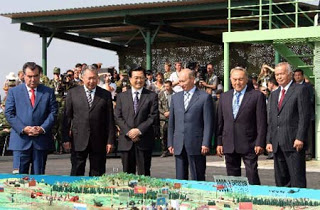 In one weekend, while Russian President Putin and Chinese President Hu Jintao are kicking it back at a retreat in the Ural mountains overseeing "Peace Mission 2007," China just rearranged the strategic balance of central Asia. The Art of War by Sun Tzu has a chapter on deception, and it was just played masterfully. Stratfor explains.
China is forced to import the majority of its energy from abroad. China fears many things, but few frighten it more than the possibility of having its maritime supply routes cut off by hostile powers. China lacks -- and will continue to lack for at least a generation -- the navy to protect its maritime interests and so its only option is to go inland. And that means Central Asia.
This means that, barring a bilateral divide-and-conquer plan in which the two share what they both exclusively need, a Chinese clash with the Russians has moved from the realm of the possible to the inevitable. Russian state natural gas firm Gazprom is currently the sole significant purchaser of Central Asian natural gas exports.
China's plans do not foresee exploiting many fresh sources of natural gas in the region, but simply diverting output from routes Russian to routes Chinese. This development, which could be in place as soon as 2009, would greatly interfere with Russia's strategic policies in a very real, sudden and broad sense.
Given Gazprom's technical limitations, without Central Asian natural gas, Gazprom can meet its export requirements for Europe or it can meet domestic demand -- not both. And considering that cheap energy acts as a panacea for social disruption at home and is a critical arm of strategic policy abroad, the Chinese decision to grab the ring will muck with Russian geostrategy in Europe, Central Asia and even at home.
It will be very interesting to watch this unfold. China sealed the deal by spending several billion dollars cash, something Russia doesn't have, to lock up strategic energy routes out of central Asia. This does a number of things at once. First it greatly diminishes the influence of Russia over the central Asian states, providing them an alternative to Russia that has been more than a bit overbearing since the end of the cold war. Second, it removes a major power base from the Russian sphere of influence, and I doubt Putin is too happy about losing any power, much less power Russia has all but enjoyed as a strategic energy reserve for decades. Third this makes Iran even more important to Russia, Russia is going to need a new source for Natural Gas, and there are only a few places left where large deposits of natural gas exist yet untapped, Iran being one of the closest (Iraq being another BTW).
Finally, this is a big chink in the SCO armor. In its self interest, China just upended strategic leverage of energy resources Russia had over Europe. Eventually, Europe will have to find another source for natural gas, something France might be thinking about today as they look for a reason to engage in Iraq.
While on the surface this little pipeline agreement between a few former Soviet block states and China seems like a very small thing, it directly effects Russia, Europe, the United States, and anyone engaged in the energy resource politics of the 21st century. It also reminds the world that the SCO is named after the real power broker in central Asia, Shanghai, not the modern pretender club in Moscow. Game on.

No comments:
Post a Comment