 |
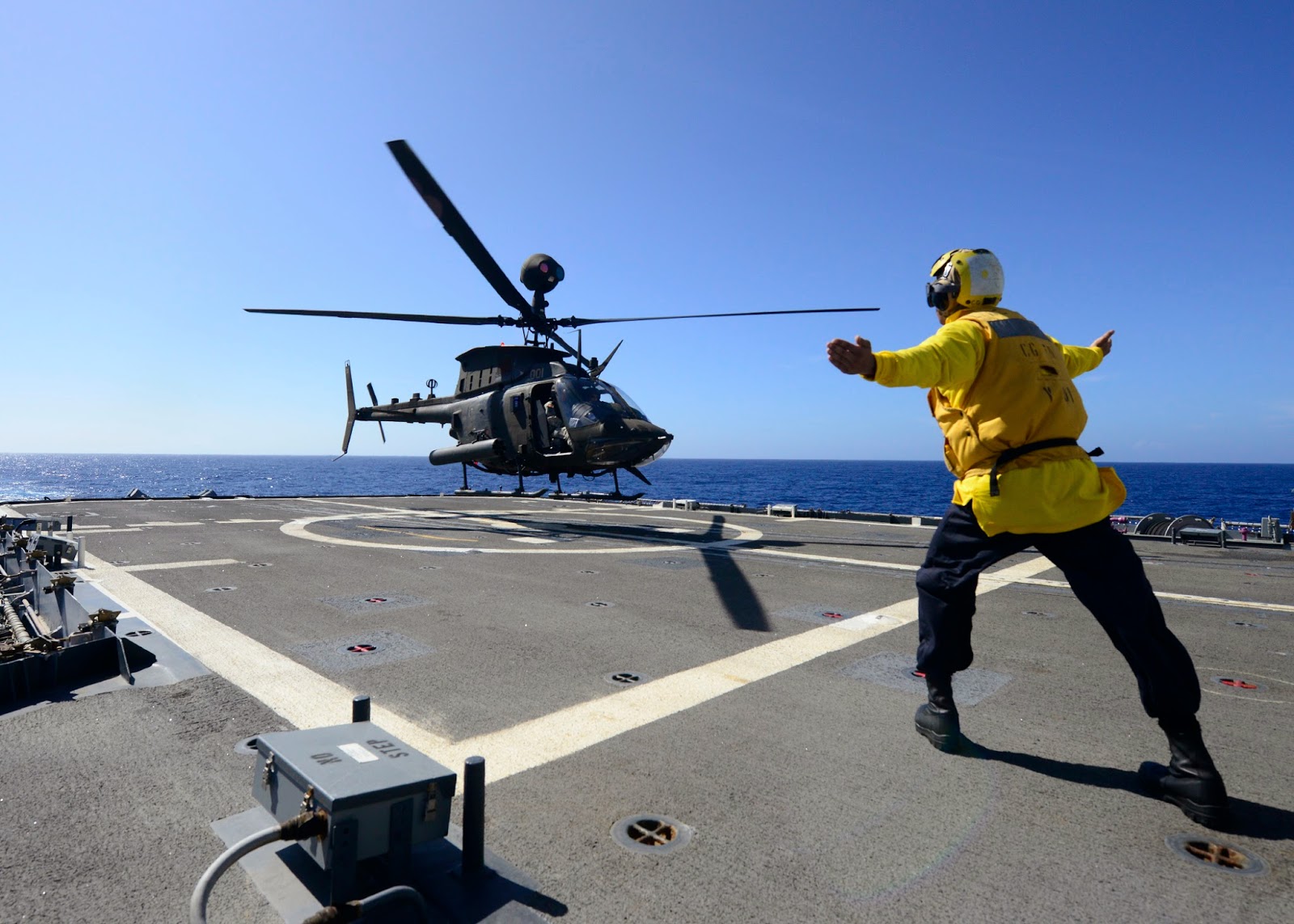
| PACIFIC OCEAN ( Dec 9, 2024) Sailors aboard the guided-missile cruiser USS Lake Erie (CG 70) direct an Army OH-58 Kiowa Warrior helicopter from the 25th Combat Aviation Brigade (25th CAB) off the coast of Hawaii during joint training operations. The 25th CAB is expected to participate similarly in other training exercises in 2014. (U.S. Navy photo by Chief Mass Communication Specialist John M. Hageman/Released) |
The following contribution is submitted by Major David Andersen, US Marine Corps.
Recently, Rajiv Chandrasekaran discussed the Army’s efforts to become more expeditionary and maritime capable. Yet,
as Mr. Chandrasekaran points out; the United States already has a maritime expeditionary force: the Marine Corps.
In business, new initiatives are challenged by various barriers such as cost, equipment design, licensing, and market saturation. If a hardware store wants to expand its business, it’s unlikely to diversify into car tune-ups. Just because a handyman can turn a wrench doesn’t mean he can drop an engine. However similar the Army and Marine Corps may appear to the untrained eye, the same may be said regarding amphibious operations. While the Army did amphibious landings quite well in World War II, they involved a short time at sea as a preamble to the sustained operations ashore that armies are designed for. Today’s amphibious operations are more diverse and require a force designed, trained and equipped to
operate at and from the sea over extended periods—as Marines are.
The Army’s current barriers include:
Cost: Army equipment is not “marinized;” a process where everything from engine intake systems to the metals and paints used are designed to withstand high levels of salt water so that corrosion can be minimized and service life extended. This is why several Army aircraft were scrapped after Operation Uphold Democracy in Haiti, as Mr. Chandrasekaran pointed out. The Army subsequently explored the price of marinization and concluded it was cost-prohibitive.
Equipment design: The majority of Army helicopters have neither rotor brakes nor folding blades and tail booms. These features are unnecessary for land-based operations but essential for safety, shipboard stowage, and operational tempo reasons in sea-based operations. Without brakes rotor blades continue spinning for extended periods of time, gradually drooping as they slow and endangering crews and equipment on a pitching flight deck. Without folding components most Army helicopters take up an inordinate amount of precious deck space on an amphibious ship. A few do have manually folding blades to permit occasional embarkation in C-17 transport planes, rather than the faster and less manpower intensive automated type found in Marine aircraft. As a result, in the time it takes to tow, spread, spot and start a single Army H-60, a typical Marine squadron can launch two full waves of six aircraft.
Licensing: Most of the Army’s aviation weapons systems are not certified for shipboard use or storage. Why does that matter? Because the many emitters aboard the ship could make them launch, fire, or detonate prematurely. Sure, the ship could turn off those emitters, but then it can’t see or communicate with other ships, or identify threats, making operations in hostile or congested waters unsafe.
Market saturation: Plenty of global business exists for expeditionary crisis response forces, so the market is not saturated. What is in short supply, however, is the number of Navy ships capable of projecting forces in “ready to fight” condition. Amphibious ships, specifically designed for that purpose, are obviously the preferred platforms. Unfortunately, the Navy does not have enough amphibious ships to lift the force specifically designed to operate from them: the Marine Corps. While aircraft carriers may appear a viable alternative, the Navy’s inventory is smaller today than it was during Operation Uphold Democracy, meaning that the ability to replicate that model without disrupting existing deployment and maintenance cycles is problematic and likely to occur only in the event of a dire national emergency. What about the USS Lake Erie as cited in the article? She had space because she was at home. When a cruiser, destroyer or frigate, deploys, she does so with a detachment of Navy helicopters designed for sea going missions, like anti-submarine warfare. So, while the market is not saturated, the current budget environment and underfunding of the fleet means the shortage is not sea-based expeditionary forces, but the ships from which they operate.
So, why go to the hardware store to change your muffler?
Rather than trying to diversify its business, what if the hardware store found another means to deliver its existing products? The Army and Marine Corps have experimented with high speed logistics vessels since 1999. The Westpac Express, leased from Austal Marine, has internally transported Marines, aircraft and vehicles throughout the Pacific theater. The Army conducted similar operations aboard TSV-1X Spearhead. With these logistics ships, aircraft and other equipment can be carried internally, requiring no special equipment or training. While they are not capable of conducting sea-based operations, they provide a means to project forces via austere port facilities. Upon arrival, vehicles are driven off and stowed aircraft are craned off and reassembled for operations. These ships and others like them are available for contract for a fraction the cost of marinizing Army capabilities, allowing the Army to improve their expeditionary responsiveness without attempting to become a second Marine Corps.
Maj Andersen is a Marine Corps AH-1W Super Cobra pilot who has conducted three Marine Expeditionary Unit (MEU) deployments, twice as a pilot where he served in the squadron Maintenance Department (OIC of the Airframes and Quality Assurance Divisions) and once as the MEU Air Officer where he was responsible for all MEU aviation operations. During these deployments he conducted extended amphibious operations into Iraq, Kuwait, the Horn of Africa, Bangladesh and the United Arab Emirates. In Bangladesh he was responsible for all MEU aviation operations in support of Humanitarian Assistance/Disaster Relief operations for Operation Sea Angel II following Typhoon Sidr. Maj Andersen also participated in one of the first deployments which utilized the Westpac Express during which his squadron deployed a detachment of 4 AH-1W and 3 UH-1N helicopters as well as required support equipment aboard the vessel, along with additional ground combat equipment, to support exercises in the Commonwealth of the Northern Marianas, the Republic of the Philippines and Thailand. Maj Andersen has also completed combat tours in Iraq and Afghanistan.

 I'm an assistant professor at the Patterson School of Diplomacy and International Commerce, University of Kentucky.
