On this week's episode of Foreign Entanglements, I speak with Toshi Yoshihara about the new Chinese air defense zone in the East China Sea:

Sunday, December 8, 2024
Foreign Entanglements: The ADIZ

 I'm an assistant professor at the Patterson School of Diplomacy and International Commerce, University of Kentucky.
Saturday, December 7, 2024
Listicle Alert!
Over at the National Interest I get into the listicle game:
What are the five greatest fighter aircraft of all time? Like the same question asked of tanks, cars, or rock and roll guitarists, the answer invariably depends on parameters. For example, there are few sets of consistent parameters that would include both the T-34 and the King Tiger among the greatest of all tanks. I know which one I’d like to be driving in a fight, but I also appreciate that this isn’t the most appropriate way to approach the question. Similarly, while I’d love to drive a Porsche 959 to work every morning, I’d be hesitant to list it ahead of the Toyota Corolla on a “best of” compilation.
Nations buy fighter aircraft to resolve national strategic problems, and the aircraft should accordingly be evaluated on their ability to solve or ameliorate these problems. Thus, the motivating question is this: how well did this aircraft help solve the strategic problems of the nations that built or bought it?
I'm an assistant professor at the Patterson School of Diplomacy and International Commerce, University of Kentucky.
Admiral Harvey on Midrats Sunday
 |
| PHILIPPINE SEA (Nov. 16, 2007) American and Japan Maritime Self-Defense Forces (JMSDF) ships transit in formation at the end of ANNUALEX 19G, the maritime component of the U.S.-Japan exercise Keen Sword 08. The exercise is designed to increase interoperability between the United States and JMSDF and increase their ability to effectively and mutually respond to a regional crisis situation. Kitty Hawk operates from Fleet Activities Yokosuka, Japan. U.S. Navy photo by Mass Communication Specialist Seaman Stephen W. Rowe (Released) |
Dear CDR Salamander and Eagle One,
Based on what I have read and/or discussed with Harvey over the last year, the following set of issues seems to be the topics he thinks about and writes about very frequently since his retirement. I'd encourage you to get him chatting up this topic for insights, and I'm sure you already had plans to do exactly that.
My question is simple, what does ADM Harvey make of Ronald O'Rourke telling the House Armed Services Committee that NOW is the time to start paying attention to the Force Structure debate? See his October 23, 2024 testimony to the Subcommittee on Seapower and Projection Forces regarding the 30-Year shipbuilding plan.
I look at the following examples as context, although it is unlikely this is an fully accurate representation of Ronald O'Rourke's thinking on the subject.
I have observed the Harvey/Wayne and the Rubel articles in Proceedings discussing small missile corvettes in "flotilla" style squadrons for adding diversity in distribution of precision missiles at sea. In essence, this looks to be an argument to use small flotilla warships in a battle fleet strike role.
I have observed two different responses from the Surface Warfare community to that specific discussion, We Need a Balanced Fleet for Naval Supremacy by CDR Phillip E. Pournelle and Naval Supremacy Cannot be "Piggybacked" on Small Ships by Lazarus.
I have observed the discussion of Influence Squadrons by Hendrix in Proceedings which also discusses small ships organized in squadrons centered around a mothership for sustained regional presence.
I have observed another article by Hendrix published by CNAS that describes the large deck aircraft carrier as an asset with a declining value at higher cost when looking into the future.
I have observed a recent report by RAND that concludes "the United States should pursue a strategy of making its sea power less vulnerable by relying more on submarines, drones, and smaller, elusive, widely distributed strike platforms" which also looks at the declining value of aircraft carriers in it's primary role in the Pacific. I am specifically talking about the report "Sea Power and American Interests in the Western Pacific" by David C. Gompert.
I have observed the NPS developed, ONA sponsored New Navy Fighting Machine that calls for a Fleet Constitution that has a greater variety of smaller vessels for multiple roles both high and low end, but essentially the NNFM looks to rebalance the fleet in favor of quantity over quality.
I have observed the LCS, intended to be a one-size fits all roles and missions modular design criticized for being too big for some roles, too small for others, lacking too few sailors to be a peacemaker, and lacking enough firepower to be a warfighter.
I have observed the US Marine Corps, consolidated into a declining number of three ship Amphibious Ready Groups, but still consuming the vast majority of shipbuilding funding of all ships not part of the main battle fleet (CVNs, CGs, DDGs, SSBNs, and SSNs). And the design of the Marine Corps 3-ship flotilla is still primarily focused around the single role of Joint Forcible Entry Operations, which presumably Bold Alligator 2012 informed about although no changes since are observable.
Are these discussions actually meaningful, as Ronald O'Rourke suggests to the House Armed Services Committee Subcommittee on Seapower and Projection Forces? Are these discussions connected, or simply related? Is the community talking about the Battle Fleet roles of small ships in places like the Pacific, or is the community talking about the global naval roles generally of small ships not in the Battle Fleet? Is there a common thread with low intensity conflict squadrons like Influence Squadrons and the wartime squadrons like the ones Adm Harvey and Captain Hughes are discussing? The Battle Force is organized for what the Battle Fleet needs to be able to do for the nation, but can the Navy say the same is true for the rest of the ships in the fleet, including the Marine Corps?
The US Navy spends a great deal of time organizing in meticulous detail every aspect of the Battle Fleet - Carrier Strike Groups, Carrier Air Wings, Attack Submarines, and Ballistic Missile Submarines and every detail regarding design and construction and maintenance and basing and training and doctrine and tactics and organization and function and role and mission and strategy...
What should the Navy's intellectual focus be when it comes to thinking about the 'rest of the fleet' that isn't specifically part of the main Battle Fleet? Should the rest of the fleet be organized together, as is happening with the MCM Influence Squadron in the Persian Gulf with AFSB Ponce, MCMs, and PCs, or should the focus remain on highly specialized ships specifically instead of collectively, or is the modular approach of LCS the right approach for the entire small vessel portion of the Navy? Is it time to rethink the way Marines are fielded at sea, or is the 3-ship ARG how things should be? Can the LCS ever be the whole solution as it is intended to be today, or is LCS just one piece of a larger set of necessary capabilities that need to be present within lower tier of the surface force?
These are just a few of the things I have been thinking about, and in my opinion listening to Admiral Harvey discuss these topics on Midrats is well worth an hour of my time.
Respectfully,
Galrahn
USNI Happy Hour - Newport
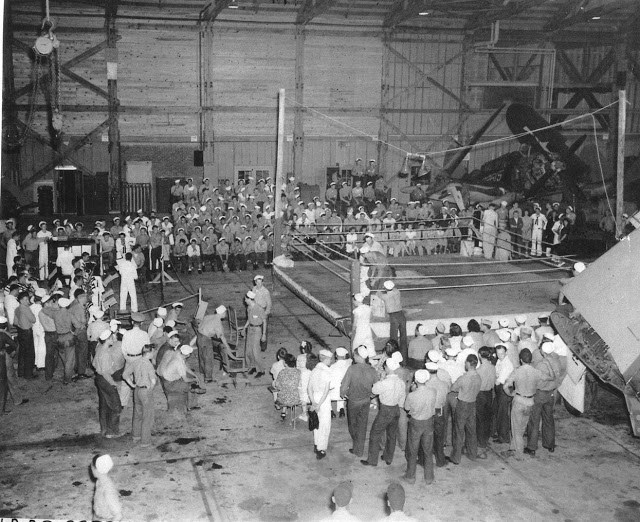 |
| A typical "smoker" at Naval Auxillary Air Station (NAAS) Oceana, in which a hangar has been converted into a boxing auditorium. Note the Navy band at left, in uniform, the aircraft under repair in the background and the (admittedly few) female guests. These events were sailors' entertainment in the mostly rural part of Princess Anne County (Virginia Beach). |
Mid 20th Century the “Happy Hour” was a common occurrence in the USN. It was an opportunity for sailors to blow off some steam, and maybe even get a little exercise. Also known as a “smoker,” in those days a “Happy Hour” was usually series of boxing or wrestling matches when the ships weren’t busy.More of this.
In our post-prohibition world it means something a bit different, but still gives us a chance to blow off some steam. On Thursday, 12 December, The Naval Institute will host a Happy Hour in Newport, Rhode Island for members, prospective members, or anyone who wants to show up to talk about daring “to read, think and write” about sea power and national security.
A member of our Editorial Board will be there to answer questions, and some writers and thinkers who have contributed to the Institute to share some of their experiences. While there will be no punches thrown, sparing over strategy and grappling with the naval issues of the day will be encouraged.
If you are in Newport, please join us to splice the main brace at the USNI Happy Hour/Social:
The Malt
150 Broadway
Newport, RI
12 December 2013, 1700 until the tab runs out or the grog runs dry.
Every year for the past several I have found a way to get a hold of the unclassified final winning papers from the Spring graduating class at the Naval War College. Yes, I've even driven from Albany to Newport and attended the awards ceremony to beg for copies of papers. Every year in reflection, some of those papers represent the best thing I read all year - and I read a lot.
I am convinced the Naval War College is, consistently every year, one the most incredible idea factories on the topic of seapower in the world. It is unfortunate that few of those ideas are exposed to the general public despite these papers being unclassified. In seeking the reason why, I have found that the overwhelming majority of students believe it is better for their career not to have their work published, no matter how good it is. That perception says a lot, and nothing good.
Personally, I think the NPS model of posting everything online is better, and I do hope one day the Naval War College takes a similar approach.
I have long believed that USNI is the one organization that could positively make a difference to the situation if they can get folks who write excellent material to take a few hours, condense those works, and somehow funnel the material into USNI for publishing via the range of publishing options available at the Institute (Proceedings, Web, Multiple Article Collections on a Single Topic for Books, etc.). This "Happy Hour" appears to me an excellent opportunity to move the ball down the road a bit, and I hope every one in Newport with an interest in Seapower shows up to support this activity - both faculty and students.
Subscribe to:
Posts (Atom)