Tuesday, July 30, 2024

Links of Note...

Some thoughts on airpower over at the Diplomat:
A recent University Press of Kentucky edited volume, The Influence of Airpower Upon History, attempts to evaluate to impact of airpower since the beginning of manned, powered flight. The book largely avoids theorizing about airpower and instead examines how statesmen have used airpower as a policy instrument, and what the effects of this instrument have been. Although the book includes a chapter (by Andrew Erickson) on the development of Chinese airpower, it concentrates mostly on airpower’s impact on European and American great power politics. Given the role that airpower is playing in America’s Pacific pivot, it’s worth taking a moment to evaluate what transformative influences airpower has wrought on Asian politics since the beginning of flight.

Monday, July 29, 2024

Piracy, Privateering, and Para-Navies

Puntland’s pirate gangs have run out of luck lately with practically no successful attacks on the now well-defended merchants plying the Indian Ocean.  So like many of their free-booting predecessors who evolved by necessity when the hunting dried up, Somali pirates have shifted to the protection racket.  This opportunistic tactic has been part and parcel of pirates for hundreds of years. In the early 18th Century, pirates off America’s Gulf coast such as the Laffite brothers rotated frequently between piracy, smuggling, spying for profit, and privateering, sometimes playing states against each other while working multiple angles simultaneously depending what enterprise was most lucrative. 

Pirates, Para-Navy, or Activists?

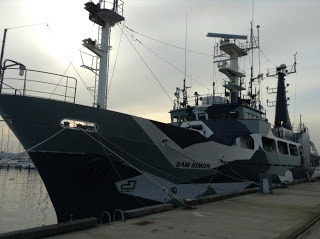
Claude Berube and I recently wrote about another sort of maritime non-state actor which I’ve discussed here extensively - the Sea Shepherd Conservation Society (SSCS).  SSCS’s “direct action” fleet has slowly increased in ships and tonnage each of the past several years, earning the title among its supporters of “Neptune’s Navy.”  Interestingly, a component of SSCS' environmental portfolio includes a fisheries enforcement "out-sourcing" function, which has proven a successful in Ecuador.  While maybe not as aggressive as SSCS, other maritime non-profits such as ShadowView (run by a former SSCS sailor) have begun to outsource their services.  Are these models much different than privateers or their more modern equivalents, maritime private security companies?  The discussion on our article among the online environmental activism and commercial shipping communities rather predictably aligns with the two polar reactions many seem to have towards SSCS: either savior of world’s cetaceans or scourge of the seas.  Perhaps a more useful perspective, at least from the naval point of view, is to study SSCS as a model that future more nefarious groups will likely emulate.

Claude and I contend that as navies around the world - including the United States Navy - shrink, these non-state maritime actors, or “para-navies” will expand to fill the vacuum at sea.  In some cases, such as Sea Shepherd, motives of non-state actors will appear noble, while other para-navies will be driven by rebellion, ideology, or simply greed.  All of them will challenge state navies and coast guards for the monopoly of violence on the water.  Much like their land-based terror and insurgent counter-parts, these entrepreneurial, adaptive organizations tend to confound traditional naval analysts who are more comfortable studying orders of battle and tactics similar to their own modern navies.  Accordingly, as we recommend in the Small Wars Journal article, organizations such as Sea Shepherd can provide a better lens through which emerging para-navies can be understood.

The opinions and views expressed in this post are those of the author alone and are presented in his personal capacity.

Sinking an Entire Navy

David Axe has an interesting blog post up entitled How to Sink an Entire Navy on the War is Boring Blog.  It is a short read but full of information, and from it, a few things stand out to me:

Professor Jim Holmes at the Naval War College likes to say that Seapower is a conscious political choice.  Great Britain has chosen to devote an increasingly smaller share of its wealth to its Navy while devoting an increasing share of its wealth to domestic programs.  A similar situation exists in the United States.  While we begin from a position of great Naval strength, the trajectory is clear.  The U.K. has been able to make the defense decisions that it does because it enjoys a close relationship with a powerful nation sharing its language, its culture, a democratic tradition, and a similar view of law.  There is no analogous power for the United States as we begin our naval decline.  We are on our own.

Artist's rendering from http://www.dailymail.co.uk/news/article-2137418/HMS-Queen-Elizabeth-Stern-Royal-Navys-new-3bn-aircraft-carrier-leaves-Portsmouth.html
Next, Axe lays out for us what the present Royal Navy looks like, including   "...two helicopter carriers, five other amphibious assault ships, six destroyers, 13 frigates, seven attack submarines and four ballistic-missile submarines."  Later he informs us that "...British officials are fast to highlight the new and improved ships planned for coming years, especially the two Queen Elizabeth-class aircraft carriers and their F-35B stealth fighters, slated to enter service starting in 2018 to replace the current helicopter carriers."  What Axe does for us here is to succinctly lay out the RN's "Fleet Design", and low and behold, what does it look like?  Why a mini-U.S. Navy!  That's right; the RN has high end carrier based aircraft (or will), aircraft carriers, nuclear attack submarines, ballistic missile submarines, amphibious shipping, and surface combatants; or as some navalists like to say, they have a "balanced fleet" .  Like much of Europe (and now the United States), the "choose capability over capacity" mantra has been swallowed hook, line and sinker in the UK.  I think deeply engrained in the minds of defense planners in the UK (particularly naval force planners) is the sense that if  they just keep the basic architecture of a great fleet together, someday fortunes will change and they can simply add capacity to a vital, balanced fleet architecture.  In the meantime, considerable national treasure is spent on capabilities of dubious strategic value, and the fleet shrinks dramatically, reducing the UK's ability to actually BE a global navy capable of tending to its vast, far-flung interests.  I realize that it may sound odd coming from an unabashed supporter of US aircraft carriers, but it is difficult to reconcile the UK building two 60,000 ton aircraft carriers with Joint Strike Fighters while its escort fleet consists of 19 ships.  Adding insult to injury is the strategically questionable decision to replace its aging ballistic missile submarine force.  The UK is wasting billions of pounds clinging to notions of prestige and tradition, notions that may be out of synch with true strategic needs.

Finally, the resource driven decline of both the RN and the USN demonstrate need to align strategy and force structure.  If the United States wishes to remain a global superpower and prevent the rise of a regional hegemon elsewhere, it must allocate sufficient resources to the goal or change the goal and the force structure.  And if the RN wishes to be globally influential, it must cease to choose strategic options that limit its ability to do so. 

Bryan McGrath


Saturday, July 27, 2024

Rep. Randy Forbes on why Conservatives should support Seapower


My boss, Congressman J. Randy Forbes, has a new piece out in RealClearDefense arguing that supporting American Seapower should be prioritized in a conservative defense agenda, similar to the support conservatives have leant missile defense over the past 30 years. 


Please check it out and, as always, feel free to send us your thoughts: Eric.Sayers@mail.house.gov


The Conservative Case For American Seapower
RealClearDefense - July 24, 2024
By Rep. Randy Forbes

As the Republican Party continues the process of reflection and analysis to assess our nation’s direction, it is an appropriate time to ask what a conservative defense and national security agenda should look like going forward. If one surveys the next decade and considers the continued emergence of China on the world stage and its activity in the Near-Seas, Iran's nuclear ambitions and potential threat in the Strait of Hormuz, the global economy’s dependency on commercial and energy shipping, and other flash-points for instability like the Horn of Africa, it is not difficult to deduce the starkly maritime character of the future security environment. Given this, I believe the backbone of any conservative defense agenda should be the prioritization of American seapower.
Moreover, I believe seapower should be a defense priority for conservatives, whose advocacy should be as closely associated with the GOP as support for missile defense has been for the past 30 years. Without a strong Navy underpinning American grand strategy, the very basis for a conservative agenda - the protection of liberty, robust economic growth, and strong support for free trade - would become untenable. With 80% of global trade traveling by sea, the strength of the American economy is directly linked with the Navy’s ability to keep the world’s sea lanes open and secure. The U.S. Constitution gave clear deference to the United States Navy when it declared Congress’ authority “to provide and maintain a Navy”.  Whether it is combatting piracy off the Horn of Africa, preventing Iran from closing the Strait of Hormuz to energy shipments, or upholding the bedrock principle of freedom of navigation in the Asia-Pacific, the Navy-Marine Corps team is essential to the health of the U.S. economy.
The primacy conservatives should accord seapower is rooted in the centrality of a strong Navy to the traditional goals and objectives of a conservative foreign policy. Through two world wars and a half-century of Cold War, U.S. foreign policy has focused on shaping the rise of another great power with aggressive ambitions. Whether Imperial Germany, the Third Reich, Japan or the Soviet Union, the United States has spent the last century guarding the equitable balance of power in key regions of the world. In every instance, it has been the U.S. Navy’s ability to command the seas where and when it chooses that allowed the U.S. and its allies to defeat or deter expansionist powers bent on dominating their neighbors. The American ascendancy to global naval dominance after World War II coincides directly with the decline in conflict between Great Powers. As with British naval predominance in the nineteenth century, a democratic superpower that can wield overwhelming seapower will generate a more stable, prosperous and peaceful international order.   
The benefits of embracing seapower as a core tenet of a conservative defense agenda extend across the spectrum of national security challenges. Strengthening alliances with key countries in the world’s most critical regions is facilitated by a preponderance of American naval power, giving prospective allies the confidence that the U.S. will not abandon them in a crisis. Defense of the U.S. homeland is buttressed by the presence of Navy surface vessels equipped with ballistic missile defense (BMD) technology. The most effective and survivable leg of the U.S. nuclear deterrent are the Navy’s ballistic missile submarines. American aircraft carriers remain the single most powerful instrument of power projection ever devised, bringing unparalleled military power to bear to deter adversaries in peacetime or contribute to victory in a time of conflict. And the amphibious fleet provides flexibility to project Marine combat power ashore or bring assistance during humanitarian crises. Indeed, the list of America’s international diplomatic and security objectives that are supported by seapower capabilities is virtually endless.
Prioritizing seapower is also the best means for conservatives to offer solutions to the challenges of the 21st century. The rise of China, both economically and militarily, is set to define this century. Due to the vast geography of the Asian-Pacific theater, the Sino-American competition promises to be maritime in nature. A renewed conservative emphasis on seapower is required to help steer the American relationship with China in a positive, peaceful direction. Only by resourcing a Navy capable of deterring aggression and reassuring American allies of our commitment to security in the Pacific can we hope for a positive result to the Sino-American rivalry.
Finally, the current state of the U.S. Navy offers conservatives an opportunity to advocate and prioritize seapower as part of a forward-looking defense agenda. Even before sequestration, the Fleet had atrophied from 568 ships in 1987 to just 285 today. By 2015, the administration is projecting a continued decline of navy forces to an abysmal 270 ships.  In key areas, including attack submarines and the amphibious vessels used to transport Marines around the world, the Navy will suffer serious shortfalls. Just as the investments made during the 1980s provided a powerful Navy that has benefited American interests in myriad ways for the last three decades, the choices made now will reverberate for decades to come. President Obama, who famously derided Mitt Romney’s farsighted vision for a revitalized Navy as harkening back to “horses and bayonets”, seems wholly uninterested in American seapower. The opportunity for conservative leadership on this subject could not be greater.
Historically, the Republican Party has been the most vigorous champion of American seapower. Theodore Roosevelt’s Great White Fleet symbolized the arrival of the United States as a great power at the turn of the 20th century and Ronald Reagan’s revitalization of the Fleet in the 1980s helped give the Soviet Union a final push onto the ash heap of history. It remains for the current generation of conservative leaders to establish seapower as the backbone of a defense policy dedicated to preserving the American-led global order.

Rep. J. Randy Forbes, R-Va., is chairman of the House Armed Services Seapower and Projection Forces Subcommittee and Co-Chairman of the Navy-Marine Corps Caucus.

Friday, July 26, 2024

Eaglen and O'Hanlon on Military Entitlements

Mackenzie Eaglen of AEI and Michael O'Hanlon of Brookings are hardly ideological soulmates, but they agree here on the necessity of reforming compensation, healthcare and retirement in the military.  I provided some of my own thoughts on the subject during the talk I did in Norfolk.

Bryan McGrath