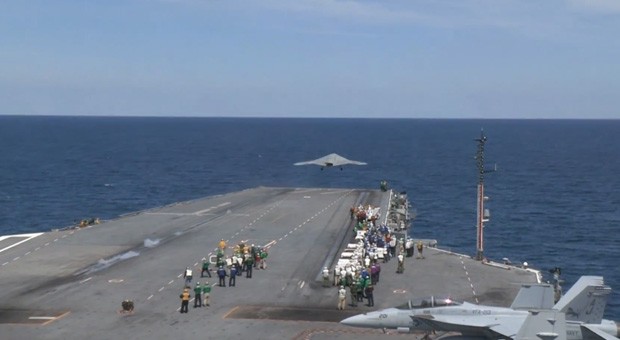
This week's launch of a UCAS demonstrator (X-47B) was a good week for the Navy--a really good week. To the extent that anyone pays attention to what the Navy does these days, this achievement has captured imaginations and has helped to reinforce the notion (fact) that the Navy is indeed moving forward with important technologies even in a time of scarcity. Whether this continues or not is an open question, but for the moment, we all have something to nod approvingly about.
Here's something you don't read often from me--I am going to give the Secretary of the Navy credit for something.
He has made investing in unmanned technologies a priority of his term from day 1. He has set aggressive--yet achievable--goals for integration of unmanned capability into the Carrier Air Wing. He has--through this prioritization--been able to fence off a number of important unmanned initiatives from cuts that some in the Navy would have gladly administered in order to keep their pet programs more fully funded. And while I remain convinced that he has squandered much of his term in the pursuit of side-shows that don't meaningfully contribute to American Seapower, his emphasis on unmanned systems in all domains will be something upon which he can stake a legacy someday.
Bryan McGrath
Thursday, May 16, 2024
A Good Week for Navy
I am a forty-something year-old graduate of the University of Virginia. I spent a career on active duty in the US Navy, including command of a destroyer. During that time, I kept my political views largely to myself. Those days are over.
Tuesday, May 14, 2024
Land Power in the Asia Pacific
Spend a few moments with this piece from Armed Forces Journal entitled "Back to Reality: Why Land Power Trumps in the National Re-balance Toward Asia." Although I am not persuaded that the author makes the case for land power "trump"ing anything, there is a considerable amount of impressive thought here about the role of (U.S.) land power in Asia, and some really insightful thinking about AirSea Battle, conventional deterrence and escalation.
Anyone who thinks conflict with China in the Asia-Pacific will leave out ground forces is mistaken. If such a conflict comes, China will almost certainly seek to extend its defensive perimeter against U.S. power projection forces, and this will almost certainly involve the PLA seizing land from nations with which we have treaty obligations or with which we are increasingly friendly. Land power--and a lot of it--will be needed. But it won't get there unless the Navy and Air Force can create operational seams in the A2AD environment, and it won't survive long without the ability to neutralize PLA advantages in the missile bombardment campaign.
Major Chamberlain also is insightful about the role of land based air and missile defense forces in shaping the operational environment. I was particularly gratified to read his advocacy of increased air and missile defense force structure within the Army TOA. Hopefully this thinking will catch on.
Bryan McGrath
I am a forty-something year-old graduate of the University of Virginia. I spent a career on active duty in the US Navy, including command of a destroyer. During that time, I kept my political views largely to myself. Those days are over.
Sunday, May 12, 2024
LGM Podcast: Canadian Security and Defence Policy
A couple days ago I sat down for an LGM Podcast with Dr. Paul Mitchell of the Canadian Forces College to talk Canadian military and procurement policy. We went on a bit about general issues of Canadian strategy, followed that up with a long discussion of Canada's relationship to the F-35 project, moved on to a discussion of the future of naval aviation, and concluded with a few words about Canadian perspectives on the "Pacific Pivot."
All images courtesy of Wikipedia.
Here's a link to the .mp3 version of this podcast.
I'm an assistant professor at the Patterson School of Diplomacy and International Commerce, University of Kentucky.
Thursday, May 9, 2024
Let's All Emote Together!
For this week's Diplomat column I delve into (gasp!) actual political science:
But what if even the leaders of states don’t know how they’ll react to certain events? A recent International Organization article by Jonathan Mercer investigated the role of emotion in decision-making. Although the theory is somewhat complicated, the argument boils down to the idea that we use our own emotional reactions to events as evidence of our interests and preferences. A classic experiment along these lines involves a coin flip, with heads deciding one course of action and tails the other. By flipping a coin, you determine whether you’re happy or sad about the outcome; accordingly, you know which path you really prefer.
Mercer argues that the leadership of the United States sent costly signals of disinterest in the fate of South Korea, withdrawing all forces and de-emphasizing the possibility of intervention in case of a North Korean attack in 1950. When the attack came, however, U.S. leaders had an unexpected emotional reaction of alarm, which led to concern about how the rest of the world would interpret inaction. As Mercer points out, U.S. policymakers used their own sense of shock and alarm as evidence that the world would see the United States as weak. Consequently, the United States intervened in contravention of its own expectations.Disclosure: Mercer was my dissertation advisor at UW. It's interesting work, and I recommend reading the full article. The focus on emotional response has some fairly interesting implications for decision-making, especially in disputes prone to brinkmanship. The framework also suggests that messaging and prediction are more complicated than we often allow for; as Mercer argues, "Strategy depends on imagining not only how another feels, but how another will feel as a result of one’s policy."
I'm an assistant professor at the Patterson School of Diplomacy and International Commerce, University of Kentucky.
Wednesday, May 8, 2024
Thoughts on Benghazi
The Benghazi hearings are today, and I'll be paying attention. I'm not sure yet if today will turn out to be anything other than a political circus. Time will tell.
Today we are going to learn who is serious and who is a clown. There will be opportunities for both Democrats and Republicans to pick a side. A Democrat today will prove themself a clown if they become overly defensive to the point they push the idea that the Federal government cannot be held accountable for anything. It will be a defensive political reaction on behalf of leaders who are responsible, but may not be holding their agencies accountable. Republicans will identify themselves as clowns if they are simply seeking political blame, because there is nothing productive to find if that is the objective.
Leaders will be the elected politicians who try to figure out what went wrong, and what needs to be fixed.
I have a few theories, but the one specific thing I will be looking for is not new, rather it is a problem that has always existed but has, in my opinion, become worse under Obama. Dan Drezner highlighted this very well just before the election last November.
And that is another reason why unserious politics will be very unwelcome today. Benghazi was the first attack, but with Boston we now have a trend of successful terrorist attacks. Are we learning the right lessons? Are decision makers asking the right questions? Assigning blame to Hillary Clinton or someone else isn't going to help resolve why we have similar breakdowns in both Benghazi and Boston, and if no one in Congress is seeking to address the roots of those issues today, the next successful terrorist attack that kills Americans leaves blood on the hands of Congressmen as far as I am concerned.
I don't want to hear about some State Department dweeb who thinks four SOF guys who were on the other side of Libya when all-hell broke loose, with no situational awareness at all in Benghazi, could have swooped in and saved the day with M-4s. That's not even credible and represents the tactical expertise of a paper pusher in State, even if cable news reports it as if it is some important revelation. The issue isn't what four SOF dudes were doing, it was why NOTHING, NO WHERE, was being staged for contingency. The DoD leaders watched and sat on their hands - HOUR after HOUR after HOUR, knowing Americans were probably being killed. Two of our top Army Generals, one of which is the Chairman of the Joint Chiefs of Staff. It's hard to believe, but that's what happened. Secretary Panetta was taking advice from the top General in the United States military, who was in the same room. It was supposed to be the best advice one could possibly get on a military action like that. Clearly it was not.
I very much would like to know why the COCOM requirement for a ARG in the Mediterranean Sea was being unmet during most of the Arab Spring, including late last year. There is a reason the Marines want 38 amphibious ships, and yet Congress is only willing to fund 33. Only a forward deployed and ready Amphibious Ship with a blue/green team could have produced the necessary intelligence and situational awareness, and fielded at the scene of action a combat ready force to rapidly respond to the attacks on our facilities in Benghazi. That is fact. That is a mission Marines are trained to do, and why we keep ships forward deployed. There was an unmet COCOM requirement for amphibious ships there. DC politicians have to date completely avoided that part of the issue.
So we have CIA security at a State Department facility without any DoD situational awareness whatsoever. Within two months we have the Department of Justice intentionally leaking evidence from an investigation that takes down General Petraeus, the top CIA man. We have Russia telling the CIA that Tamerlan Tsarnaev is a suspected extremist, information that comes not long after Tamerlan Tsarnaev is being examined by the FBI and DHS knows he leaves the country. FBI's investigation at Benghazi is so thorough the very first group of journalists to actually go to the battle location finds all kinds of sensitive information at the scene. Seriously? The agencies aren't talking, and are clearly not working very hard for each other. The agencies are all doing their own thing, and events continue to unfold where Americans are being killed in terrorist attacks - foreign and domestic. We elect leaders to insure taxpayer money is not being wasted. Right now at least 5 federal agencies appear to be completely out of control.
Now lets ask the hardest question of all - is it time to start asking whether this the inter-agency cooperation issue has become much worse as a result of the Bradley Manning effect. We knew there was going to be fallout in information sharing between agencies because of what Bradley Manning did - a member of the Department of Defense stealing accessible data from the Department of State and exposing that sensitive data to the public. Anyone with any experience in the real world knew that was going to come back and hurt the data sharing process, and create friction in inter-agency information sharing capacity. B2B experts know how easy it is to share data - hell most Americans wouldn't believe the kind of data sharing about Americans that takes place in states that do background checks for firearms purchases, but the Bradley Manning effect has created all kinds of hurdles to sharing intelligence information in the federal agencies; an effect one might suggest is integrating into the culture of inter-agency business.
My starting assumption, based on information that I have read to date, is that both Benghazi and Boston represent acts of terrorism that manifested because of communication and cooperation breakdowns between federal agencies, and the reasons for those breakdowns are many - but were influenced in no small part due to the cultural changes in federal agencies insiders and keen observers noticed taking place after Bradley Manning released those diplomatic cables. American people are dieing. Two attacks is a trend. Who is part of the solution, and who is part of the problem?
Benghazi is a tough issue, maybe too difficult and complicated for serious people to score any political points. So today, if it becomes about scoring political points, expect another successful attack. If it becomes a serious issue where political points are scored on accident rather than intentionally, it means suddenly some elected officials decided to be leaders for a change, and do their job.
The result of all of this should, most likely, be a lot of work for the President.

Today we are going to learn who is serious and who is a clown. There will be opportunities for both Democrats and Republicans to pick a side. A Democrat today will prove themself a clown if they become overly defensive to the point they push the idea that the Federal government cannot be held accountable for anything. It will be a defensive political reaction on behalf of leaders who are responsible, but may not be holding their agencies accountable. Republicans will identify themselves as clowns if they are simply seeking political blame, because there is nothing productive to find if that is the objective.
Leaders will be the elected politicians who try to figure out what went wrong, and what needs to be fixed.
I have a few theories, but the one specific thing I will be looking for is not new, rather it is a problem that has always existed but has, in my opinion, become worse under Obama. Dan Drezner highlighted this very well just before the election last November.
the most troubling element of Barack Obama's first-term foreign policy legacy -- his management of the foreign policy process. As my Foreign Policy colleague Rosa Brooks has written about in agonizing detail, the dysfunction that was talked about in Obama's first year in office hasn't disappeared along with Osama bin Laden.That's the key in my opinion, inter-agency cooperation is at an all time low, and it is never really very high. It is not just CIA, State, and the DOD - indeed we have to add DoJ and DHS to the mix, because we saw manifestations where the lack of good inter-agency cooperation allowed one of the terrorists involved in the Boston marathon bombing to slip through the cracks.
Indeed, the aftermath of Benghazi puts this on full display. To be blunt, for all the GOP efforts to make the lack of pre-attack planning an indictment of the White House, consulate security in Benghazi is not the kind of decision that rises to the White House level. The aftermath of the attack is another story, however. In the past 24 hours alone, report after report after report after report shows Obama's foreign policy agencies defending their own turf, leaking to reporters in ways that heighten bureaucratic dysfunction, and revealing the White House's national security team to be vindictive and petty.
And that is another reason why unserious politics will be very unwelcome today. Benghazi was the first attack, but with Boston we now have a trend of successful terrorist attacks. Are we learning the right lessons? Are decision makers asking the right questions? Assigning blame to Hillary Clinton or someone else isn't going to help resolve why we have similar breakdowns in both Benghazi and Boston, and if no one in Congress is seeking to address the roots of those issues today, the next successful terrorist attack that kills Americans leaves blood on the hands of Congressmen as far as I am concerned.
I don't want to hear about some State Department dweeb who thinks four SOF guys who were on the other side of Libya when all-hell broke loose, with no situational awareness at all in Benghazi, could have swooped in and saved the day with M-4s. That's not even credible and represents the tactical expertise of a paper pusher in State, even if cable news reports it as if it is some important revelation. The issue isn't what four SOF dudes were doing, it was why NOTHING, NO WHERE, was being staged for contingency. The DoD leaders watched and sat on their hands - HOUR after HOUR after HOUR, knowing Americans were probably being killed. Two of our top Army Generals, one of which is the Chairman of the Joint Chiefs of Staff. It's hard to believe, but that's what happened. Secretary Panetta was taking advice from the top General in the United States military, who was in the same room. It was supposed to be the best advice one could possibly get on a military action like that. Clearly it was not.
I very much would like to know why the COCOM requirement for a ARG in the Mediterranean Sea was being unmet during most of the Arab Spring, including late last year. There is a reason the Marines want 38 amphibious ships, and yet Congress is only willing to fund 33. Only a forward deployed and ready Amphibious Ship with a blue/green team could have produced the necessary intelligence and situational awareness, and fielded at the scene of action a combat ready force to rapidly respond to the attacks on our facilities in Benghazi. That is fact. That is a mission Marines are trained to do, and why we keep ships forward deployed. There was an unmet COCOM requirement for amphibious ships there. DC politicians have to date completely avoided that part of the issue.
So we have CIA security at a State Department facility without any DoD situational awareness whatsoever. Within two months we have the Department of Justice intentionally leaking evidence from an investigation that takes down General Petraeus, the top CIA man. We have Russia telling the CIA that Tamerlan Tsarnaev is a suspected extremist, information that comes not long after Tamerlan Tsarnaev is being examined by the FBI and DHS knows he leaves the country. FBI's investigation at Benghazi is so thorough the very first group of journalists to actually go to the battle location finds all kinds of sensitive information at the scene. Seriously? The agencies aren't talking, and are clearly not working very hard for each other. The agencies are all doing their own thing, and events continue to unfold where Americans are being killed in terrorist attacks - foreign and domestic. We elect leaders to insure taxpayer money is not being wasted. Right now at least 5 federal agencies appear to be completely out of control.
Now lets ask the hardest question of all - is it time to start asking whether this the inter-agency cooperation issue has become much worse as a result of the Bradley Manning effect. We knew there was going to be fallout in information sharing between agencies because of what Bradley Manning did - a member of the Department of Defense stealing accessible data from the Department of State and exposing that sensitive data to the public. Anyone with any experience in the real world knew that was going to come back and hurt the data sharing process, and create friction in inter-agency information sharing capacity. B2B experts know how easy it is to share data - hell most Americans wouldn't believe the kind of data sharing about Americans that takes place in states that do background checks for firearms purchases, but the Bradley Manning effect has created all kinds of hurdles to sharing intelligence information in the federal agencies; an effect one might suggest is integrating into the culture of inter-agency business.
My starting assumption, based on information that I have read to date, is that both Benghazi and Boston represent acts of terrorism that manifested because of communication and cooperation breakdowns between federal agencies, and the reasons for those breakdowns are many - but were influenced in no small part due to the cultural changes in federal agencies insiders and keen observers noticed taking place after Bradley Manning released those diplomatic cables. American people are dieing. Two attacks is a trend. Who is part of the solution, and who is part of the problem?
Benghazi is a tough issue, maybe too difficult and complicated for serious people to score any political points. So today, if it becomes about scoring political points, expect another successful attack. If it becomes a serious issue where political points are scored on accident rather than intentionally, it means suddenly some elected officials decided to be leaders for a change, and do their job.
The result of all of this should, most likely, be a lot of work for the President.
Subscribe to:
Posts (Atom)