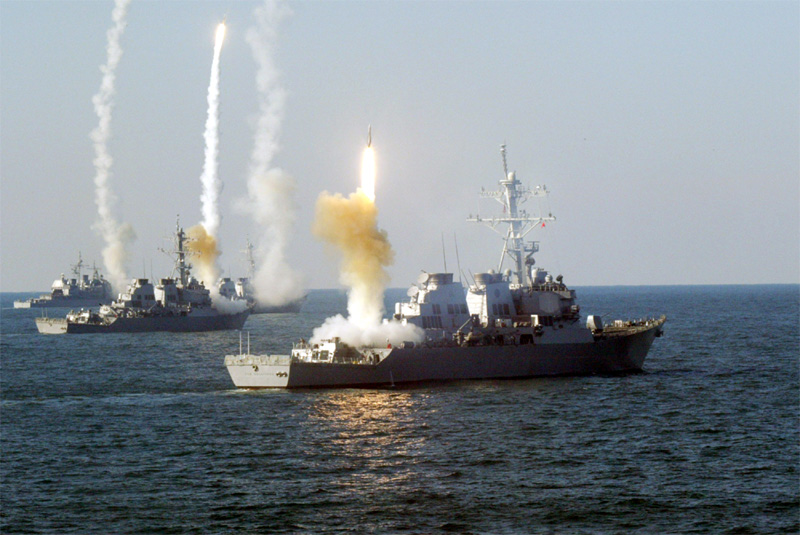
I have intentionally taken a few weeks to think about the recent article by Chris Cavas in Defense News on the memo widely discussed in the media by Vice Admiral Tom Copeman, Commander Naval Surface Forces. The article outlines a lot of different areas for discussion, everything from destroyers to LCS to amphibious ships to MLP to the SLQ-32 to new anti-surface missiles, and what is interesting is that I hear some of the topics in the article isn't even in the memo VADM Copeman sent.
Navy leadership, as a community, doesn't like it much when these type of upper level debates get out through the press. The reality is, Flag officers in the Navy have debates and discussions internally all the time, so it doesn't necessarily mean anything that different Flag officers will promote different ideas in a private discussion and there will be disagreement in those discussions. What does mean something is when the discussion goes public, because that suggests there is a legitimate split in the surface warfare community on what the best way ahead is.
Each topic mentioned in the Defense News article is a unique subject, so I intend to treat each topic as such when discussing. The first big topic is the debate over the way ahead for high end surface combatants. I've been discussing for years the split, which is actually into two main groups and a third minor group. The first main group is the DDG-51 Flight III crowd who prefers to continue the evolution of the existing Arleigh Burke class destroyers because it is suggested to have the least cost risk and can presumably be fielded the fastest. The second main group is the new destroyer crowd who sees the Arleigh Burke class as lacking the growth margin necessary to stay competitive for the next 50-65 years the new ship class would be expected to serve. By 50-65 years I mean a new Flight III built later this decade would be delivered around 2025 and be expected to serve until 2065, and if the Flight III is still being build in 2030 the ship would be fielded in 2035 and serve until 2075 - 62 years from now.
The third crowd, which is small and not really a legitimate option, advocates using the DDG-1000 hull for a new destroyer. Let me be clear, DDG-1000 as a three ship class is great for keeping the industrial base solid and has some great new technologies that will have significant, positive long term impacts to the US Navy, but the hull is not a model for the future. Let the DDG-1000 be a class of three, my bet is long term no one in the Navy will regret having built three ships and no one in the Navy will regret the decision to build no more than three ships.
I'm in the second crowd that believes the Navy needs a new destroyer. As things already are, a Flight IIA DDG-51 built in 2017 is going to be fielded in 2022, and be expected to serve as a relevant capability until 2062, meaning the DDG-51 will serve the US Navy at least 70 years - longer than any other US Navy ship than the USS Constitution. It is possible DDG-51 will still field a relevant combat capability in 2062 when the last of the ships are retiring. It's also unlikely. Those who believe DDG-51 will be relevant must first point to a ship commissioned in 1943 that would be relevant today. The counter argument to that is USS Iowa (BB-61) and USS New Jersey (BB-62) were commissioned in 1943, and both would be relevant today. All I will say is when a piece of equipment is absurdly unaffordable, it is not relevant.
The Navy needs a new surface combatant, and this is my argument why.
SWOs, take this as a compliment. As a community you only really care about what you can see, touch, hold, handle, etc.. yourself. If you don't have it and don't use it, it's a powerpoint slide and you couldn't care less about it. Good quality to have. DDG-1000 is both a blessing and a curse. It is going to be a mess, and will also be fantastic. The electric drive of DDG-1000 is going to change the way the Navy thinks about power on warships, and once SWOs have the capability to use power in a dynamic way, they will never want to be without that capability.
So my first key for the future of surface warfare is the development of a roadmap for electric drive, and DDG-51 Flight X doesn't do that.
The Navy must get operations and maintenance costs down. As much as people bitch and moan about the cost of ships, anyone who actually looks at defense budgets knows that procurement of "stuff" in the Navy budget is not where the future cost growth or the big expenses are. Reducing operations and maintenance costs of new ships is the key to sustaining a fleet large enough to be responsive to the demand signal of politicians leading a superpower. As much as the LCS is hated upon by people, even in profiles where the ship races around the world at high speed with a tanker in tow and has contractor maintenance all over the word, the CBO and Navy numbers both show today that LCS is still less expensive than the current FFGs over the life of the ship, and every LCS that replaces a FFG saves the Navy money - even with additional crew on LCS.
So my second key for the future of surface warfare is the development of a roadmap that reduces the operations, manning, and maintenance costs of large surface combatants over the life of the ship without allowing quality degradation of the ship over time, and DDG-51 Flight X doesn't do that.
Finally, technology is rapidly changing best practices. Admiral Greenert's single most important contribution to the US Navy so far as CNO is to get everyone thinking about the future in a platform/systems context. It's not a new idea to the Navy, see how Spruance/Ticondoroga shared a hull, for example. What is new on top of this concept however is the integrated reliance of CEC, and several of the advances we are seeing in networked ASW sonar tech. Now Navy has Hawkeye 2000, AMDR, AESA radars, new sonar tech, P-8, unmanned sensor capabilities, etc.. all being integrated to enable AEGIS to be a legitimate theater level networked combat capability unlike anything ever fielded before. Modern Surface Warfare executes US political policy in what I call the four primary domains US Policy depends on for Strategic Dominance; Sea, Air, Space, and Cyber. For the air and space picture, getting AMDR right and insuring the ship can support (via power) a radar for the duration of the life of the ship is critical for the future of surface warfare.
So my last key for the future of surface warfare is the development of a hull sized to support power capacity and sensor equipment that will remain relevant to the battlespace environment AEGIS is being fielded in, and DDG-51 Flight X doesn't do that.
To me that means Navy needs a new large surface combatant hull form at between 10,000 - 12,000 tons (not named DDG-1000), and needs a plan to fill the gap of time it will take to develop a new 21st century warship. In my opinion, if the Navy designs the large surface combatant hull form right, the hull should be able to support different variants that field different types of payloads (systems). My thoughts are heavily influenced by the work and opinions of many others, a great source for those who want to understand the primary issues is Navy DDG-51 and DDG-1000 Destroyer Programs: Background and Issues for Congress by Ronald O'Rourke (PDF). Allow me to suggest the bottom 2/3s of Page 41 is required reading for all.
Friday, April 5, 2024
Thursday, April 4, 2024
From the PACOM Playbook to PACOM's Plan B(MD)
![]() |
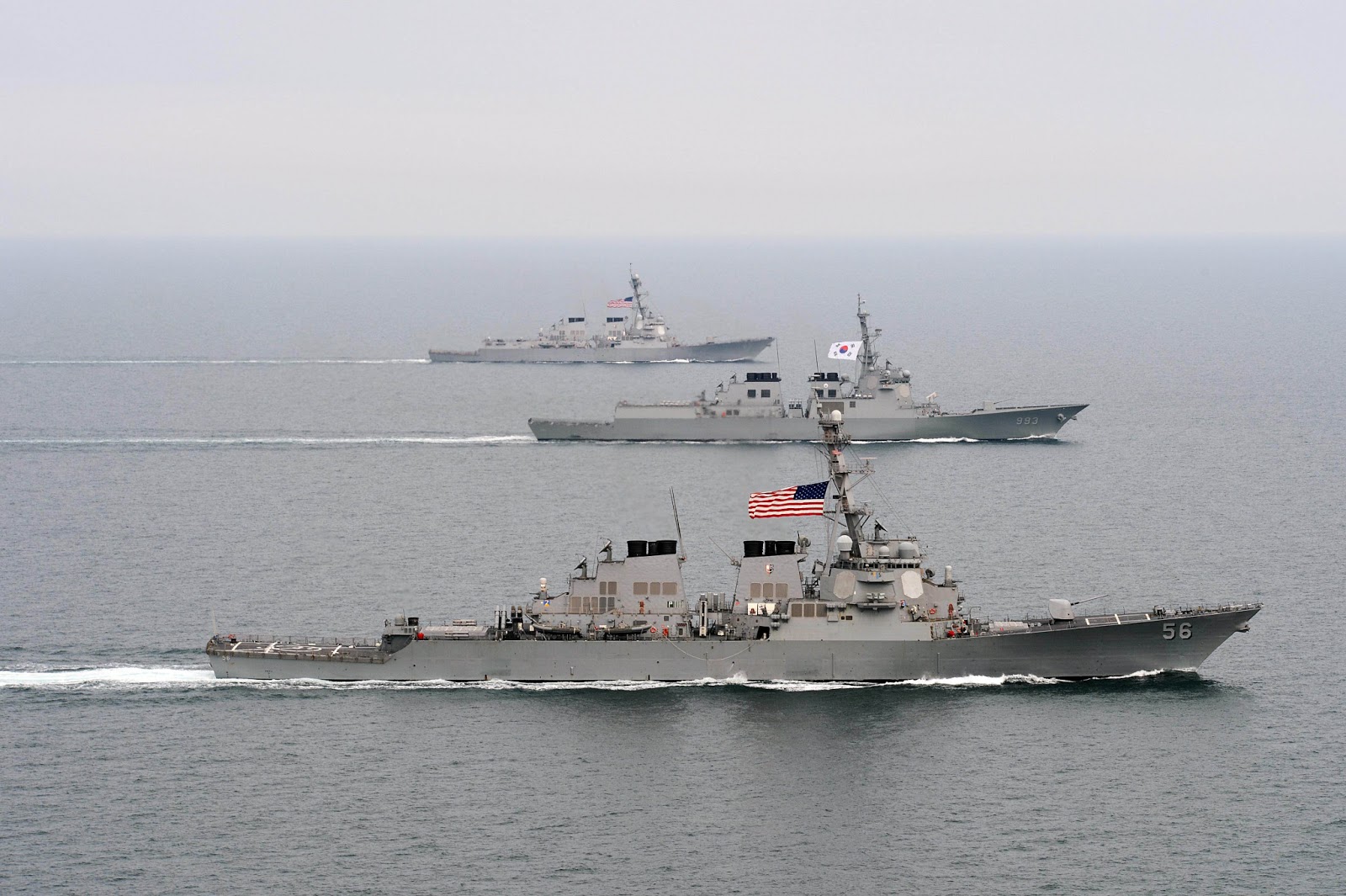
| WATERS TO THE WEST OF THE KOREAN PENINSULA (March 17, 2024) The Arleigh Burke-class guided-missile destroyer USS John S. McCain (DDG 56), front, the Republic of Korea Navy Aegis-class destroyer ROKS Seoae-Yu-Seong-Ryong (DDG 993), middle, and the Arleigh Burke-class guided-missile destroyer USS McCampbell (DDG 85) move into formation during exercise Foal Eagle 2013. McCampbell and McCain are members of Destroyer Squadron 15, forward deployed to Yokosuka, Japan, and are underway to conduct exercise Foal Eagle 2013 with allied nation Republic of Korea in support of regional security and stability of the Asia-Pacific region. (U.S. Navy photo by Mass Communication Specialist 3rd Class Declan Barnes/Released) |
This annual training period in North Korea typically coincides with South Korea and the United States holding their annual Foal Eagle and Key Resolve exercises. For the past few years the pattern has been fairly consistent with North Korea being extra threatening (and feeling extra threatened) and usually a war of words breaks out for about a month or so. Once the US/South Korean military exercises end, North Korea will call for negotiations and take credit for resolving the crisis they manufactured in the first place. Last year when this chess game was over, many in the US had a bad taste in their mouth unhappy with the result, and as a result a lot of thought and planning by PACOM went into this years Foal Eagle 2013 exercises.
Everyone who follows me on Twitter might have noticed about mid-February that I was gearing up for this years annual chess match on the North Korean peninsula. I will never be an Asia expert, but I admit to being fascinated by the North Korean government that has somehow remained completely resilient to any type of external influence for over a half century. In particular North Korea, not China, is a subject I like to raise when talking about geopolitical issues in the Pacific with Admirals and Generals, because with North Korea the biggest threat is the lack of good intelligence.
Earlier this year I was following up with various Admirals and Generals I had met over 2012. As part of those calls I had a long conversation with someone I have gotten to know at PACOM on AirSea Battle and specifically the Pacific region; and more specifically we often discuss North Korea, not China. I was informed that the 2013 Foal Eagle exercise would be something I, in particular, would appreciate because it truly leverages public affairs within the context of both strategic communications and operations; a topic I have frequently written about. I was given no hints as to what this meant, except I was told Secretary Panetta had set aside extra funding for the Air Force for Foal Eagle 2013, and most of the details were already worked out. This conversation took place 2 months ago.
The Playbook
Adam Entous and Julian Barnes at the Wall Street Journal have revealed the US script that has played out over the month of March. Described as the 'Playbook', they detail events in their latest Wall Street Journal article.
The U.S. is putting a pause to what several officials described as a step-by-step plan the Obama administration approved earlier this year, dubbed "the playbook," that laid out the sequence and publicity plans for U.S. shows of force during annual war games with South Korea. The playbook included well-publicized flights in recent weeks near North Korea by nuclear-capable B-52 and stealth B-2 bombers, as well as advanced F-22 warplanes.The Wall Street Journal goes on to detail the Playbook, even describing Secretary Hagel as one of the playbook's chief backers, even though I know for fact the Playbook was actually written by PACOM on Secretary Panetta's watch and with his full support. The article then highlights the meat of the politics.
The U.S. stepped back from the plans this week, as U.S. officials began to worry that the North, which has a small nuclear arsenal and an unpredictable new leader, may be more provoked than the U.S. had intended, the officials said.
"The concern was that we were heightening the prospect of misperceptions on the part of the North Koreans, and that that could lead to miscalculations," a senior administration official said.
The public-relations effort was designed not only to send a message to North Korea, but also to assure a hawkish new government in South Korea that it had full U.S. backing and there was no need for it to respond militarily to the North's provocations.The First Quarter: March
U.S. intelligence agencies assessed the risks associated with the playbook and concluded there was a low probability of a North Korean military response because the regime's top priority has been self-preservation. U.S. officials believe the North understands that taking military action could prompt a devastating U.S. and South Korean counter-strike that could destabilize the regime.
"Everyone is concerned about miscalculation and the outbreak of war. But the sense across the U.S. government is that the North Koreans are not going to wage all-out war," a senior Obama administration official said. "They are interested first and foremost in regime survival."
The U.S. plan was discussed during several high-level White House meetings, according to participants. The effort was backed by Mr. Hagel in one of his first acts as defense secretary. John Kerry, the new secretary of State, supported the Pentagon, as did other top administration officials, according to meeting participants.
In the deliberations, supporters said it was better for the U.S. to control the escalating steps, to ensure the situation didn't spin out of control. In part, according to these officials, the plan was an effort to ensure that South Korea's new government wouldn't feel compelled to respond to North Korean threats, which often emerge at the time of the exercises, as the North conducts its own annual legislative meeting.
But within the administration, some officials voiced concern about unintended consequences of provoking North Korea. Some of these officials questioned the faith the White House and Pentagon placed in the intelligence agencies, which have a mixed record of predicting North Korean behavior.
The intelligence gaps are particularly acute when it comes to reading new North Korean leader Kim Jong Eun, who remains an obscure figure and someone who intelligence agencies themselves have described as potentially more unpredictable than his father.
However, few objections were raised at the highest levels during the meetings, according to participants—unlike in other Obama administration deliberations about using military force abroad, including Libya, Northwest Africa and Syria, that have been marked by protracted debates. President Barack Obama gave the green light to proceed with the playbook, these people said.
The Playbook was intended to function as escalation control by the Obama administration. As someone who jumps online every night at 8pm EST to read the morning news in North Korea, allow me to suggest the Playbook worked better than expected. When North Korea abandoned the Armistice back on March 10, it was clear to observers that North Korea was operating from a script. As I discussed at that time, escalation control was the key to managing the tensions, and I do think the US still maintains escalation control over the situation today, with or without the old Playbook.
As I have observed the US airpower show of force that has visited South Korea over the past month, I found myself in huge admiration for how well the US was playing the game with North Korea in 2013. What headlines that bluster the presence of US military power failed to mention is that every single aircraft that has been flown over South Korea over the past month had been planned many months ago as part of the planning process for the Foal Eagle 2013 exercise. This was never a secret btw, I exchanged emails with a public affairs officer who confirmed this for me right after B-52s made their appearance on March 19. The B-52s, the B-2s, the F-22s, etc... all those flights and activities were planned to appear in Foal Eagle long ago, and there was nothing new or reactionary by the United States taking place as events unfolded throughout March. While bombers and advanced fighters have been involved in previous Foal Eagle exercises, the key distinction this year was the announced use of those platforms.
Unlike previous years, this year the US publicized the presence of B-2s and F-22s through defense public affairs, because otherwise North Korea (or you and I) would never know they were involved in the exercises, even though the actual flights by those aircraft were planned and paid for months ago. So what is new this year? The public affairs piece that mentions their presence and activity, and the PA professionals who were able to mingle those activities into the context of the North Korean rhetoric - so reporters could go write plenty of news stories - is the only thing that is actually different from the US/SK perspective relative to previous years. Talk is cheap, which may explain why our defense public affairs folks are actually pretty good at it when given the green light.
Throughout the entire month of March as North Korea has stepped through their well orchestrated script for escalating tensions in the region, the US has been following a script of their own; a script written long ago for the Foal Eagle exercises and supported fully by the White House. In my opinion, everything North Korea is doing - even through today - is part of their script, and everything we have been doing has been part of our script. The intelligence officials in the WSJ report are right, there is no evidence that North Korea is off script. We do not know what their script is, but there does appear to be broad agreement that North Korea didn't write a script that ends with them being wiped out in a war. Neither script was written in a way that predicted the others actions, and public affairs and the use of media by both North Korea and the US is solely responsible for connecting the activities of the other side.
It would appear that in the end, the actions contained in the North Korean script forced us to abandon our script.
April Fools Day
If the US and North Korea have been playing a game of chicken as each side executed their scripted events in the public sphere, it is now clear that beginning on April Fools Day North Korea won that game of chicken, and the US was the first to flinch.
Every military activity related to the Korean peninsula discussed in the public was part of the script until on Tuesday - for the first time - the narrative being produced by US media was no longer fully incorporated into the Playbook. The retasking of USS Decatur (DDG 73) to head towards North Korea was a new event, and everyone who follows naval power closely knew it. The problem was, PACOM was one ballistic missile defense destroyer short of what was needed to meet demand signal coming from North Korean activities.
While most of the media made a big deal about the USS John S. McCain (DDG 56) being close to the Korean peninsula, the fact is the US Navy has a BMD capable destroyer on that patrol every single day of the year. Without going into too much detail, USS John S. McCain (DDG 56) is on a regular patrol that gives the United States an early warning detection capability should someone in Asia launch a ballistic missile at us. There is an AEGIS warship there 24/7/365 and on leap year day too. As soon as the media started talking about USS John S. McCain (DDG 56) and USS Decatur (DDG 73), neither of which has any attachment to Foal Eagle 2013 or the Playbook, apparently that is when the Obama administration got nervous and pulled back on the Playbook.
But here is the issue: PACOM needed USS Decatur (DDG 73) because there wasn't another BMD ship available. Attention Congress, there is a capacity issue in 7th Fleet for BMD capable destroyers in the Obama administrations 'pivot to Asia' plan, because the Navy fell short one forward deployed BMD capable warship when PACOM came calling in regards to a North Korean crisis.
The challenge PACOM faces is that PACOM believes North Korea is going to be launching a ballistic missile soon, but the difference between this ballistic missile and previous North Korean ballistic missile launches is that this missile has a mobile launching platform. That makes the launch time of the next ballistic missile an unknown, and just as important the launch point for the next ballistic missile an unknown. This combination of unknown time and unknown launch location requires PACOM to cover every threat axis from North Korea in this threat environment, just in case, to insure regional security.
What you have been reading in the press is only partially correct, because there are actually nine US Navy ballistic missile defense capable warships operating throughout the 7th Fleet today, not two or three as has been reported. As we navalists know, AEGIS Ballistic Missile Defense is an integrated network approach to developing a very large regional shield where each ship is both a radar and a shooter, and by integrating other assets in the region, the Navy can track a ballistic missile at launch and potentially develop a firing solution within only a handful of seconds. The more sensors and the better the quality of data, the faster a threat assessment can be made by AEGIS thereby enabling options for response quickly. This process is one that the Navy is well trained for, and in complicated exercises has practiced successfully in actual intercept events that last no longer than 20-30 seconds in practice windows that have spanned days.
While Foal Eagle and the "Playbook" was essentially a strategic communications exercise with North Korea in this environment of higher tension, when PACOM faced a situation where the potential for an actual missile launch in this environment became a legitimate possibility, PACOM has reacted by establishing a regional ballistic missile shield around our partners and bases. This regional ballistic missile defense shield layers around the Japanese ballistic missile defense capabilities, which can be integrated with the US Navy capability through AEGIS.
The US already has an X-Band radar in Japan that can track launches, additional radars in South Korea that can be utilized for launch detection, and nine BMD capable warships that can help track and develop firing solutions for intercepting any ballistic missile threat. Because the area that requires defense from the particular missile North Korea intends to launch is fairly vast, the US Navy ultimately was one ship short to meet the ballistic missile shield demand PACOM needed for full protection. When USS Decatur (DDG 73) was retasked, as a public asset outside the Playbook, political leaders got the impression they had lost escalation control with the Playbook and apparently gave it up. It is somewhat disappointing the Playbook was so rigid it couldn't adapt when inserting a new asset into it's strategic messaging.
Seapower as Strategic Deterrent
Throughout the duration of the cold war, mutually assured destruction is often credited for deterring nuclear war. While the debate over mutually assured destruction still exists today regarding the wisdom of the policy; the bottom line is MAD worked. Ballistic missile defense, in theory, adds a new strategic option for the United States in dealing with nuclear powers like North Korea that have limited capabilities. For the first time in human history, the United States is fielding a fully mature and developed ballistic missile defense shield to protect US allies and territories from an announced threat of nuclear attack.
One of the key strategic differences between ballistic missile defense as a deterrent and mutually assured destruction as a deterrent is that the United States is basically saying the enemy can shoot first, and if the attack is a nuclear attack but is also successfully defended against, then the United States reserves the option of responding without using nuclear weapons. This is a critical point critics of ballistic missile defense apparently don't believe is important, because a successful nuclear attack against US allies or territories requires a nuclear response. The option of not having to respond to a nuclear attack with nuclear weapons is the value of successful ballistic missile defense, and why smart investment and stewardship of ballistic missile defense is in the best interests of the United States.
It has been reported that the deployment of land based interceptors to Alaska is going to cost one billion dollars. That suggests the latest announcement that THAAD interceptors will be deployed to Guam will probably also cost one billion dollars. THAAD interceptors are expensive, and about half the time they even work. Those two land based ballistic missile defense deployments cost as much as a single new AEGIS ballistic missile defense destroyer, and while the AEGIS system is only capable of intercepting ballistic missiles in the very early and final stages of a ballistic missiles flight, the AEGIS BMD system has a much more reliable track record and has been tested under much more realistic conditions, including multiple targets and decoys, unlike the THAAD system. An AEGIS ballistic missile defense destroyer is also mobile, which is why the US Navy will be protecting Guam with an AEGIS ballistic missile defense warship for the next several weeks until the THAAD system can be deployed to Guam.
In theory THAAD is more capable than the AEGIS system because it can intercept at a higher altitude. The problem is THAAD is less reliable than AEGIS, less mature than AEGIS, and more expensive than AEGIS; but for now it is all the US has.
There is another reason why I believe Seapower is important right now as a strategic deterrent. I believe North Korea's creativity is interesting primarily because they are limited by means and are simplistic in method, and sometimes North Korean methods are so simple they appear absurd at first glance. North Korea publicized today that they have "smaller, lighter and diversified" nuclear weapons, which in theory makes some sense because they have only a limited supply of material to make nuclear weapons with. I know it has been something of a running joke for years, but if things go hot I would not be surprised if North Korea tried to deliver a nuclear weapon via a sea mine rather than by missile. North Korea is very skilled in developing sea mines, but not so much when it comes to rocket technologies. The ability to keep North Korea's naval forces from causing any problems is going to be important over the next month in preventing a war. An incident like the sinking of the Cheonan 3 years ago right now could spark a chain of events that leads to Korean War II, but an even worst case scenario is if North Korea was to find a way to sink a US or Japanese warship, because that puts South Korea in the middle of a crossfire.
Halftime Adjustments
While I can understand why PACOM called in the US Navy to build a regional ballistic missile defense shield when it became clear North Korea might launch a ballistic missile from a mobile launcher, I don't understand why the Obama administration threw out the Playbook and then ran off to tell the Wall Street Journal about it. Regardless, someone clearly needs to clue Hagel in on a little secret: Seapower is the winning playbook if the objective is to prevent war.
The ballistic missile defense shield PACOM is setting up is a defensive capability. It is also a very limited piece of the US Navy's capability - indeed it's only a small piece of the surface combatants being used for the ballistic missile defense shield. There are no carriers projecting power into the Yellow Sea, there are no submarines launching missiles, and there are no amphibious ships preparing to send Marines ashore in South Korea.
If North Korea does continue to escalate further, and I believe they will, the Stennis Carrier Strike Group is deployed and is currently in port in Singapore, and the Nimitz Carrier Strike Group is deployed currently off the US west coast heading east. Those two carriers represent 100+ aircraft that can project power as needed in any contingency, and can do so right into downtown Pyonyang if necessary.
And if tensions result in a hot war, those submarines nobody in North Korea can detect will be the first strike that knocks out the Command and Control capabilities of North Korea in the first minutes of hot war.
And if for some reason the US needs to reinforce the South Korean Army, US Marines will be delivered into theater from amphibious ships.
And if, God forbid, a nuclear device goes off in South Korea, the nearby SSBN that no nation on the planet can find today will make sure Pyonyang is melted off the face of the planet.
American Seapower is inherently designed to be an escalation control mechanism for political leaders during a crisis. Seapower is a stabilizing presence capable of preserving peace through projecting strength or providing defensive, and an enabling capability when it is time to deliver the US Army to win a war.
No matter what the Playbook was last week, the winning Playbook for the US going forward dealing with North Korea is Seapower. Military strategists have spent most of the 21st century convincing political leaders in Washington that US military power is best exercised with land power - in Asia of all places, but hopefully with a splash of cold water called the threat of nuclear war, political leaders are waking up to the historical reality that Seapower is how Superpowers manage enduring peace without being intrusive on the sovereignty of partners. Seapower enables nations to enjoy enduring prosperity through maintenance of stability, lines of communication for trade, and security. Seapower is also going to be how PACOM will be managing peace in the Pacific crisis of the present and future, so I hope those involved with Hagel's strategic review are paying attention.
It's only April 4th, Foal Eagle still has 25+ more days. It is going to be a long month with plenty more threatening rhetoric and behavior ahead. Is a ballistic missile launch how this ends? Maybe, but I still believe North Korea desires a limited skirmish of some sort as part of their script, although it could be that the Playbook has actively deterred that potential outcome.
There is a lot of good analysis of the situation in North Korea out there. I highly recommend two sites in particular that may not be part of your regular web readings. The Interpreter Blog at the Australian Lowy Institute is always a great source for analysis of events in the Pacific, and in particular North Korea right now; and just about everything written by Jeffery Lewis these days covers every angle of North Korean nukes and missiles.

Wednesday, April 3, 2024
It's Only a Checkbox
From the Command Inspection of Naval Postgraduate School report by the Naval Inspector General, dated October 22, 2012. The following section begins on page 10 of the report. Highlights by me.
This makes sense to me, because under the law the Secretary of the Navy appoints the heads of the schools and faculty, and the CNO is the resource sponsor who pays the bills. I have no idea how long Ray Mabus intends on staying on as Secretary of the Navy, but if he leaves at any point over the next 4 years my money is on Juan Garcia being the next Secretary of the Navy... and I think it would be a job he has earned btw.
After reading the full IG report on NPS - and it's an eyeopener - I've been thinking a lot more about what education actually means in the US Navy. For example, the NPS Fact Book boasts of 12 PhDs awarded to students in 2011. I've been told that zero of the twelve PhDs that were awarded were to US Navy officers in the unrestricted line. When I inquired what year the last US Navy officer in the unrestricted line was conferred a PhD from NPS, I was told they would get back to me, and of course they never did. I am sure there had to have been at least one US Navy unrestricted line officer to get a PhD at NPS over the past many years, but be aware if you are that one person - you were unmentionable.
I have noticed people don't really want to talk or hear about the topic of higher education in the Navy, for whatever reason. I struggle to find evidence the Navy as an institution actually cares about higher education, and if we look at the trend lines produced both at NPS and NWC, distance education is becoming more important while spending a year thinking about big issues in a setting like NPS and NWC is becoming less important. Said another way, to the Navy advanced education is just another check box on a career path that is nearly entirely determined by a persons checked boxes.
In thinking about Navy higher education i noticed a few things. For example, RADM Ted Carter has been named the Prospective President of the Naval War College. According to his biography RADM Ted Carter is the recipient of the U.S. Navy’s prestigious Vice Admiral James Bond Stockdale Leadership Award, the recipient of the U.S. Navy League’s John Paul Jones Award for Inspirational Leadership, and has even been designated an Honorary Master Chief by the Master Chief Petty Officer of the Navy. His personal decorations include the Defense Superior Service Medal (two awards), Legion of Merit (two awards), Distinguished Flying Cross with Combat V, Bronze Star, Defense Meritorious Service Medal, Air Medal (two with Combat V and five strike flight), Navy and Marine Corps Commendation Medal (two with Combat V), and various service medals and unit awards. By every standard I use to make such judgments, RADM Ted Carter is an American badass in uniform today.
But when you go through and take a close look at RADM Ted Carter's biography, you struggle to find a single reason why he was selected to be the 54th President of the Naval War College, because the Naval War College is a Masters degree granting postgraduate school, and RADM Ted Carter doesn't have a Masters degree. Apparently the only qualification RADM Ted Carter has to be President of the Naval War College is that... he is a native of Rhode Island. By no possible standard can it ever be said that education was an important factor in selecting the 54th President of the Naval War College.
Then I noticed it again. Vice Admiral Miller became the 61st superintendent of the U.S. Naval Academy on Aug. 3, 2010 when VADM Fowler resigned 30 day early under a cloud of controversy related to financial irregularities at the academy as well as multiple honor-code violations by USNA midshipman. Again, using my very sophisticated criteria for making such judgments, Vice Admiral Miller is unquestionably an American badass in uniform. When I read his biography my first question was to ask if any active duty military officer since WWII has done more work with political leaders during a time the nation has been at war than VADM Miller has? Unless my math is off, VADM Miller has almost as much time addressing military politics with civilian leaders as General Marshall did in the 1940s.
But Miller also has a Bronze Star, the Defense Distinguished Service Medal, the Distinguished Service Medal, the Legion of Merit (6 awards), three Air Medals, the Meritorious Service Medal (3 awards), the Joint Service Commendation Medal, the Navy Commendation Medal (2 awards), Navy Achievement Medal and various service and campaign awards. He is recognized for combat operations against Libya in the 1980s, Iraq in the 1990s, and Iraq again in the 2000s. He's a Viking pilot, which makes him either a legend or a myth, plus he worked at N3/N5 - which is where the Navy sends all the smartest officers to work.
And yet, the 61st superintendent of the U.S. Naval Academy doesn't have a Masters Degree, so once again by no possible standard can it ever be said that education was an important factor in selecting VADM Miller as the 61st superintendent of the U.S. Naval Academy.
I do not want anyone to misinterpret what I am saying. Vice Admiral Miller might be a great superintendent of the U.S. Naval Academy, and RADM Ted Carter could turn out to be an outstanding President of the Naval War College; this is not about them as individuals, and focusing on them specifically would be to completely miss the point.
Just as the Navy has a requirement that aviators command aircraft carriers, a Masters degree should be a minimum education requirement to command one of the educational institutions of the US Navy. I don't think that is inappropriate to suggest. As of December 2012 I looked at every single University with a Division I football program (I searched by conference) and from what I could tell, USNA is the only University superintendent or Chancellor/Vice Chancellor equivalent without a Masters degree.
So what is the value of education to the professional US Navy officer? If there is any value at all, and if so, up to what point does value exist? Where is the evidence Navy leadership recognizes or even appreciates that value? The trends that favor distance learning in the US Navy look to me like a budget priority from the resource sponsor, and in my opinion lack of value on higher education sends a clear message what the priority of education is to officers within the Navy.
Budgets are tight, and education is a popular topic when it comes time to trim budgets. In today's Navy the check box that marks completion of mandatory annual political correctness training is more important to a naval officers promotion prospects than any hard work a naval officer commits towards a higher education like a Masters degree. Incentives and priorities should influence our expectations for the final product, so tell me, what exactly do we expect with the current US Navy training/education priorities in the career paths for Navy officers, and how do we translate those priorities into expectations of how Naval leaders are prepared at the strategic and tactical levels on the next naval battlefield?
Academic (didactic instruction) RequirementsAccording to the Navy Times back when the news of IG investigation broke it was reported that Juan Garcia, assistant Navy secretary for manpower and reserve affairs, had been tasked to look into several aspects of the issues raised in Naval Postgraduate School IG report. I am not sure exactly what level of responsibility he has in looking into all of the issues at NPS that are cited in the IG report, but I recently heard that Juan Garcia was looking at all three Navy schools as part of setting a standard for Navy education.
a. NPS delivers graduate master and doctoral degree programs, graduate level certificate programs, and professional development courses. Graduate degree programs include 56 resident degree programs and 18 distance learning programs. NPS offers 38 certificate programs with various delivery formats including resident, distance learning, or combination of resident and distance learning (hybrid delivery). NPS provides various professional development courses that range in duration from a few days to weeks with resident, distance learning, or hybrid delivery including mobile education teams domestically, afloat, and internationally. Professional development courses, referred to as "short courses," are training courses that do not qualify for academic credit.
(1) These various academic programs and courses undergo comprehensive levels of external and internal curriculum reviews. Part of the external curriculum review process occurs through four accrediting bodies: Western Association of Schools and Colleges, Accreditation Board for Engineering and Technology, The Association to Advance Collegiate Schools of Business, and National Association of Schools of Public Affairs and Administration.
(2) Eighty-Four percent of the in-residence degree curricula respond to Navy and Marine Corps sponsors and are subject to a biennial curriculum review process, which establishes and updates the essential skill requirements expected of graduates. Eighty-Nine percent of the distributed learning degree programs and 72% of the NPS certificate programs have DON sponsors and also undergo this curriculum review process. This level of collaborative curriculum review with sponsor involvement allows the curriculum to be responsive to the requirements of DON. An examination of the collaborative curriculum review process found that it is generally an effective process that serves sponsors and NPS appropriately. However, a notable exception is the friction between the Graduate School of Operational and Informational Sciences (GSOIS) and OPNAV N2/N6 who sponsors three GSOIS curricula. The Dean of GSOIS indicated they reached an impasse and temporarily suspended the curriculum review process. The Dean of the Graduate School of Engineering and Applied Sciences indicated it was more difficult than normal, but his school had recently successfully completed curriculum reviews with OPNAV N2/N6 for its sponsored curricula.
RECOMMENDATION
048-12 That NPS develop standard procedures for collaborative curriculum review with sponsors (where there is also a business relationship). The procedure should contain safeguards to ensure sponsors do not compromise fundamental graduate level educational requirements for rigor or length of time of educational programs. NPS should maintain a majority voice in how curriculum is best delivered.
b. NPS conducts internal curriculum reviews through the NPS Review and Assessment Program (RAP) Framework. RAP is an academic measures and metrics program that facilitates comprehensive assessment and improvement of all of the academic programs conducted by NPS. The Western Association of Schools and Colleges visiting team indicated that NPS was a "model for others" for mapping course work for program outcomes (a key component to effective curriculum review). Recent modifications, that include new program reviews, have made the curriculum review process more responsive and transparent which should improve an already solid system of ensuring the education is directly tied to current and future requirements of DON. While the new NPS program process requires both sound academic and business cases for approval, it does not formally solicit approval from DON leadership prior to implementation.
RECOMMENDATION
049-12 That NPS include the Navy’s Education Coordination Council in its new program review process.
c. The effectiveness of the quality of instruction can be captured by these various metrics: establishing a correlation between program outcomes and learning objectives in coursework (part of curriculum review), performance of students in coursework, end of quarter student surveys, alumni surveys, and surveys of sponsors (or supervisors of the students after graduation). Collectively, inspection of these metrics indicated that most students and sponsors/supervisors were satisfied with the effectiveness of the quality of education. However, there were students and faculty who would routinely refer to NPS as "a pump and not a filter." The perception was that all the students will graduate (> 98% graduation rate) regardless of performance and that a student would have to "work at it" to actually fail a course or not graduate.
d. The NPS 2008 Strategic Plan shifted the focus of NPS to become a "naval/defense oriented research university" that also provides graduate education. From 2007 to 2010, total sponsored program (education, research and services) funding doubled and research funding tripled, while mission funding from DON remained static, or declined. This influx of funding and
discussions with faculty indicate that research and reimbursable programs are the first thought of many at NPS. Collectively, with the emphasis of NPS on becoming a top-tiered research institute, and "a pump and not a filter" perception among a significant representation of faculty and students, there are some indicators that NPS is not appropriately focused on educating (didactic teaching of) naval officers.
RECOMMENDATION
050-12 That NPS renew its commitment to educating naval officers in its Strategic Plan.
This makes sense to me, because under the law the Secretary of the Navy appoints the heads of the schools and faculty, and the CNO is the resource sponsor who pays the bills. I have no idea how long Ray Mabus intends on staying on as Secretary of the Navy, but if he leaves at any point over the next 4 years my money is on Juan Garcia being the next Secretary of the Navy... and I think it would be a job he has earned btw.
After reading the full IG report on NPS - and it's an eyeopener - I've been thinking a lot more about what education actually means in the US Navy. For example, the NPS Fact Book boasts of 12 PhDs awarded to students in 2011. I've been told that zero of the twelve PhDs that were awarded were to US Navy officers in the unrestricted line. When I inquired what year the last US Navy officer in the unrestricted line was conferred a PhD from NPS, I was told they would get back to me, and of course they never did. I am sure there had to have been at least one US Navy unrestricted line officer to get a PhD at NPS over the past many years, but be aware if you are that one person - you were unmentionable.
I have noticed people don't really want to talk or hear about the topic of higher education in the Navy, for whatever reason. I struggle to find evidence the Navy as an institution actually cares about higher education, and if we look at the trend lines produced both at NPS and NWC, distance education is becoming more important while spending a year thinking about big issues in a setting like NPS and NWC is becoming less important. Said another way, to the Navy advanced education is just another check box on a career path that is nearly entirely determined by a persons checked boxes.
In thinking about Navy higher education i noticed a few things. For example, RADM Ted Carter has been named the Prospective President of the Naval War College. According to his biography RADM Ted Carter is the recipient of the U.S. Navy’s prestigious Vice Admiral James Bond Stockdale Leadership Award, the recipient of the U.S. Navy League’s John Paul Jones Award for Inspirational Leadership, and has even been designated an Honorary Master Chief by the Master Chief Petty Officer of the Navy. His personal decorations include the Defense Superior Service Medal (two awards), Legion of Merit (two awards), Distinguished Flying Cross with Combat V, Bronze Star, Defense Meritorious Service Medal, Air Medal (two with Combat V and five strike flight), Navy and Marine Corps Commendation Medal (two with Combat V), and various service medals and unit awards. By every standard I use to make such judgments, RADM Ted Carter is an American badass in uniform today.
But when you go through and take a close look at RADM Ted Carter's biography, you struggle to find a single reason why he was selected to be the 54th President of the Naval War College, because the Naval War College is a Masters degree granting postgraduate school, and RADM Ted Carter doesn't have a Masters degree. Apparently the only qualification RADM Ted Carter has to be President of the Naval War College is that... he is a native of Rhode Island. By no possible standard can it ever be said that education was an important factor in selecting the 54th President of the Naval War College.
Then I noticed it again. Vice Admiral Miller became the 61st superintendent of the U.S. Naval Academy on Aug. 3, 2010 when VADM Fowler resigned 30 day early under a cloud of controversy related to financial irregularities at the academy as well as multiple honor-code violations by USNA midshipman. Again, using my very sophisticated criteria for making such judgments, Vice Admiral Miller is unquestionably an American badass in uniform. When I read his biography my first question was to ask if any active duty military officer since WWII has done more work with political leaders during a time the nation has been at war than VADM Miller has? Unless my math is off, VADM Miller has almost as much time addressing military politics with civilian leaders as General Marshall did in the 1940s.
But Miller also has a Bronze Star, the Defense Distinguished Service Medal, the Distinguished Service Medal, the Legion of Merit (6 awards), three Air Medals, the Meritorious Service Medal (3 awards), the Joint Service Commendation Medal, the Navy Commendation Medal (2 awards), Navy Achievement Medal and various service and campaign awards. He is recognized for combat operations against Libya in the 1980s, Iraq in the 1990s, and Iraq again in the 2000s. He's a Viking pilot, which makes him either a legend or a myth, plus he worked at N3/N5 - which is where the Navy sends all the smartest officers to work.
And yet, the 61st superintendent of the U.S. Naval Academy doesn't have a Masters Degree, so once again by no possible standard can it ever be said that education was an important factor in selecting VADM Miller as the 61st superintendent of the U.S. Naval Academy.
I do not want anyone to misinterpret what I am saying. Vice Admiral Miller might be a great superintendent of the U.S. Naval Academy, and RADM Ted Carter could turn out to be an outstanding President of the Naval War College; this is not about them as individuals, and focusing on them specifically would be to completely miss the point.
Just as the Navy has a requirement that aviators command aircraft carriers, a Masters degree should be a minimum education requirement to command one of the educational institutions of the US Navy. I don't think that is inappropriate to suggest. As of December 2012 I looked at every single University with a Division I football program (I searched by conference) and from what I could tell, USNA is the only University superintendent or Chancellor/Vice Chancellor equivalent without a Masters degree.
So what is the value of education to the professional US Navy officer? If there is any value at all, and if so, up to what point does value exist? Where is the evidence Navy leadership recognizes or even appreciates that value? The trends that favor distance learning in the US Navy look to me like a budget priority from the resource sponsor, and in my opinion lack of value on higher education sends a clear message what the priority of education is to officers within the Navy.
Budgets are tight, and education is a popular topic when it comes time to trim budgets. In today's Navy the check box that marks completion of mandatory annual political correctness training is more important to a naval officers promotion prospects than any hard work a naval officer commits towards a higher education like a Masters degree. Incentives and priorities should influence our expectations for the final product, so tell me, what exactly do we expect with the current US Navy training/education priorities in the career paths for Navy officers, and how do we translate those priorities into expectations of how Naval leaders are prepared at the strategic and tactical levels on the next naval battlefield?
Friday, March 29, 2024
What to make of speculated deals for Su-35/Lada?
In the past week,
there have been a lot of speculations regarding a deal where Russia would
export 24 Su-35s and 4 Ladas to China.
Now, there have been official denials from Russian government and sukhoi
has also not put this on their website.
That would indicate this deal is definitely not done yet. I normally would ignore these su-35 rumours
from Russia, but there have been enough support reading through the Chinese
sources for me to think that there are serious discussions for this. In addition, Chinese sources also indicate
that there could also be sale of S-400 and IL-476 as part of a large deal. Obviously, this would be the largest sale
package from China to Russia since probably 2002. I will just look at the individual parts of
the deal and whether they make sense from a Chinese point of view.
Back in 2008 when
the su-35 rumours first came out, it made sense for China to buy 2 or more
regiments of Su-35. As time went on, it
seemed like the domestic flankers produced by SAC have been more or less
satisfactory for PLA. I often read on
Western/Russian news sources about how they are shocked to see Russia is still
willing to sell such an advanced aircraft to China even after China “cloned”
Russian fighters, but those articles really do not seem to have a good grasp on
reality. We know that China has two
“stealth” fighter jet programs under development that will probably achieve IOC
sometimes toward the end of this decade, so it doesn’t make sense for China to
buy and then “copy” a large number of su-35s.
Shenyang AC is actively developing and producing naval and fighter
bomber versions of flankers in J-15 and J-16.
Su-35 is mostly an air superiority aircraft, so it’s not going to help
those projects. At the same time, China
is also not exporting any of its flankers to other countries, so this export
deal will not threaten Russia’s other export markets.
One of the reported
reasons from Chinese side for purchasing Su-35 is the coming end of production
of J-11B. They have requirement for 1
regiment (24 aircraft) of air superiority version of flankers before the more
advanced 5th generation fighters can enter service. While that is possible, I think su-35 will
create a logistical problem in the future like the Sov destroyers with the
Chinese navy. They will need to maintain
a new type of aircraft, a new engine, a new generation of Russian avionics and
Russian missiles. That would seem to be
a lot of trouble for just one regiment.
That would lead to my conclusion that they are purchasing this strictly
to get their hands on the 117S engine.
Russia made it clear to China early on that they would only be willing
to sell 117S to China as part of a Su-35 order.
I think 24 is probably the minimum number of Su-35s that Russia would be
willing to sell to China to allow Chinese access to 117S engine. China does have the largest MRO plant for
AL-31F outside of Russia. All
maintenance work for AL-31 is done inside China. I would assume 117S maintenance and life
extension work would also be done there.
Despite improvements in the reliability of WS-10A, I still read about
problems found in deployment. If there
is one problem that can cause real delay in J-20, it would be not having a reliable
engine solution in its development and early deployment. 117S would also be possible options for J-10
and J-15/16 projects. If China does
choose to purchase Su-35s, access to 117S engine would be the primary motivation. And Russia would benefit by exporting su-35
and possibly large numbers of 117S engine later.
The deal for 4 Lada
submarines is more interesting. Many
PLAN followers have asked why China would be interested in purchasing so many
units of a submarine that Russia has not even accepted into its own service
(its AIP system is not going to be ready until later). Typically, China chooses to only purchase
mature systems that it can quickly induct into service. On top of that, it seems to some that Chinese
submarines seem to have reached the technology levels of their Russian
counterpart with that mysterious new conventional submarine in 2011. The reality is that Chinese submarines still
have a way to go in stealth.
As part of this
deal, China will be getting transfer of technology along with local production
for 2 of the 4 submarines. On top of that,
some unreported Chinese subsystems will be going onto these submarines. So, the question is what is China providing
as part of this submarine and what is it interested in? The currently mass produced 039B submarine
are already equipped with AIP system that can be installed on the Chinese
version of Lada submarine. On top of
that, China could install its own sonar system and combat systems onto
Lada. The latter part should not be surprising
since China has also installed its own sonar on kilo submarines. What China seeks as part of this deal is the
Russian’s design of Lada submarine and its noise insulation technology. From Lada, China could learn how to design
and build a single hull submarine with conformal sonar. If we look at China’s new submarine that came
out in 2011, it seemed to adapt numerous features from Lada submarine. This submarine is supposedly one of a kind
built to replace the old Gulf class ballistic missile test bed. It is probably too large and expensive to be
mass produced. Based on their experience
from this submarine and Lada project, it’s quite possible that China’s next
series of submarine would look somewhere in between (possibly single hull) and
have many of the features currently on Lada class. Russia also has a lot to gain here, because
it needs a new submarine for export to replace kilo. Regardless of whether Russia chooses to use
any Chinese subsystems for Lada in the future, Chinese involvement in this
project will ensure that the export version of Lada becomes fully developed and
commercially viable.
So while I’ve read
numerous panic articles online about how this deal will significantly improve
China’s capabilities and shift the cross strait balance of power even more
toward China’s favour, I think those articles really show very little appreciation
of China’s current military industrial complex.
While these purchases will help and speed up PLA development, they are
by no means game changers. However,
these purchases will improve ties between the two countries at a time where
Russia constantly complains about the trade imbalance.
Thursday, March 28, 2024
Context Reveals a Reckless CVN CO Got His Revenge
This New York Times article is incredible. A lot of people are talking. Read it all.
Comment:
No one in the Navy can survive a five month investigation, so whenever that happens the officer being investigated is going to get hit hard. Doesn't matter who it is. The SECNAV will have the last word on this, so I'll wait to see what the ultimate conclusion is. And yeah, FOIA will tell all, because everyone and there mother wants to know if the Navy is jumping the shark with all these firings. Is the Navy upholding a high standard for leadership, or an unrealistic standard and simply using the firing of COs for PR purposes now? Time will tell.
Be warned, the "racially insensitive remarks" are not going to be what you think it is, unless you get offended when a strike group commander is encouraging the 5000 person crew of an aircraft carrier to be vigilant and intelligent when protecting the ship from the beeping beep Iranian mother beepers. The context is going to be interesting, and it will be very interesting to see how Ray Mabus sees this.
Here is what is really fascinating to me though. The New York Times just told the American people that the CO of the only CVN in the 7th Fleet today is a vengeful, reckless asshat. As outlined by the New York Times, the CO is so reckless that he will "fly" a 100,000 ton nuclear reactor waving the US flag through the most congested sea lanes in the world, and when the CO was called out for his reckless behavior at the time it was occurring, the CO reacted by getting his superior shipped off the CVN through the IG process, and ultimately ruined the career of the Admiral with a FIVE MONTH IG investigation - an investigation which no one of any rank in the Navy can possibly survive. When process is weighed with result, the IG process is looking less credible, and when the CO is still in command the Navy loses credibility.
The aspect of the New York Times story related to the CO is shocking when everything is examined in context. The behavior demonstrated by the CO is dangerous. It is poison to the institution when commanding officers must be that cautious when witnessing incredibly dangerous behavior, deadly behavior even.
Kirby may think he doesn't need to comment on the IG report, but when the New York Times undermines the CO of a deployed aircraft carrier in a way that tells a very specific and detailed story of a CO on a power trip, that issue cannot simply be ignored. I find it incredible that the Navy has looked the other way on the CO here, because this is clearly not an issue of a whistle-blower, this is an issue of a CO abusing professional processes for purposes of person revenge being told to America through the New York Times.
Subscribe to:
Posts (Atom)