Tuesday, January 29, 2024

Arguing for Submarines, The Advanced Course

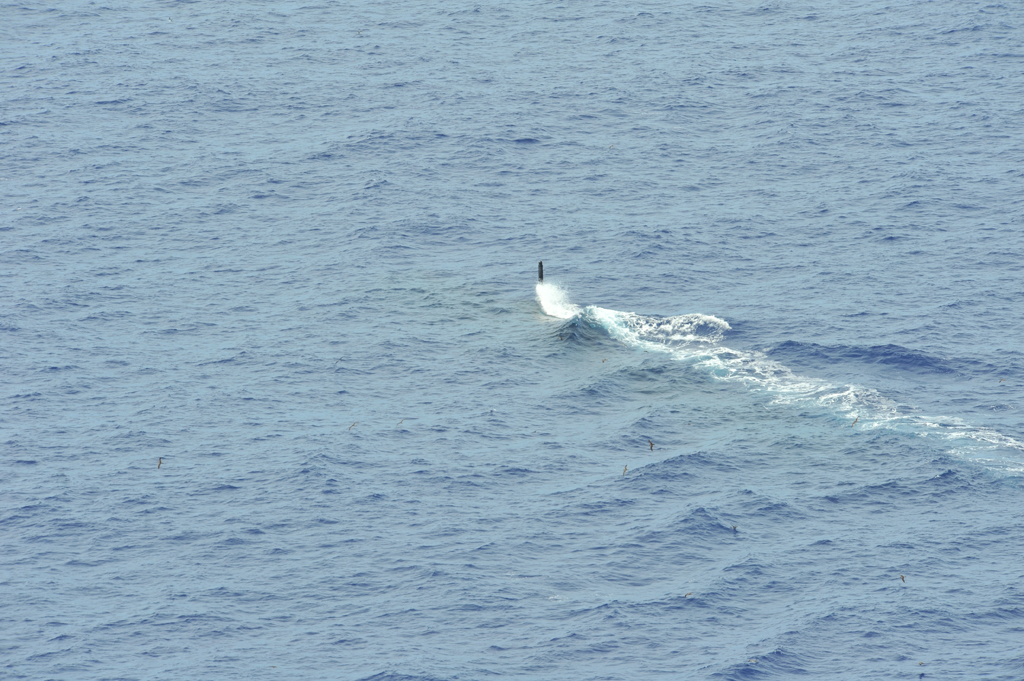
The Periscope of HMAS Farncomb, on the Pacific Missile Range Facility (PMRF) off Hawaii, moments after a successful Sink Exercise (SINKEX) at RIMPAC 2012. HMAS Farncomb fired a Mark 48 Torpedo into the hull of former US Navy Ship Kilauea striking the ship below the bridge. The hulk broke in two and sank. Mid caption: Australia is one of 22 nations attending RIMPAC that includes six submarines, 40 surface ships and an aircraft carrier participating in a realistic maritime warfare scenario. Australian soldiers from 1 RAR are also participating in the amphibious aspect of the exercise, alongside US Marines. RAAF AP-3C Orions and a Wedgetail are also providing air support. Link
Submarines and Maritime Strategy - part 1. When was the last time you read an argument for submarines like that from a US Navy officer of any rank in the context of maritime strategy?

No seriously, that wasn't a rhetorical question, I'm curious when the last time was and what the article was, so I can go read it.

That's a pretty impressive post Justin. I actually sympathize with Nic Stuart, because I have made some arguments on this blog more than a few times that resulted in a Navy Captain response that made me feel really foolish. If Nic didn't feel that way after your post, he may need to read it again.

Monday, January 28, 2024

Budget Thoughts

I don't really want to get too deep into the budget discussion yet because a memo (PDF) and a PowerPoint (PDF) isn't exactly a plan. I have only a few initial thoughts.

The memo and the PowerPoint were both written with the expectation they would leak to the media. This sets the expectation moving forward that everything will unfold in public.

The CNOs PowerPoint that breaks out State by State impact is written like one would write a highly political document. All indications are the Navy put the document together, but it very much looks like the White House is coordinating everything. Whether this is a good or bad thing is subject to interpretation.

The evil here is not sequestration, it is the Continuing Resolution. Even if OSD canceled the Joint Strike Fighter tomorrow, the Navy could not move money around from that program to any other budget to make up for any specific budget shortfalls, because the Continuing Resolution that is the current budget the Navy is operating under prevents exactly that type of big decision making or movement of money around the budget. The CR is probably written that way so that no politicians pet project gets canceled. The Continuing Resolution is the posterchild of bad governance.

Both political parties own sequestration, but in my opinion Democrats own more of it than Republicans since Democrats have not yet produced a single alternative to sequestration. Sequestration has not happened yet though, so right now Democrats simply own something that may or may not happen.

Both political parties own the Continuing Resolution, but in my opinion Republicans own more of it than Democrats and as of right now it is the current law. While it is true the Senate has not passed a budget in the lifetime of every child that will enter kindergarten this fall, the details of the Continuing Resolution have not been an important issue for Republicans who have been dead set in protecting industry interests over DoD interests. There are opinions out there that the Continuing Resolution is another example of how weak the leadership of Buck McKeon is as Chairman of the House Armed Services Committee and he has basically thrown the DoD off the boat in support of the House leaders priorities. It was noteworthy Defense News didn't name Buck McKeon to the top 100 individuals in Defense.

Either way, the Continuing Resolution prevents the services from preparing for sequestration because it prevents any significant movement of money inside the budget. The worst case scenario is a year long Continuing Resolution, and if combined with sequestration the damage will be much more significant than just sequestration.

All we can really say with certainty is that the Republican Party has changed over the last four years, and the CR and sequestration have revealed for anyone paying attention that the Republican Party is no longer the political party that represents the DoD as has traditionally been the case in American politics, although with the Continuing Resolution written as is today, the Republicans party is still very much the political party of the defense industry.

Regardless of the partisan politics, it is going to be a very difficult year for defense. A smaller budget for defense is not a bad thing by itself, indeed I believe the DoD budget is too high and taxpayer money is wasted today in defense spending absent strategy. It is my opinion the clear and present danger to the defense of the United States is not less money for defense, but poor governance by elected officials in the management of less money for defense.

As of right now, poor governance by elected officials in the management of less money for defense is exactly what is going on with the Continuing Resolution, and regardless of who folks believe is to blame politically, both political parties own some responsibility and deserve criticism for the way the DoD budget is being managed. It will be interesting to see how things unfold over the next several weeks, because with the White House apparently involved in the response process by the DoD, it could get pretty ugly.... indeed very politically ugly particularly when it becomes time for new political appointments and the administration likely has fewer extremely smart and well respected non-partisan experts carrying their water.

I have a theory that because Bob Work has been Undersecretary of the Navy that both the Obama Administration and the Navy has avoided a lot of public criticism from the greater naval community, which unlike the public think tank communities of the other services (particularly Army) who think tactically and primarily in terms of money/programs, naval thinkers tend to think about big picture strategy and foreign policy and historically have written criticisms that can come off the press with politically damaging blows to the confidence in political leaders (indeed George Bush took several hits from 2005-2008 from the naval centric community that were so devastating they land on John McCain as a second order of effect). Everything I am seeing from Obama's second term appears to be right out of the Jimmy Carter playbook for DoD management, starting with a politico heavy appointment list absent any truly respected defense expertise. History says that kind of poor governance will catch up with the Democratic Party in 2016.

I tend to believe that when Bob Work leaves in May(ish) (and I believe the absence of Hillary Clinton at Department of State will result in a similar effect), not too long after it is going to get ugly as the really smart people start to unload on the Foreign Policy and Defense establishment after holding fire for four years, and I won't be surprised at all if it is through those broadsides that a Republican Party foreign policy is reborn over the next 4 years. It really surprises me the Obama administration doesn't intend to appoint Bob Work to be SECNAV, because usually those guys are pretty smart about keeping the their opponents off guard. It is my opinion the Navy has been living in 4 years of the Bob Work Effect, which has basically provided a buffer effect from the really sharp criticisms from nearly every serious defense person in DC regardless of political affiliation. My sense is the Ray Mabus Effect is simply not going to get it done for the Administration, and in all likelihood neither will the Chuck Hagel Effect or the John Kerry Effect.

Now think about the future of defense - a bunch of politico type appointments with very few highly respected experts or elder statesmen, a year long continuing resolution, sequestration or budget cuts of similar size, and the current partisan political environment. I'm thinking the next four years are going to look and sound like a train wreck in slow motion for the DoD.

And yet I am still glass half full...

Navy is Thinking Outside the Box on LX(R)

Found this from January 16, 2013. Very interesting.
The Navy is interested in concepts for improving future amphibious ship affordability while still retaining warship capabilities. One approach towards this goal might be to use commercial design and build practice for as much of the ship as possible, and apply military standards only where necessary to achieve specific performance requirements. The Navy would like Industry perspectives on potential benefits and challenges to implementing such a concept. Specifically, the Navy requests information on:

o The feasibility and cost of building a Navy ship to commercial standards (as opposed to military standards), classed by ABS to Steel Vessel Rules (www.eagle.org), with the following capacities:

o 20,000 ft2 (1,860 m2) vehicle stowage space, with access to both well and weather decks, and with at least 13.5 ft (4.1 m) clear overhead

o Well deck capable of embarking either two Landing Craft, Air Cushion (LCAC) or one Landing Craft Utility (LCU)

o Troop berthing for 400

o 20,000 ft3 (570m3) magazine capable of stowing all types of USMC ammunition

o NAVAIR certified flight deck with two land/launch spots for MH-53E or MV-22 aircraft

o The feasibility and cost of imposing the following additional design requirements on the above concept:

o US Navy crew (approximately 350), with Navy standard damage control lockers & equipment

o US Navy combatant damaged stability standards

o Longitudinal bending moment dictated by Navy rather than being derived from seaway loads or ABS rules

o Grade A shock qualified emergency take-home auxiliary propulsion system

o Grade A shock qualified command and control spaces for government furnished electronic systems

o Segregated Grade A shock qualified Navy standard electrical, cooling water, and other distributive systems to service take-home auxiliary propulsion and other vital systems.

For the purpose of this RFI, assume that half of distributive system loads are to vital systems.

o US Navy firefighting systems

o The practicality of implementing a mixed commercial and military standards ship by designating certain compartments as reserved for military standard equipment, with the shipbuilder free to outfit all other compartments in the most cost effective manner that satisfies ABS Steel Vessel Rules.

o Labor and material breakdowns for any ship costs estimates.

o Explanations for how specific potential future amphibious ship requirements would affect costs.

o Contractual, specification, or other issues that might impact a mixed commercial and military standards ship program.

o Other ideas or suggestions for future amphibious ship affordability such as acquisition strategies, innovative total ship solutions, technology advancements, or design and construction concepts/methodologies.

It is desirable that data be received with unlimited rights to the Government.

Nevertheless, we recognize that proprietary data may be included with the information provided. If so, clearly mark such proprietary information and clearly separate it from the unrestricted information as an addendum.
I've highlighted the pieces I think are highly relevant here. The money for LX(R) is not going to change. It is $1.3 billion. If your budget is finite, as it is for this program, how can the Navy maneuver within a fixed budget?

Well, if I am reading this solicitation for information correctly, one way would be to trade some of the survivability of the ship for more survivability on shore. By that I mean it looks like someone is looking into what it might mean if some areas of the ship were built to a commercial (I read as below NVR) specification as a way of saving money and using those savings to add more options to the capability of the vessel in support of LX(R) features that help meet more aspects of the requirements stated by all parties.

This is a clever solicitation designed to encourage clever ideas.

Friday, January 25, 2024

Crowd-sourcing Future Fleet Designs

The Navy is rapidly headed for fiscal shoal waters where tough decisions will need to be made, with perhaps the design of tomorrow's fleet being the most important. The combination of unsustainable O&M expenditures and deployment tempo, a broken acquisition bureaucracy, indeterminate strategic futures, declining manning levels, and a ground swell of deferred maintenance creates an extremely complex environment in which to plan a future fleet. In an effort to expand the dialogue of this important issue beyond the inner circles of OPNAV, the Beltway Bandits, and think tanks, here's another experiment in crowd-sourcing. Below, American taxpayers, our international colleagues (including likely a few adversaries), and other random readers can have a chance to vote on some alternative U.S. Navy fleet compositions. Please choose one of the above options* and feel free to discuss your rationale in the comments below. I've purposely kept the options a bit vague and open for interpretation to promote discussion. Unfortunately, limitations in polling (and my tech skills) prohibit more than one vote, but feel free to log in and cast a second vote in this completely unscientific poll if you think there is some combination of the above that is preferred. As I've done in the past here, at a future date, I'll provide a summary of the best responses in the comments.

For full disclosure, my votes will be cast for smaller, more distributed and affordable ships, and a move towards more naval unmanned systems. But don't let that sway you... Spread the word here.

*Tech notes: If your browser is having trouble with the voting widget, hit the refresh button.  Hit the red x to close the little ad banner.

The opinions and views expressed in this post are those of the author alone and are presented in his personal capacity. They do not necessarily represent the views of U.S. Department of Defense, the US Navy, or any other agency.

Wednesday, January 23, 2024

USS Monsoon Griffin Test

The Navy just released an interesting video of Raytheon's Griffin missile testing from USS Monsoon (PC-4) off VACAPES last month.   Although relatively short-range (about 5km), Griffin brings some much-needed offensive firepower to the PCs.  The $45k a pop Griffin has proliferated in the U.S. military in the past few years, with roll-on installations on Marine Corps C-130s and other aircraft.  Monsoon's testing also represented a successful demonstration of laser designation and targeting at sea (albeit on a clear day). The dual quad-pack Griffin set up onboard Monsoon is very compact and lends itself to installation onboard even smaller vessels such as the MK VI.
 
The Patrol Coastal Griffin Missile System, the addition of remotely-operated MK 38 MOD 2 25mm chain guns onboard other combatants, and a few other programs are part of the Navy's rapid deployment efforts to counter the fast inshore attack craft/fast attack craft swarm threat.