The Congressional Research Service recently produced a document that provides a fairly comprehensive and accurate overview of the past several years of Navy involvement in IW and CT. Also included are pertinent sections of the FY13 NDAA and appropriations acts. Most interesting, however, are the additional oversight questions, especially this one: "How many Navy personnel globally are involved in IW and CT activities, and where are they located? How much funding is the Navy expending each year on such activities?"
The answer to that question would likely surprise most observers if provided in terms of man-days and ship-days dedicated to these operations. Many in OPNAV - including individuals in the IW Office - have argued that large multi-purpose combatants can adequately support IW and therefore specialized platforms, especially smaller less expensive ships, aren't required. There is truth that larger CRUDES and Amphibs are adequate for most of these missions. But what this argument misses is the fact that naval vessels engaged in supporting IW operations often get tied down for extended periods of time and aren't necessarily immediately available to prepare for or respond to major contingency operations. And one only has to look at recent record deployment lengths and deferred maintenance to understand that we simply don't have enough ships to meet current COCOM demands. Because these missions aren't going away anytime soon, the Navy should increase emphasis on acquiring additional platforms specialized for IW in order to free up higher end platforms for conventional missions. There are numerous reasons for acquiring smaller, cheaper, more numerous platforms to complement the Ferraris in today's fleet. In the long run, this move will save wear and tear on major combatants and provide vessels that are more optimized for the missions at hand.
The opinions and views expressed in this post are those of the author alone and are presented in his personal capacity. They do not necessarily represent the views of U.S. Department of Defense, the US Navy, or any other agency.

Thursday, September 6, 2024

Wednesday, September 5, 2024
Libertarians and National Defense
WARNING: This blog post will explore matters of a political nature. If you are offended by political speech (or by political speech with which you disagree), please skip this post.
Dr. Chris Preble of the Cato Institute was good enough to publicize this latest bit of his on Twitter this morning, which is how it came to my attention. Preble--as many of you know--is a leading advocate of what I tend to view as a neo-isolationist strain of Offshore Balancing. Bright and seemingly logical, Preble lays out his arguments in a straightforward manner. Without examination of the underlying assumptions, his views appear responsible, even sometimes preferable. When exposed to deeper inquiry however, they shoal upon the rocks of isolationism and an inability to explain why a less secure world is preferable to a more secure world.
Libertarianism strikes me (and others) as a fine bit of political ideology when alloyed with other ideologies. Their preference for dramatically limited government helps pull Conservatives to the right, and the preference for removal of government from the private sphere appeals to many Liberals seeking to advance social policies. Unalloyed however, Libertarianism is a quaint, interesting, and ultimately unsuitable approach to governing a modern Republic, especially a world power.
In his Foreign Policy post this morning, Preble aims his guns at both political parties and their Presidential candidates, though he is particularly disappointed in Governor Romney's approach (reminder: I am an active and enthusiastic supporter of Romney for President), primarily because it moves the country and the defense budget in directions anathema to Preble's world view. As is my custom, I will address individual statements and ideas from his post.
"The Republican Party has become a hallmark of inconsistency. The GOP claims to be committed to small government and fiscal discipline, yet advocates huge increases in military spending."
Straw-man: Preble conveniently forgets the sizable portion of the GOP that continues to believe in an active role for the U.S. in world affairs, and that such a role leaves the U.S. ultimately in a safer position. He seems to believe that the GOP can be pigeon-holed into a small government, fiscally disciplined, small/defend the homeland military--but that isn't the GOP--that is Preble.
"The key to turning around the American economy, they say, is to free up resources in the private sector, cut taxes, and shrink the size of government -- excepting, of course, the Pentagon. "
A strong national defense and a leading role in the world are not inconsistent with freeing up resources in the private sector, cutting taxes and shrinking the size of government. Preble conveniently ignores the salutary impact of the former three actions on promoting growth in an economy, all of which generally are supported by Libertarians. Reverse America's economic decline, grow the economy, limit federal expenditures to 20% of GDP, rein in entitlements and the money will be there for a strong national defense.
"The party that opposes nearly all other forms of federal spending happily embraces the military variety."
Really? I've been a Republican for nearly three decades, and I've never thought or been in a room where the prevailing opinion was that "all other forms of federal spending" should be opposed. Indeed, such a view is more likely to be heard at Cato HQ than in a meeting of Republicans. Yet another Straw-man.
"Republican candidate Mitt Romney accuses Obama of fostering a "culture of dependency" in the United States, yet ignores that U.S. security guarantees have created an entire class of affluent countries around the world that now rely upon U.S. tax dollars to pay for their defense."
Again--straw-man. Mitt Romney and the Republican Party are not advocating eliminating the programs upon which the culture of dependency has thrived, but reforming them in a way that the truly deserving can be served without continuing and exacerbating the nation's slide into insolvency. Preble's approach internationally is to abrogate treaties, bring home the troops, and have the Navy (a greatly reduced Navy) postured off of San Diego and Norfolk awaiting continental invasion. A domestic policy version of Preble's approach to international power would not be one of reform, but of destruction.
Additionally, Preble ignores the great value the U.S. had gained in terms of security as a result of its role as the leader of the free world, one that has indeed incentivized friends and allies to spend less on defense, but one that has also underwritten a period of stability and peace that is unparalleled in modern human history. The resources spent on a web of alliances in Europe and Asia have arguably contributed to peace and stability in areas in which the study of the past would suggest the absence of such qualities.
"His (Obama's) reasoning is straightforward: He wants Republicans to agree to tax increases to offset the extra Pentagon spending. It is a clever ploy that highlights the inconsistency and confusion within GOP ranks. Some Republicans are open to tax increases to pay for an even-larger military, but Romney is not. It isn't clear, however, how he would pay for his promised increases, which exceed the president's plans by at least $1.7 trillion over the next decade."
Inconsistency and confusion? Because some in the Party are open to tax increases? This strikes me as cherry-picking to the nth degree. Of course, some in the Party are open to tax increases. Some in the Democratic Party are dead set against them. The prevailing views within the Party are what is important, and on this front, Republicans are consistent--a lack of revenue is not our problem. Too much spending and too little growth are the problems. As to Preble's charge that it isn't clear how Romney would pay for his promised increases, one wonders how clear Preble needs things to be to be satisfied. Romney's already aiming at federal spending at 20% of GDP which should EXCITE a Libertarian. Clearly this means cuts in domestic programs. Lots of them. AND it means executing policies designed to GROW the economy. Because domestic programs will be cut does not mean EVERY domestic program will be cut, and the Constitutionally mandated requirements for national defense will get a more privileged position toward the front of the funding line. If Preble's complaint is that he wants meticulous detail, then he is tilting at windmills. President Obama ran a brilliant campaign in 2008 that was short on specifics but long on "I'm not George Bush". Getting elected President in this country remains a race to alienate the fewest while motivating the largest.
"Republicans could reasonably claim that military spending should get a pass because the Constitution clearly stipulates a federal role in defending the country. But nowhere is it written that Americans must provide security for others; that is the job of their governments, not America's."
Republicans can and do point to the Constitutionally mandated federal role in national defense. The suggestion that doing so should consist solely of minding our own knitting is simplistic and irresponsible in a world of ballistic missiles, terrorism, and rising powers. Preble would have us believe that we should pull back from the world and allow new security balances to emerge, ones in which we are less crucial to their maintenance. He does not suggest what our actions should be should a balance emerge inimical to our national security interests, but he does consistently describe force structures and postures that would be powerless to reverse such an outcome. Nor does he address what is to my mind, the crucial question neo-isolationists must answer, and that is "what is your evidence that a world resulting from from your approach to American power would be MORE stable and MORE favorable to American interests than the world we've enjoyed, underwritten by our military power, for the past seven decades?"
"Indeed, the Republicans' reflexive commitment to more military spending is particularly curious given their appreciation for how incentives work in the domestic sphere. Republicans know quite well that people are not inclined to pay for things that others will provide for them. GOP leaders speak often of moral hazards -- when individuals or businesses behave irresponsibly because others are there to bail them out. The same problem exists in international politics, but is strangely ignored in the GOP's plan to continue policing the world."
Republicans are also sophisticated enough to recognize the differences in the public and the private spheres, and the differences between the incentives of business and the incentives of international relations. Preble ignores the completely rational--and ultimately counter to U.S. interests--potential decision of friends and allies to cast their lot with a regional power in response to the vacuum created by a U.S. pullout. It is just as easy to turn to (insert the rising power) to provide regional stability while protecting bloated welfare states as it is to turn to us. Why Preble thinks such a state of events is preferred is beyond my ken.
Preble is right in asserting that certain nations should be called to account for anemic contributions to their own defense; this is the stuff of persistent and nuanced diplomacy, diplomacy that recognizes the domestic challenges faced by the leaders of these countries. It is not properly pursued by unilateral withdrawls and public shaming.
It's not easy being a Libertarian. Your ideas are often respected but rarely implemented. Allies are sought wherever available, creating fleeting alliances with politicians as different as Tom Coburn and Barney Frank. Polls are seized upon that demonstrate the willingness of the American people to cut defense spending, but rarely is there any discussion with those polled of what the possible consequences could be and the status of the United States that would result.
Bryan McGrath
Dr. Chris Preble of the Cato Institute was good enough to publicize this latest bit of his on Twitter this morning, which is how it came to my attention. Preble--as many of you know--is a leading advocate of what I tend to view as a neo-isolationist strain of Offshore Balancing. Bright and seemingly logical, Preble lays out his arguments in a straightforward manner. Without examination of the underlying assumptions, his views appear responsible, even sometimes preferable. When exposed to deeper inquiry however, they shoal upon the rocks of isolationism and an inability to explain why a less secure world is preferable to a more secure world.
Libertarianism strikes me (and others) as a fine bit of political ideology when alloyed with other ideologies. Their preference for dramatically limited government helps pull Conservatives to the right, and the preference for removal of government from the private sphere appeals to many Liberals seeking to advance social policies. Unalloyed however, Libertarianism is a quaint, interesting, and ultimately unsuitable approach to governing a modern Republic, especially a world power.
In his Foreign Policy post this morning, Preble aims his guns at both political parties and their Presidential candidates, though he is particularly disappointed in Governor Romney's approach (reminder: I am an active and enthusiastic supporter of Romney for President), primarily because it moves the country and the defense budget in directions anathema to Preble's world view. As is my custom, I will address individual statements and ideas from his post.
"The Republican Party has become a hallmark of inconsistency. The GOP claims to be committed to small government and fiscal discipline, yet advocates huge increases in military spending."
Straw-man: Preble conveniently forgets the sizable portion of the GOP that continues to believe in an active role for the U.S. in world affairs, and that such a role leaves the U.S. ultimately in a safer position. He seems to believe that the GOP can be pigeon-holed into a small government, fiscally disciplined, small/defend the homeland military--but that isn't the GOP--that is Preble.
"The key to turning around the American economy, they say, is to free up resources in the private sector, cut taxes, and shrink the size of government -- excepting, of course, the Pentagon. "
A strong national defense and a leading role in the world are not inconsistent with freeing up resources in the private sector, cutting taxes and shrinking the size of government. Preble conveniently ignores the salutary impact of the former three actions on promoting growth in an economy, all of which generally are supported by Libertarians. Reverse America's economic decline, grow the economy, limit federal expenditures to 20% of GDP, rein in entitlements and the money will be there for a strong national defense.
"The party that opposes nearly all other forms of federal spending happily embraces the military variety."
Really? I've been a Republican for nearly three decades, and I've never thought or been in a room where the prevailing opinion was that "all other forms of federal spending" should be opposed. Indeed, such a view is more likely to be heard at Cato HQ than in a meeting of Republicans. Yet another Straw-man.
"Republican candidate Mitt Romney accuses Obama of fostering a "culture of dependency" in the United States, yet ignores that U.S. security guarantees have created an entire class of affluent countries around the world that now rely upon U.S. tax dollars to pay for their defense."
Again--straw-man. Mitt Romney and the Republican Party are not advocating eliminating the programs upon which the culture of dependency has thrived, but reforming them in a way that the truly deserving can be served without continuing and exacerbating the nation's slide into insolvency. Preble's approach internationally is to abrogate treaties, bring home the troops, and have the Navy (a greatly reduced Navy) postured off of San Diego and Norfolk awaiting continental invasion. A domestic policy version of Preble's approach to international power would not be one of reform, but of destruction.
Additionally, Preble ignores the great value the U.S. had gained in terms of security as a result of its role as the leader of the free world, one that has indeed incentivized friends and allies to spend less on defense, but one that has also underwritten a period of stability and peace that is unparalleled in modern human history. The resources spent on a web of alliances in Europe and Asia have arguably contributed to peace and stability in areas in which the study of the past would suggest the absence of such qualities.
"His (Obama's) reasoning is straightforward: He wants Republicans to agree to tax increases to offset the extra Pentagon spending. It is a clever ploy that highlights the inconsistency and confusion within GOP ranks. Some Republicans are open to tax increases to pay for an even-larger military, but Romney is not. It isn't clear, however, how he would pay for his promised increases, which exceed the president's plans by at least $1.7 trillion over the next decade."
Inconsistency and confusion? Because some in the Party are open to tax increases? This strikes me as cherry-picking to the nth degree. Of course, some in the Party are open to tax increases. Some in the Democratic Party are dead set against them. The prevailing views within the Party are what is important, and on this front, Republicans are consistent--a lack of revenue is not our problem. Too much spending and too little growth are the problems. As to Preble's charge that it isn't clear how Romney would pay for his promised increases, one wonders how clear Preble needs things to be to be satisfied. Romney's already aiming at federal spending at 20% of GDP which should EXCITE a Libertarian. Clearly this means cuts in domestic programs. Lots of them. AND it means executing policies designed to GROW the economy. Because domestic programs will be cut does not mean EVERY domestic program will be cut, and the Constitutionally mandated requirements for national defense will get a more privileged position toward the front of the funding line. If Preble's complaint is that he wants meticulous detail, then he is tilting at windmills. President Obama ran a brilliant campaign in 2008 that was short on specifics but long on "I'm not George Bush". Getting elected President in this country remains a race to alienate the fewest while motivating the largest.
"Republicans could reasonably claim that military spending should get a pass because the Constitution clearly stipulates a federal role in defending the country. But nowhere is it written that Americans must provide security for others; that is the job of their governments, not America's."
Republicans can and do point to the Constitutionally mandated federal role in national defense. The suggestion that doing so should consist solely of minding our own knitting is simplistic and irresponsible in a world of ballistic missiles, terrorism, and rising powers. Preble would have us believe that we should pull back from the world and allow new security balances to emerge, ones in which we are less crucial to their maintenance. He does not suggest what our actions should be should a balance emerge inimical to our national security interests, but he does consistently describe force structures and postures that would be powerless to reverse such an outcome. Nor does he address what is to my mind, the crucial question neo-isolationists must answer, and that is "what is your evidence that a world resulting from from your approach to American power would be MORE stable and MORE favorable to American interests than the world we've enjoyed, underwritten by our military power, for the past seven decades?"
"Indeed, the Republicans' reflexive commitment to more military spending is particularly curious given their appreciation for how incentives work in the domestic sphere. Republicans know quite well that people are not inclined to pay for things that others will provide for them. GOP leaders speak often of moral hazards -- when individuals or businesses behave irresponsibly because others are there to bail them out. The same problem exists in international politics, but is strangely ignored in the GOP's plan to continue policing the world."
Republicans are also sophisticated enough to recognize the differences in the public and the private spheres, and the differences between the incentives of business and the incentives of international relations. Preble ignores the completely rational--and ultimately counter to U.S. interests--potential decision of friends and allies to cast their lot with a regional power in response to the vacuum created by a U.S. pullout. It is just as easy to turn to (insert the rising power) to provide regional stability while protecting bloated welfare states as it is to turn to us. Why Preble thinks such a state of events is preferred is beyond my ken.
Preble is right in asserting that certain nations should be called to account for anemic contributions to their own defense; this is the stuff of persistent and nuanced diplomacy, diplomacy that recognizes the domestic challenges faced by the leaders of these countries. It is not properly pursued by unilateral withdrawls and public shaming.
It's not easy being a Libertarian. Your ideas are often respected but rarely implemented. Allies are sought wherever available, creating fleeting alliances with politicians as different as Tom Coburn and Barney Frank. Polls are seized upon that demonstrate the willingness of the American people to cut defense spending, but rarely is there any discussion with those polled of what the possible consequences could be and the status of the United States that would result.
Bryan McGrath
Sunday, September 2, 2024
Putting Major Naval Powers at Risk with Irregular Warfare
Like the opening moves on a hundred million square kilometer chess board, great and smaller naval powers have once again begun to maneuver for Indian Ocean and Western Pacific naval infrastructure. The Southeast Asian underdogs in this match are outgunned and outspent so creativity is the order of the day. As various nations modernize and build up combat forces in the Pacific, it is worthwhile to examine alternatives to conventional naval power which could be used to thwart any real or perceived PRC threat. For an illustration of this creativity using irregular warfare, see this article penned by NWC Professor James R. Holmes analyzing an idea to establish a Vietnamese naval militia in order to defend the Paracels. Here, J. Noel Williams suggests another alternative to a new bilateral naval arms race.
 IW presents numerous other opportunities to those countries - including the United States - who wish to dissuade any PRC hegemonic intentions without bankrupting themselves in the process. How else could under-resourced countries confront major naval powers via unconventional means?
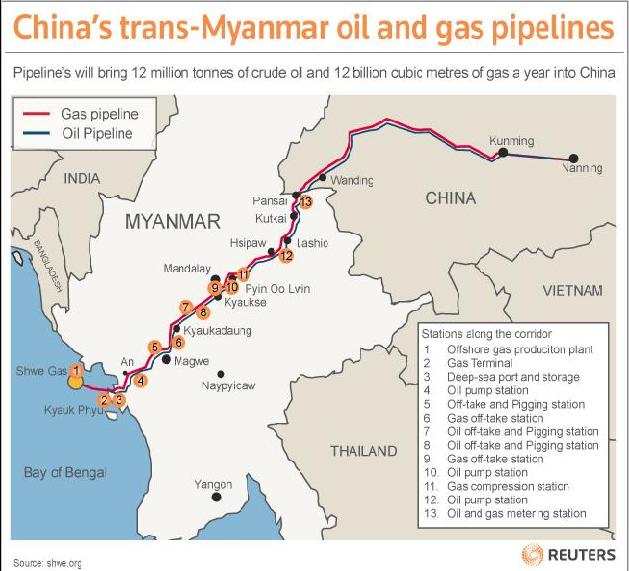
China is surrounded by littoral nations interested in balancing China’s new assertiveness. We should look for ways to establish co-binding relationships with these nations to assure sovereign access to the region beyond the more easily challenged access to the commons. The threshold for China to strike these sovereign nations is certainly higher than the threshold to attack our warships in the commons. We should make use of this advantage by encouraging the use of “dual use” infrastructure that would improve their port facilities for commerce but would also facilitate the use of these ports for basing or periodic use by our sealift and combatant naval forces. For example, a large, medium-speed, roll-on/roll-off ship from a maritime prepositioning squadron would show commitment while offering tangible benefits for humanitarian assistance and disaster relief missions in the host country or the region.Conversely, China is building up her own strategic "dual use" infrastructure across the Indian Ocean. This "string of pearls" can be put at risk through irregular warfare. In keeping with Professor Holmes’ war of the flea theme, Mao also argues to “attack dispersed, isolated enemy forces first; attack concentrated, strong enemy forces later.” An illustration of an isolated force is Myanmar, a strategically important country to the Chinese, who rely on the Strait of Malacca as a narrow thoroughfare for 80% of their petroleum imports. Planned pipelines will move millions of tons of crude oil and billions of cubic feet of natural gas from Myanmar to China, circumventing the need to transit the Strait. This infrastructure represents a vulnerability to China for those countries who might consider warfare via surrogates - of which there are several possibilities in Burma - or other indirect means. Similarly, weaker nations might focus on the former East India Company outpost Cox’s Bazar, Bangladesh, which has been discussed as a possible terminus for the Trans-Asian railway, another means for China to mitigate its shipping risk.
Saturday, September 1, 2024
The emergence of 052D
PLAN followers such as myself are always excited to see new class of ship to come out and to speculate on new classes. In a recent blog entry, I wrote about the 052C program and afterwards. I speculated that the destroyers under construction in the docks are are 052D.
It turned out that my speculations were correct and one of them was launched this past week. We have been seeing a steady stream of photos coming out as people are getting a closer look at the changes on 052D.
The first thing we saw was that 052D has relatively the same hull as 052C, which is understandable, since they are using the same propulsion technology. The question has always been what kind of different weapon systems they will fit on this new class. The first set of photos we saw showed new Phased Array radar panels installed on 052D. It's the same type of radar we recently saw installed on the test ship. From the third picture, you can see that it's quite a bit larger than the ones on 052C. The sides of the bridge (especially the ones holding the radar panels) are slightly to noticeably more sloped for possible signature reduction. A new 130 mm main gun is installed in the front replacing the older 100 mm main gun. The CIWS up front remains as Type 730. We see a FCR installed on the foremast for the main gun. However, the rest of the foremast looks to be quite different than 052C. We no longer see the OTH targeting radar commonly found on 054A and 052B/C ships.
Then, we got a set of photos showing over the top view of this ship compared to 052C. The second picture shows 052D holding a new type of VLS structure up at front that's more similar to MK-41 and the HHQ-16 VLS than the circular ones on 052C. This is possibly the multi-missile VLS that was reported to have been under development. Compared to 052C, we are seeing a modified funnel design that buries funnels for signature reduction. The base that holds the Type 517M radar is moved forward compared to 052C. We will have to wait to see what's around that. The hangar was moved from the left side to the center. It seems like Type 730 will not be installed here, since it requires deck penetration and the hangar for 052C had to move off center because They placed the aft VLS installations and Type 730 along center. Rather, the non-deck penetrating version of HQ-10 will probably be installed here. I suppose the targeting radar for HQ-10 will either be installed alongside it or next to the Type 517M. The area that used to hold the YJ-62 launchers and the multipurpose rocket launchers have been replaced with the aft VLS installations. The rocket launchers have been moved to the two sides of the platform on top of the hangar. I'm not sure where the anti-ship missiles will be installed.
So, we do see quite dramatic changes to the weapon systems employed on 052D. The hull is similar but appears to have some modifications to fit the weapon systems and have reduction in signature. The beam of the ship appears to greater than 052C from the comparisons, but that's probably just based on the angle of the shot. A more powerful multi-functional radar has been installed, which could only point toward greater AAW potential. The biggest question on most people's mind are the number of VLS cells. From people that have been there, the word is that the front VLS installation and aft VLS installation are both holding 32 VLS cells. That's compared to 36 and 12 on 052C. Another question has been whether these cells can quad pack or dual pack one of the shorter ranged missiles. The other question is whether they can hold LACMs or AShM or ASW missiles. We will find out in the coming months and years, but that's still a mystery at this point.
Either way, it's a definite improvement over the combat capabilities of 052C. While holding 64 VLS cells may not satisfy some PLAN fans (compared to 96 MK-41 on Flights II Arleigh Burke class), one has to remember that this ship is most likely around 7000 to 8000 ton in displacement fully loaded. Until the next generation of AAW warship comes out with greater propulsion, there is a limitation to how much 052 series of ships can hold.
Time to Pack it In, Army
This can't go by without a post. When the Army feels comfortable enough to hold an interpretative dance performance in the combat zone, then clearly somone's priorities are askew. It's time to send home the 82nd and the rest of the folks who brought their garrison mentalities forward and let SOF run the war.
The opinions in this post are the author's alone.
The opinions in this post are the author's alone.
Subscribe to:
Posts (Atom)