I received this article via email from several people today, each of whom probably thought that what would get my interest is the reporting on the continuing objections from the ground force community to AirSea Battle. I must admit to being somewhat interested that the Washington Post would take time for a serious analysis of AirSea Battle, to the extent that any serious analysis can take place in an unclassified setting.
Instead, what unfolds is a timid hit-piece, full of innuendo and with a whiff of score settling. Careful only to land glancing blows, Greg Jaffe traces the conceptual evolution of AirSea Battle back to its Pentagon roots, and in the process, questions the Director of the Office of Net Assessment's (Andrew Marshall) integrity in the awarding of contracts by inferring that he distributes resources to his favorites, and no one is more favored than the Center for Strategic and Budgetary Assessments, run by a Marshall protege, Dr. Andrew Krepinevich. Citing the proportion of CSBA's revenue generated by ONA contracts, Jaffe gives us Krepinevich's salary, reporting that it is twice what others in his position make. The horror.
So, not only is AirSea Battle subject to (generally useful) criticism from land-power advocates, it now should be looked at askance because of its birth from a dubious marriage between ONA and a think tank? I'm not convinced.
CSBA is one of the most professional organizations I've worked with, and I've worked with many of the DC think tanks and war-gaming shops. Quibble if you will with their revenue, but if you've ever worked with them, you'll find a couple of very obvious facts. First, they don't occupy a Taj Mahal office complex, so your government dollars aren't going to that. Second, their staff is ridiculously small for the complex and important work that they take on. So your government dollar isn't going to the overhead support of Writers in Residence, Non-Resident Scholars, Resident Fellows, Non-Resident Writing Fellows and the like. You get world class analysis, professionally done, by a staff of experts who work like dogs--and produce their findings quickly, a rarity in Washington sometimes.
Additionally, if ONA money goes to firms that have connections with Marshall, maybe it is worthwhile to look at the quality of the people who have earned his confidence. I am familiar with probably ten people in the DC area who worked closely with Marshall, who learned his methods, who trained at his knee--who then went out into the thinktank and wargaming worlds to make their way. These are not Junior Varsity people--they are some of the smartest, most analytically rigorous thinkers I know, and the the work that they do for Marshall and every other customer who seeks them out is superb. If Marshall goes to the well, it is because he knows he can get quality work from people who know what they are doing.
I guess Mr. Jaffe was unable to get his editors to buy off on a straight story about the legitimate questions surrounding AirSea Battle, that he had to "sex it up" a little bit by hinting about corruption and playing up class envy. Maybe next time.
UPDATE: I'm in the midst of an interesting Twitter conversation with Gulliver, of the Blog Ink Spots . He tweeted "I haven't seen one single human who read that piece suggest that it was "insinuating favoritism."
I've asked him/her for permission to post their Tweet in order to get a sense of how much of an outlier I am on this. Am I wrong in stating that the WaPost article hinted at ONA favoritism in the awarding of contracts? Please respond with your views.
Bryan McGrath

Thursday, August 2, 2024

An Unwise Cut from the SAC-D: VIRGINIA Payload Module in Trouble
A story here outlines opposition in the SAC-D to the Administration's plan to build the VIRGINIA Payload Module (VPM) into downstream versions of the world's best attack boat. VPM would help soften the blow of the retirement of the SSGN's, in theory distributing the considerable number of land-attack launchers contained therein across a larger number of VIRGINIA boats. Additionally, the adaptabilty of the VPM could lead to employment of weapons and sensors other than Tomahawk, to include other land-attack weapons, UUV's and other more highly classified uses.
VPM is an example of the wisdom of the CNO's "payloads, not platforms" appraoach to gaining capability increases. This is a short-sighted mark by the sub-committee, and I urge lawmakers to reverse it as the FY13 budget process unfolds.
Bryan McGrath
The Hollow Force is Here

Over the past six months, the service has instituted measures to address gaps in critical positions, offering cash and other perks to compel sailors to head back out to sea. While those measures are still taking hold, Navy officials said last week that more must be done to address the at-sea manning issue -- including involuntary measures -- as nearly one-third of its total enlisted ratings are currently unfilled.This is data specific to the hollowing of the force. It isn't the cost of building ships that is shrinking the fleet, it is the cost of manning ships that is shrinking the Navy. Those costs aren't coming down, and the fiscal environment for the Navy isn't getting better anytime soon. In my opinion the Navy needs to be very transparent on this issue.
As a result, existing programs are being expanded and new measures implemented to ensure these billets are staffed properly, according to a Navy news release.
“As our Navy is in ever-increasing demand around the world, filling these gap billets at sea has become more critical,” Chief of Naval Personnel Vice Adm. Scott Van Buskirk said in the release. “These actions should reduce the short-notice actions to man high-priority billets, such as cross-decking and diverts.”
The Navy is separating nearly 3,000 midcareer sailors this year in 31 other fields that are overmanned.
In the end, hollowing the force is not necessarily the worst option, and can be done selectively as the Navy gets over small hurdles. The problem is that without more transparency from the Navy, we have no idea what size the hurdle is, and whether the measures being taken are to simply stop the bleeding or fix the problem.
More likely, the measures Vice Adm. Scott Van Buskirk has put into action are simply intended to stop the bleeding, because the sense I get talking to folks in those units and on those ships with serious manpower shortages is that the problem isn't going to be solved quickly.
Wednesday, August 1, 2024
An Australian Perspective
G'day
readers. My name is Justin Jones and I am Galrahn's latest recruit to ID. I
will be blogging from an Asia Pacific, specifically Australian, perspective. In
my day job, I am a serving Naval Officer and the Director of the Sea Power Centre -
Australia, the Royal Australian Navy's 'think tank.' I am also the Naval
Associate at the Lowy Institute for
International Policy. My blog contributions will represent my own views and
not necessarily reflect those of the Department of Defence, Australian Defence
Force or Royal Australian Navy.
I am
honored to be invited to contribute to this very prestigious blog and I look
forward to interacting with you virtually. I can be contacted via the email
address on the right hand side of the page. You can also follow me on Twitter:
@DaggerNav
CSIS Asia Pacific Posture Assessment
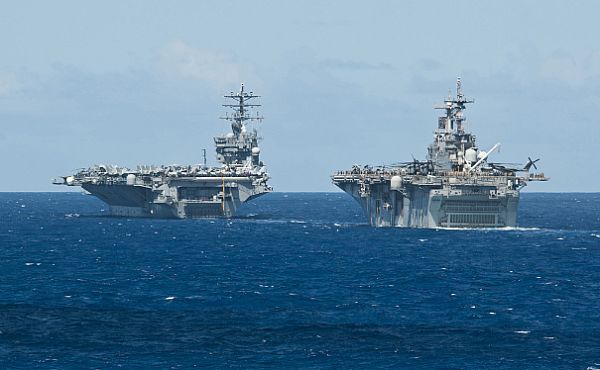 | ||
| PACIFIC OCEAN (July 27, 2024) The aircraft carrier USS Nimitz (CVN 68) and the amphibious assault ship USS Essex (LHD 2) are underway in close formation during the Rim of the Pacific (RIMPAC) 2012 exercise. Twenty-two nations, more than 40 ships and submarines, more than 200 aircraft and 25,000 personnel are participating in the biennial RIMPAC exercise from June 29 to Aug. 3, in and around the Hawaiian Islands. The world's largest international maritime exercise, RIMPAC provides a unique training opportunity that helps participants foster and sustain the cooperative relationships that are critical to ensuring the safety of sea lanes and security on the world's oceans. RIMPAC 2012 is the 23rd exercise in the series that began in 1971. (U.S. Navy photo by Mass Communication Specialist 3rd Class Raul Moreno Jr./Released) |
Section 346 of the 2012 National Defense Authorization Act directed the Defense Department to commission an independent assessment of U.S. force posture in Asia. This task was assigned to the Center for Strategic and International Studies, who has delivered a very excellent report that will be discussed in the House Armed Services Subcommittee on Readiness at 2:00pm on Wednesday, August 1, 2024.
I had never heard of David Berteau before this report, he just never popped up on my radar, but he's in my A+ list because this guy is a serious professional, and the report reflects exactly that. In my opinion, the U.S. Force Posture Strategy in the Asia Pacific Region: An Independent Assessment by CSIS is exactly the kind of high bar quality we should expect from the Defense Think Tank community. CSIS has delivered quality taxpayer funded work, and should be proud of their effort.
So enjoy the report, and see also this unclassified response from Secretary Panetta regarding the report. I do believe many in this audience will appreciate the high quality work delivered in this report on a very relevant topic.
Below are only a few (of the many) thoughts inspired by my reading of this report. I encourage the community to contribute your own analysis and commentary in the comments.
Engage the Army
Did you read the Army prepositioning article in the New York Times I linked to Monday. What I did not mention in that topic is that the article actually describes a change from the existing APS Strategy 2015, although surprisingly nobody in the comments apparently picked that up, and Army folks simply argued as if APS Strategy 2015 was still the plan. APS Strategy 2015 called for 9 prepositioning ships, but the Army didn't fund 9 ships, and while not fully funding all 9 ships the Army also decided to use that afloat space as the storage facility for MRAPS rather than as a traditional prepositioning squadron.
From what I am seeing, all appearances are the US Army is simply checking boxes specific to MRAP storage and prepositioning rather than taking the prepositioning of Army assets forward in the Pacific seriously. I don't think many caught on to the changes that have been made to APS Strategy 2015, and I think folks believed this prepositioning squadron reported in the New York Times was exactly the same as traditional Army prepositioning squadrons, even though it is clearly something different. This approach to Army prepositioning, using it as afloat MRAP storage and reducing the size of prepositioning altogether in the Pacific appears to be counter to the recommendations on page 91 of the CSIS report.
Indeed I found it noteworthy that most of the recommendations on page 91 that are recommendations intended to better align the engagement strategy of PACOM with the DOD are specific to what the US Army needs to be doing. I'm a simple Navy nerd, but if I was an Army nerd, I would note that all data points suggest there is a huge vacuum of critically thinking about how the US Army has capabilities specifically relevant to the Pacific theater just waiting for some smart guy to start talking about with new ideas. If you think you're that guy, perhaps you need to be writing those ideas here on ID, because we welcome new ideas and unconventional thinking specific to the Pacific theater from smart Army folks. Dumb Army folks can go apply at Blackfive (just kidding!).
On Growing the High End
In option three, which is the option that increases the force posture in the Pacific, the report suggests a CSG in Perth and an ARG in Hawaii. Why did the authors not recommend a CSG in Hawaii and an ARG in Perth? The authors made clear in the report that basing a nuclear powered aircraft carrier in Australia was a huge political hurdle, and they also noted the enormous associated costs. So why the recommendation if it's almost certainly a no-go politically? From a political and financial perspective the CSG in Hawaii and ARG in Perth would appear to be the more politically viable approach, and if the ARG was centered around an America class LHA, would that not work as a nice middle ground approach? I find the 4 MAGTF argument in the report a very compelling discussion for forward basing a second ARG in the region, although with the neverending DoD pivot towards the Middle East rather than Asia, Perth makes more sense for that ARG to me than Hawaii does.
On Decreasing Posture
One of the things I try to do is question assumptions, and sometimes I do it even when I don't necessarily believe the assumptions are wrong. I found it curious that according to the CSIS report there is nothing whatsoever to be gained except affordability in the decreased posture option 4. I'm not sure I believe that a decrease in force posture in the Pacific can have only negative impacts to everything but cost, and decrease in force posture is inherently negative to US policy.
It seems to me that what option 4 reveals is that the report is written with an opening assumption that decreasing force posture in the Pacific is inherently a bad thing for US policy. That assumption bothers me because it presumes a lack of resiliency and trust in the capabilities of our allies without us there to hold their hand. I'm sorry, but I've had the pleasure to get to know and understand the capabilities of folks from Australia, South Korea, and Japan - three of the primary places in the Pacific US forces are being forward based under the current Pacific posture policy; and in my opinion CSIS has overvalued our handholding and undervalued the abilities of our allies. I am curious, upon reflection and feedback, if the authors have reconsidered their conclusions in option 4, even if only in parts, and considered the possibility of any (at all) benefits whatsoever in decreases in force posture, even if they are selective and specific about what those decreases are.
In my opinion, CSIS did not give the same intellectual rigor to option 4 that they appeared to give the rest of the study, because I find it very hard to believe the US could not reduce the military footprint in the Pacific in any way without only having negative impacts.
Subscribe to:
Posts (Atom)