Ideally, cuts to defense will reflect a careful, rational approach to maintaining the military means for accomplishing America's foreign policy ends. The major players would debate and evaluate the grand strategic rationale for American military power and develop a somewhat more modest political framework for the Department of Defense.
In the real world, actual defense cuts will result in bitter bureaucratic infighting and interest group mobilization in support of particular systems and programs. While service amity in the United States has managed to hold across several previous rounds of defense cuts, most notably during the post-Vietnam and post-Cold War drawdowns, there are some indications that this set of cuts may shatter the norm of collaboration that has developed between the military services.
Unfortunately, the result of this intra-constituency battle will likely be messy. Programs that lack a rationale will survive, while weapons that lack an interest group will die. The connection between means and ends will be lost, because no specific constituency has a vested interest in a rational consideration of foreign policy values or the capacity to consider value trade-offs. Little consideration will likely be given to the notion of a meaningful drawdown of U.S. military commitments, resulting in a force even more badly overstretched. In the long run, defense cuts are necessary, good for not only the economic health but also the overall security of the United States. In the short run, cuts are going to lead to bloody fights that will leave behind a diminished military and a nasty bureaucratic mess.

Wednesday, August 3, 2024
Fighting for Pieces of a Smaller Pie...
I have a few thoughts on how the politics of defense cuts may play out in the next five or ten years. Long story short, it's not going to be pretty; even if you think that cuts in defense spending are a good idea (and I do), the actual process of cutting is likely to be very messy.

 I'm an assistant professor at the Patterson School of Diplomacy and International Commerce, University of Kentucky.
Tuesday, August 2, 2024
Aircraft Carrier Construction Well Underway in China
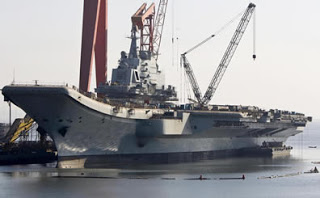 Bill Gertz at the Washington Times has an article on Chinese aircraft carriers, a vogue topic these days.
China has begun work on its first aircraft carrier and probably will develop two or more, along with outfitting a former Russian carrier that is set to begin sea trials soon, Pentagon officials said.What makes this article different is that it cites satellite photography showing construction of a carrier underway at Changxing Island Shipyard in Shanghai. With that little bit of detail, we will soon be seeing photos on Chinese BBS.
“We expect China to build at least one indigenous carrier, probably two or more, but they have not revealed how many they intend to build, what the construction schedule will [be] or what their missions will be,” said a defense official familiar with intelligence assessments.
A second defense official said China regards aircraft carriers as key symbols of global power projection and is unlikely to build just two.
Other defense officials said assessments about the indigenous carriers are based on intelligence showing construction of the first indigenous carrier at the Changxing Island Shipyard in Shanghai.
The carrier appears in satellite photos to be similar in design to the Varyag, a Soviet-era carrier purchased by China that uses a sky-jump style takeoff ramp at the front of the ship.
If there is enough evidence to spot construction of an aircraft carrier in satellite photography (assume Dock 3) - and furthermore tell how big the vessel will be based on those photos - that would suggest the aircraft carrier at Changxing Island Shipyard has been under construction for some time now. If we review the rumor mill and media reports, the likely start date for the entire carrier project was June 3, 2009, which celebrated the 144th anniversary of Jiangnan Shipyard. For those who are not familiar, it is part of Chinese culture to mark anniversaries in a special way to bring good fortune. That date was also when Chinese security at the shipyard increased drastically around Dock 3, and shortly after several new facilities around the dock were completed.
If we assume June 3, 2024 as the start date, that would put the carrier project at 26 months old now. Want to make a safe bet? Bet on the Chinese rumors that say 2 aircraft carriers in the water before 2015, because those well known rumor guys in China seem to consistently get things right the last few years. For those looking to know more, as odd as it may sound to an old analyst, it does appear the crowd souring intelligence developed on forums like SinoDefense.com is nearly as accurate and often more current than the information about Chinese naval activity one finds in the annual DoD PLAN report produced for Congress.
On Defense Spending and Budget Cuts
I am waiting until after the Senate finishes their work and the President signs the dotted line before I go into the topic in detail, but until then I fully endorse this post by Andrew Exum.
Saudi Arabia Wants a US Built Fleet
 There is a sense this deal is getting closer and closer.
Saudi Arabia plans to raise its arms purchases from the United States to $90bn from the $60bn announced last year, as the kingdom seeks to upgrade it navy, diplomats in the Gulf said this week. Last year, US officials said Riyadh planned to buy $ 60bn worth of military aircraft, including upgrades to existing fleets.Some additional notes.
“There is a plan for Saudi to spend an extra $ 30bn to upgrade its navy fleet,” said a Western diplomat in the Gulf. “This extra amount also includes maintenance and training for the forces,” another Gulf-based diplomat said. A Saudi government adviser said he expected the deal to upgrade the navy fleet would be completed soon. “The chances this deal won’t be finalised are very remote. The money will basically be used to update the eastern fleet,” he said, adding the upgrade was part of a separate programme to the $60bn plan announced last year. US officials said last year the $60bn programme would be complete in 15 to 20 years. It was not clear over how many years the $30bn addition would last.We have heard everything from Burke destroyers to variants of the Littoral Combat Ship. I'm not going to speculate, although I have heard that up to $30 billion of this money is for building ships. That amount of money spent on US shipbuilding from Saudi Arabia would be enormous for the shipbuilding industry.
More importantly, this the single biggest shipbuilding contract since when? I stopped after going back half a century. I wonder what role Ray Mabus has had in getting a deal this large done, if any?
Monday, August 1, 2024
More Clarity, or Added Confusion?
 Am I missing something? Check out the second half of this Navy Times story and tell me what you think.
Aviation readiness isn’t tied exclusively to the budget, Navy officials said.Where did Rep Forbes get his information? From the Navy. That means the Navy is who says that an electronic attack aircraft in a carrier hangar without a jamming pod for over a half-hour doesn’t count as “fully mission-capable" even if the aircraft is otherwise just fine?
“A combination of factors, not just funding, impact readiness and capability, which we closely monitor. Gaps in maintenance funding have the potential to place more workload on the fleet to move equipment in order to manage readiness and cannibalization rates,” said Lt. Paul Macapagal, a Navy spokesman.
The capability rates the subcommittee evaluated are below goals, due in part to operations in several theaters at high op tempo, a changing emphasis from Iraq to Afghanistan that lengthened supply lines, as well as other factors, said Capt. Mike Kelly, the force materiel officer at Naval Air Forces.
Additionally, the data the subcommittee is using isn’t the best tool to assess full mission capability, Kelly said. For example, an electronic attack aircraft might be in a carrier hangar, in great shape, but isn’t equipped with a jamming pod. For every half-hour it sits without that pod it technically doesn’t count as “fully mission-capable,” he said.
It’s better to consider whether the aircraft is ready for a certain task, Kelly said.
“Do I have the aircraft? Do I have the mission sets? Do I have the required equipment? Do I have the required crew?” he asked. “We send each and every strike group with a complete set of assets. We’ve been solid doing that, and I can’t think of any shortages when we’re sending them to sea.”
But if the jam pod is broken and that is why the electronic attack aircraft doesn't have a jammer, doesn't that mean the aircraft isn't fully mission capable, and suggests the aircraft would have to cannibalize a jammer off another aircraft in order to perform a mission?
Seems to me that if the Navy is measuring by that criteria, the Navy is measuring correctly. That would then beg the question why the data the subcommittee is using isn’t the best tool to assess full mission capability if indeed the data used by the subcommittee (and even in the example provided by Lt. Paul Macapagal) effectively assesses full mission capability?
The Navy is saying "but the aircraft isn't broken" while Forbes is saying "fix the jammer" before you pat yourself on the back. I get it things won't always work right, but when the target is 60% full mission capability and the Navy is only able to get 45% from the entire fleet, I'm thinking Forbes is making the right point.
I'm not sure if the new information adds more clarity or more confusion. Am I missing something?
Subscribe to:
Posts (Atom)