Thursday, June 23, 2024

Presidents Speech on Afghanistan

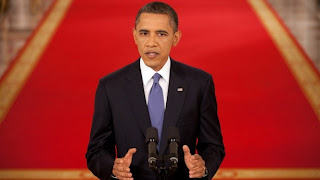
The President of the United States gave an important speech Wednesday night on the way forward in Afghanistan. If you wish to review or read the speech, a transcript is available on the White House website. As has become common with this President, the speech was well written, but the delivery didn't seem to connect with the audience as authentic. If you viewed the speech, I would be curious the impression you had - because my impression sitting in a room with several friends was this President is perhaps one of the first US Presidents in American history who could not independently articulate the strategic objective of the war in Afghanistan he has committed the military to fight on behalf of the nation.

I find myself in 100% support of the direction President Obama has chosen for Afghanistan, and see the drawdown of 33,000 US forces in that country as a positive first step. The death of Osama bin Laden; regardless of whether it was symbolic or substantive, achieved the last important strategic objective a large, prolonged military presence in Afghanistan needed to achieve. The future of Afghanistan will be largely decided by the government of Afghanistan, and American strategic interests in any future of Afghanistan at this point can be achieved through sustained, persistent engagement - an engagement that does not require a large land Army in Asia. As Libya has reminded us, persistent use of limited military power cannot defeat weak or failed states, but it can contain them while preventing bad guys from gaining power.

What disappointed me most about the announcement of drawdown of US military forces from Afghanistan was not the Presidents speech, rather much of the incoherent political reaction by various political leaders and pundits. Strategic thinking appears dead in defense policy today, and tactical thinking prevails in the political dialog. Below are a few notes to consider when contemplating what tonight's first step towards drawdown in Afghanistan actually means.

Obama's War

Barack Obama's bold move was to draw down 33,000 US military forces by summer of 2012, which will still leave about ~70,000 US military forces in Afghanistan. By comparison, the Bush administration high mark for total US military forces in Afghanistan was ~35,000, meaning even after this drawdown the United States will still have around twice as many military forces in Afghanistan than at any point during the Bush administration.

Strategic Victory

The political arguments crying foul because President Obama failed to discuss what victory looks like in Afghanistan is perhaps the most incoherent political argument of them all. Not only is it impossible for a single pundit discussing victory to articulate strategic victory in the context of strategic national interests, but they would be all alone even trying to articulate what victory in Afghanistan is because nobody can articulate it coherently. 70% of the defense think tank community is retired US Army, and across the entire right to left spectrum of credible Afghanistan analysis and discussion - every single one of those folks articulate or public articles and papers discussing strategic victory in Afghanistan in the context of avoiding strategic defeat.

The US Army shouldn't have to articulate in public what strategic victory is, and to prove it - they don't, but they do often discuss the danger of strategic defeat. The President of the United States didn't mention strategic victory in his speech and I don't believe for a second he could define it - much less articulate it in a speech. Political pundits who complain about the lack of a discussion regarding victory in Afghanistan cannot themselves articulate what victory is in Afghanistan, so why exactly is this considered a strong political criticism?

Credibility

There is concern that if the United States pulls out of Afghanistan, American credibility is diminished and it suggests somehow that America is in decline. In my opinion, any super power that fights a land war in Asia without a coherent strategic objective that can be articulated to the nations population is the mother of all signs that a nation is on a course of diminished credibility and declining power, and is certainly a bigger sign of serious trouble than a tactical adjustment like troop numbers on any military battlefield could ever be. When you believe that America cannot afford to "lose" a war in Afghanistan of all places, then you are the declinist who lacks confidence in America's position in the world today. Credibility for Afghanistan is primarily a domestic concern by politicians and pundits who believe it is retreating if you walk away from any fight, including fights where victory has limited strategic value. Credibility is not a legitimate battlefield concern.

Taliban Victory

The political argument that suggests the Taliban wins because they outlast us in Afghanistan unless we kill absolutely all of them doesn't make much sense to me. We overthrew the Taliban as the government of Afghanistan with less than a battalion of US forces in 2001, and somehow we now require a dozen brigades to prevent them from taking power? There is no evidence that suggests a small military presence couldn't keep the Taliban out of power, because there is already evidence that suggests it only takes a small military presence to remove the Taliban from power. No matter what the United States does from now until 2012, 2014, or even 2020 - tribal power will still be the dominating political power in Afghanistan. Whether the United States politically exploits unified tribal power or divided tribal power against the Taliban, the Taliban will have serious trouble consolidating power in Afghanistan as long as the US remains engaged. Even if the size of that engagement is far less than a dozen brigades, as long as it is bigger than a single battalion - I like our chances in preventing the enemy from achieving victory.

Let's Talk Strategy For a Change

There will be political criticism that President Obama broke ranks with certain Generals in regards to policy for Afghanistan. This audience is smarter than that, because we all know there are always Generals and Admirals on both sides of every debate. After 9+ years of following the advice of certain prominent Generals, the nation is still at war in Afghanistan. The suggestion that breaking the trend indicates a political mistake by the President is unsupported unless one believes it was always the plan to fight the longest US war in history in Afghanistan.

There are strategic arguments related to the use of military power in Afghanistan, Iraq, Libya, Yemen, Pakistan, and even Somalia that have not been articulated as US political policy, and I believe that issue as part of a broader discussion of defense policy is just waiting to jump into the public debate as election season approaches. I strongly believe that many US military leaders would welcome a public defense policy debate, indeed would feel more empowered if they were unleashed in advocating strategic justification arguments on behalf of their service instead of defense budget arguments focused on winning their portion of the administrations budget pie.

For 16 of the last 22 years the United States has been fighting wars on the ground around the world, but over that same period since the cold war the world has changed considerably. The President has a real opportunity to turn the defense budget debate into a public policy and strategy debate that guides difficult spending choices in defense. As we move into election season, I think there would be enormous value to the President to move the defense discussion away from budget and towards policy, because I think he will find his policies are more congruent with the likely direction of a strategic discussion than they will be in a political defense debate framed in the context of government spending priorities.

This analysis doesn't focus in on the fine print of the Presidents speech, rather my take on some of the finer points I witnessed discussed as a result of the speech. Feel free to add your thoughts on the speech or my commentary in the comments below.


Wednesday, June 22, 2024

Site Stuff

I tried out the mobile viewing settings for the site, and wasn't very pleased. Part of it has to do with problems regarding the comments in the mobile settings, which I can probably fix if I make an effort to go through the code. The other part is I like accessing the links I have on my own site from my own phone. I use a Droid phone, and for the most part it looked OK but needs some tweaks.

For those of you who tried it, I would appreciate feedback here. I am getting a lot of traffic these days and a lot of interest in terms of advertising. I'm giving serious consideration to exploring my options there, and would appreciate feedback on that subject if you have any thoughts. This blog site not have a revenue problem because comment is free around here, but I am always open to audience input on these issues (as long as you respect the fact I am simply farming for ideas and advice rather than seeking instructions).

If there are any specific annoyances related to the site, please leave comments in this thread. I am going to actually try to make an effort to clean stuff up.

NATO and Means-End Reasoning

My thoughts on Gates’ NATO speech:

It is worth noting, however, that protection of Libyan civilians through airstrikes sits so far outside NATO’s founding purpose that the framers of the 1949 treaty that brought the alliance into existence would hardly recognize the mission. NATO is a tool that has been effectively repurposed since the end of the Cold War, but tools are not infinitely malleable. So while the alliance may not be the ideal tool for managing military intervention in Europe’s “near abroad,” that does not mean that the organization is — or risks becoming — useless. Instead of disparaging allies, it would make more sense for critics to consider what NATO can and cannot do, and adapt their expectations accordingly
.

Austal's LCS Corrosion Problem

It started when Bloomberg reported the Navy had discovered “aggressive” corrosion on the USS Independence (LCS 2). There weren't many details in the original report, so I initially chalked this up to part of the learning curve both the Navy and Austal will suffer through with a new ship type built completely of aluminum. The story became more interesting to me as an observer when I saw the way Austal Chief executive Andrew Bellamy responded to the news.
Chief executive Andrew Bellamy said any corrosion on the vessel, known as a ''littoral combat ship'' for its ability to hug the shore, would be the fault of the operator or maintainer.

''We have built 230 vessels of this type that have not suffered from this type of problem … where the operator and the maintainer of the ship have followed the procedures in a thorough way,'' Mr Bellamy said. ''I suspect there is a problem in the area of operational maintenance if there is a galvanic corrosion issue.''

The rust claim comes weeks after the Perth-based Austal said it would sharpen its focus on the defence sector amid weakening demand for commercial boats.
Blame the Navy for poor maintenance because Austals first big warship runs into a problem none of their simple commercial ferry designs ever had? That seems like a really poor way to respond to problems encountered. My impression at the time this article was released is that the Navy was dealing with a rust problem, so to me this article was nothing more than a good laugh at the hubris of Austal.

But it turns out this isn't a simple rust problem, which was my mistake in following this story. Check out this remarkable press statement sales pitch by Austal.
Galvanic corrosion is an issue that has challenged U.S. warships since 1844, when the USS Michigan, the first iron-hulled Navy ship, entered service. Today, two common and robust solutions, impressed current cathodic protection systems and the use of strategically-placed sacrificial anodes, are in wide use throughout the world, particularly in ships where two different metals such as steel and aluminum are utilised in the one vessel.

As a specialist in aluminum shipbuilding, having built over 220 aluminum vessels for defence forces and commercial clients around the world since its formation in 1988, Austal is intimately familiar with the management of galvanic corrosion. An electrochemical process, galvanic corrosion occurs when two dissimilar metals, after being in electrical contact with one another, corrode at different rates.

According to company records, galvanic corrosion has not been a factor on any Austal built and fully maintained vessel, and our technical experts are eager to support any request to identify root causes of any corrosion issue in any aluminum naval vessel in service today. The Westpac Express, an Austal-built and fully maintained high-speed catamaran, has shuttled U.S. Marines throughout the Pacific Basin continuously for ten years, with a 99.7% availability over that period.

As Prime Contractor for Jackson, the third Independence-variant Littoral Combat Ship (LCS-6), Austal has a well-developed methodology for the management of galvanic corrosion, which it has deployed globally on behalf of its defense and commercial clients. If selected to provide post-delivery support for the Littoral Combat Ship (LCS) Class Services program, it is a straight forward process for Austal engineers to regularly conduct systematic reviews of the electrical grounding throughout each Austal-built vessel to detect and eliminate stray currents that might cause electrolysis between the stainless steel impeller housing and of the adjacent aluminum structure.

An integral part of any post-delivery support program for a high-performance, high-speed vessel such as the Independence-variant LCS is to provide a cadre of qualified maintainers who can help our Navy partners to deploy temporary sacrificial anodes every time the vessel is moored, and ensure that high-voltage maintenance equipment is properly grounded before use aboard ship. These are services that Austal’s skilled aluminum specialists, operating from six maintenance hubs in the Asia-Pacific, North America, South America, Europe and the Middle East, offer Austal customers every day.

With almost 2,200 current employees at Austal’s USA shipyard, with a future workforce planned of over 4,000, each and every Austal employee is committed to making the Littoral Combat Ship a success. Awarded a ten-ship contract in December 2010, Austal has eagerly assumed the role of Prime Contractor for the Independence-variant Littoral Combat Ships awarded under the 10 ship block buy contract, and, as a Prime Contractor for those 10 ships, Austal will always stand by its products and our Navy partners.
It turns out this is not rust, rather an electrolysis issue between the stainless steel waterjet parts and the aluminum hulls, and when the Navy calls an electrolysis problem “aggressive corrosion" that suggests to me the metal is completely gone - not rusted. In the case of LCS-2, the problem was apparently accelerated by stray currents in the hull from the electrical distribution system problems the ship has been having since it was turned over to the Navy. Normally an electrolysis problem would be prevented by the use of a Cathodic Protection System (CPS), but wouldn't you know it - USS Independence (LCS 2) doesn't have a CPS.

LCS-4 doesn't have one either, but apparently CPS is part of the lessons learned process and was included in the fixed-price contracts for Austal versions of the LCS beginning with LCS-6. LCS-2 will have the CPS installed at the next drydock period, while Austal has said a CPS will be added to LCS-4 before the ship is turned over to the Navy.

The question everyone seems to be asking is whether the JHSV could suffer the same issue. With all due respect to the Austal press statement, vessels built for Navy purposes have a great deal more technology potentially running electrical currents through the ships than commercial ferry's do, and Austal isn't exactly a world wide expert on building frigate sized navy ships. The stray currents in USS Independence (LCS 2) could easily reoccur in the JHSV creating similar problems if prevention isn't built into the design. The Westpac Express is a commercial design and the charter did not significantly add technology nor were changes made to Westpac Express that runs electrical power throughout the ferry, so Austal is making an apples to oranges comparison suggesting their immune from criticism because their simple commercial vessels don't have this problem.

I've heard from a few unofficial but relatively informed folks the JHSV does not have a cathodic protection system, and if that turns out to be true we could see the Navy move to address that issue before JHSV-1 conducts sea trials later this year. I'd be curious to know if Westpac Express has a CPS installed, or some other form of prevention is used at all.

I tend to think of this problem as the first public problem that is part of a steep learning curve process both the Navy and Austal were bound to run into with the Austal version of the Littoral Combat Ships, indeed I suspect there will be other public problems revealed over time that will require relatively simple, albeit costly, solutions. Is this a big deal? Hard to tell, but given both the problem and solution is well understood, in the context of unknowns yet to be discovered with LCS - to me this isn't really that big of a deal as long as the long term solutions effectively work as intended.

Mistrals Represent Politics and Industry, Not Military Power

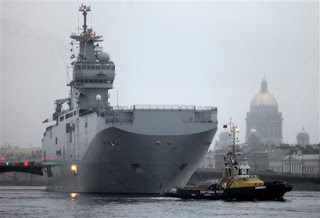
By now everyone has likely heard that Russia and France have finalized the deal for the Mistral class amphibious ships. If you want to know more, I highly recommend this remarkably thorough article at Defense Industry Daily that covers just about every angle possible from the industry perspective.

As I have mentioned in the past, this deal is not a threat to US interests and the only threat that might exist to US allies is the possibility the ships could be used in a territorial dispute with Japan. With all due respect to Russia, in a territorial dispute involving conventional military power between Russia and Japan, the spirit of Admiral Togo Heihachiro will prevail in that fight every single time. The Mistrals won't be used in that way, or they will not survive. I suspect when the Mistrals are finally making a deployment, they will be used in much the same way everyone else uses large amphibious ships these days - acting as a command node for conducting soft power diplomacy missions and helping address 3rd world problems from offshore.

The deal between Russia and France is about politics and industry, and really isn't so much about military power like some politicians would like you to believe. I find myself in strong agreement with this Stratfor analysis.
Russian Prime Minister Vladimir Putin, Deputy Prime Minister Sergei Ivanov and Defense Minister Anatoly Serdyukov are visiting Paris to meet with French President Nicolas Sarkozy and other French government officials on June 20-21. The visit quickly follows the conclusion of an agreement between Russia and France for two French Mistral-class amphibious assault ships, worth $1.7 billion, that France has agreed to sell to Russia with the full technology transfer Moscow demanded. The ships would be built in France and delivered in 2014 and 2015, with the potential for another two to be built in Russian shipyards under French supervision.

The Russian officials’ visit is a chance to very publicly emphasize the Mistral deal, a boon for the Kremlin which wants to signal to the rest of Europe that it has a strong security relationship with France (part of its ongoing campaign to unsettle the Central Europeans and make them doubt the commitment of their West European NATO allies). It is also an opportunity to discuss several other deals the two countries are working on, covering energy, military and space technology cooperation. For France, building close ties with Russia is about ensuring that the evolving Berlin-Moscow relationship does not leave Paris unable to affect security issues on the continent.
The issue I intend to watch closely is how much Russian shipbuilder OSK will ultimately contribute and learn from the French in construction of these ships, and whether it is even possible to get a base of subcontractors stable enough to support construction of large navy vessels in Russia. All indications are if any new Mistrals are built in Russia, they would be built by the recently announced new STX shipyard being built in St. Petersburg.

The Russian shipbuilding industry can really only build two types of naval vessels - submarines and small frigates/corvettes. Exports of these types of ships to various nations sustained the industry through the really bad years following the cold war, but export orders for Russian naval vessels are drying up as most of the world is expanding domestic shipbuilding markets. Is the Mistral a program that can truly kickstart the Russian shipbuilding industry towards better quality and production techniques in the 21st century, or is this a gamble unlikely to pay off? I tend to believe it will ultimately be a small step in the right direction, and not the leap Russian political leaders hope.