Wednesday, November 4, 2024

USS New York

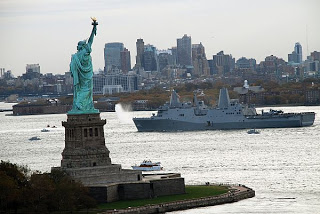
Impressive. Very impressive. I had a few friends who took the ride on USS New York (LPD 21) from Norfolk this week, I imagine they had fun. Both the Navy and New York City are doing this commissioning in a first class way, and the buzz surrounding the event this week even as far north as Albany is proof.


For those down in the city, the schedule for public visitation is as follows:
Wednesday, November 4 - 10:00 a.m. to 4:00 p.m.
Thursday, November 5 - 1:00 to 4:00 p.m.
Sunday, November 8 - 9:00 a.m. to 12:00 p.m.
Monday, November 9 - 9:00 a.m. to 4:00 p.m.
Tuesday, November 10 - 9:00 a.m. to 4:00 p.m.
Wednesday, November 11 - 9:00 a.m. to 2:00 p.m.
I encourage anyone who lives close to the city to get out and see her. The ship is a lot bigger than you think, and is a lot different than any Navy ship you have ever been on. If you haven't been on an LPD-17 class ship yet, you should have a look around (particularly Marines who have deployed on other amphibious ships).

They may have completely screwed up the USS San Antonio (LPD 17), but I believe there is something special about this class of ship, and the Navy would be wise to build as many of them as possible.

Also, whoever decided to take a MV-22 and CH-53 on her to the ceremony is very smart. Having them on the flight deck for everyone to see... nice touch.

Tuesday, November 3, 2024

Book Review: Small Boats, Weak States, Dirty Money

Martin Murphy's Small Boats, Weak States, Dirty Money is a detailed and exhaustive investigation of piracy, smuggling, maritime robbery, and maritime terrorism. Although Murphy delves into some historical aspects of piracy, his central focus is the development of modern piracy, and the use of maritime terror by modern terrorist organizations.

Murphy investigates the legal and definitional problems of piracy in some detail. He locates the rise of modern piracy in decolonization, and in the development of modern maritime law. With the collapse of the great European empires, successor states acquired legal responsibility for the maintenance of order within their territorial waters. Unfortunately, these successor states often lacked either the capacity or wherewithal to control criminal maritime activity. At the same time, the need to express and reinforce sovereignty limited the degree to which colonial successor states could request or accept assistance from major states. Accordingly, Murphy argues that maritime piracy tends to increase as the interest and capability of local states (and local substate actors) to police their areas decreases. Maritime piracy in Southeast Asia, for example, declined after Malaysia, Indonesia, and Singapore began to pay attention and devote resources to the problem. Poverty certainly creates opportunities for recruitment of pirates, but poverty alone cannot create piracy; lack of state authority enables the success of pirate organizations. Moreover, successful piracy creates a negative feedback loop by empowering criminal organizations and separatist groups.

Murphy's analysis of the social and organizational networks that pirates and maritime terrorists occupy is sophisticated, well argued, and readable. He argues that piracy is, because of some definitional issues, probably more widespread than most analysts acknowledge. Robbery in port, for example, does not count in piracy statistics, even though it makes up a substantial percentage of all criminal maritime activity. Similarly, distinctions between "public" and "private" purposes, which has traditionally been the manner in which piracy has been distinguished from war or terrorism, often serve to obscure the extent and scope of piracy.

Murphy's chapters on terrorism detail the long history of terrorist attacks in the maritime arena. Murphy has little patience for formulations of the maritime terrorism question that treat such terrorism as an unrealized potential; terrorists have used the maritime arena for years, and have done so effectively. Speculation about what terrorists might do is less useful, in Murphy's account, than analysis of what they have done thus far. Like piracy, maritime terrorism is an essentially local phenomenon, usually performed by local actors with local grievances. The Tamil Tigers remain the prototypical maritime terrorist groups, but various other terrorist organizations have resorted to the maritime arena. These campaigns have often lacked the flash associated with other terrorist campaigns (major events such as the seizure of the Achille Lauro and the bombing of the Cole excepted) but have nevertheless been as effective as any other terrorist campaign.

Murphy's conclusion regarding piracy is that it represents an irritant to international trade, but a genuine threat to the stability of the states and regions that it afflicts. Piracy helps maintain criminal syndicates and other illicit actors that undermine state authority, and which can limit the development and effectiveness of domestic institutions. Similarly, Murphy is skeptical of some of the more alarmist warnings about maritime terrorism; he details why certain maritime terrorist scenarios discussed in the media are practically implausible. Nevertheless, he is not reassuring regarding the threat of maritime terrorism; terrorist use the maritime arena regularly, and will continue to do so in the future.

This is the best one volume discussion of illicit activity in the modern maritime arena that I've seen. It is an exceedingly helpful corrective to the conceptions of piracy and maritime terrorism that occupy the public conversation. Murphy's account is too complex and detailed to summarize in this relatively short review; many of the arguments that he makes bear additional analysis and discussion. Most who have any interest in piracy and illicit maritime affairs will find something of use in the book. Academics will be pleased by the organizational and anthropological analysis, while policymakers and policy executors will find the detailed accounts of piracy, smuggling, and terrorism extremely useful.

Monday, November 2, 2024

Earmarking FutureTech in Hawaii

Herbert A. Sample of the Associated Press has been looking into Sen. Daniel Inouye's (D-Hawaii) earmarks, and has an impressive list on display. This one in particular stands out:
Pacific Marine/Navatek Ltd., Honolulu: $2.2 million to build model of amphibious vehicle.
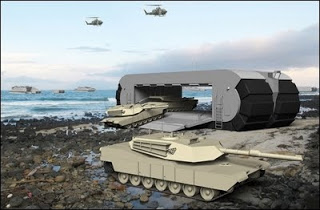
Like them or not, earmarks are a part of Congress not going away. They aren't always bad, but they don't always make sense either. I'm going to have a tough time complaining too much about this one though, because to me, this is a case where Sen. Daniel Inouye is putting up the money to build something way outside the box. It is for Navatek's version of the T-Craft, which ONR did not accept in phase II. From the February 20, 2024 Honolulu Advertiser:
"If our preliminary $2 million design is accepted, we move to phase two where we would receive an additional $10 million to produce and model-test a detailed design of the ship," said Navatek President Steven Loui in a written statement. "If awarded the phase three work, Navatek will receive an estimated $150 million to design, build and test a 350-foot prototype craft."
It was not accepted in phase two, but it is certainly one of the most interesting designs for amphibious ship to shore connectors presented in some time. The $2.2 million earmark is to build a half-scale model of the Navatek T-Craft version. Good or bad, it is certainly interesting.

It should be noted that Navatek has produced interesting new designs for the Navy in the past. It was only a few years ago they built Sea Flyer.

Seeking 2 New ID Writers

Information Dissemination is seeking a new contributor to the blog whose primary contribution would be on matters related to the United States Air Force. The contributor is expected to have some conceptual knowledge of the ongoing AirSea Battle doctrine development and be capable of producing constructive discussions to this development from an Air Force perspective, and additionally provide analysis to ongoing activities of the USAF as news events occur. A strong understanding of USAF strategic direction is desired.

Information Dissemination is seeking a new contributor to the blog whose primary contribution would be on matters related to the United States Marine Corps. The contributor is expected to have some conceptual knowledge of the ongoing strategic and doctrinal discussions of the Corps today, in particular provide analysis and opinion regarding the Marine Corps focus to return to being a sea service. Additionally, the contributor is expected to provide analysis to ongoing activities of the USMC as news events occur, in particular in both wars. A strong understanding of USMC strategic direction is desired.

The contributors will be expected to post 2-3 times a week. Send me an email if you are interested for either position. As always, the contributors will have flexibility to discuss whatever they want - in whatever way they want, and are expected to treat the blog as an owner.

HA/DR: Operational or Strategic?

From a Sept. 30 bloggers roundtable with Rear Adm. Richard Landolt, Commander of the Amphibious Force 7th Fleet based in Okinawa, Japan. I was supposed to make the call, but my work schedule has been fairly crazy for 6 weeks (ends later today, thankfully). I was able to email in a question early that morning, and Petty Office Selby let the question fly.
PETTY OFFICER SELBY: Okay. And we'll go back around the horn in a second. I have a question from Galrahn, sir: 7th Fleet generates a lot of regional publicity surrounding their humanitarian assistance programs, like Pacific Partnership, but also their disaster response and recovery operations -- the 2004 tsunami being one of the most visible, but also in several cyclone and mudslide responses in southeast Asia. As we are at the two-year anniversary of CS21, I was wondering if you can answer whether HA/DR is strategic or operational for the Navy, and how and why; or even what might be missing.

ADM. LANDOLT: I would say it's both strategic and operational. We're going to continue to do these. The amphibious force is that force that's on call and in high demand to practice these with other countries, as we do during Pacific Partnerships or African Partnership Station, or when they go down to South America. But we also make money when we do this and create those relationships during their execution that stand the test of time.

I have -- as I just said, USS Denver has done this twice now in the last two months. It's a good example of this -- to set for other countries who could be thinking about this, because a lot of countries take heat, their governments take heat when they don't respond well to these type of events. We are more than happy to show them how we train for this and the capability we bring. And that, in turn, might help them to drive some of their programs towards those kind of platforms or assets they may need.

Having been around the world in a number of places, for instance, I see too many countries that -- they want to buy a fast, sexy, pointy-nose aircraft; and what they really need are helicopters that can lift cargo and get into mountainsides and help their own people out during times like these.

So I think it -- the answer is both, strategic and operational. We will continue to do this. Pacific Partnership, by the way, is going to involve Indonesia next year. And in fact, the Indonesians have a hospital ship called the "Doctor Soeharso," S-O-E-H-A-R-S-O. Because there was so much damage to the hospitals in Padang, the Soeharso pulled into port there, and was very useful to them. And that same ship will take those lessons learned -- she learned from this real-world exercise -- real-world event, and use it during the Pacific Partnership next year.
I would have followed up by asking what he means when he says "we also make money when we do this." I have a few ideas how this analogy applies, but I'd be curious for his specific examples.

I think the answer is interesting, but I'm not sure I am convinced. I remain unsure, two years after CS-21, whether HA/DR is strategic or operational. Obviously it is operational, but there are so many things that go into effective HA/DR and I am starting to lean towards the camp that says for the US Navy, HA/DR is operational.

That isn't to say HA/DR can't be, or isn't strategic, only that it isn't for the US Navy. Let me touch on my thoughts here.

Many of the aspects of HA/DR that make the effort strategic comes from outside the US Navy, for example, the strategic communications and political cooperation and partnerships that build from HA/DR can have a strategic quality about them, but the Navy piece is operational. With that said, all of those other pieces that make the combined total effort don't work without the Navy, so this is a complex issue and not cut and dry.

What this means is Navy can do everything right in HA/DR and still fail in a strategic objective, and the Navy can do everything wrong in HA/DR and still succeed in a strategic objective. That doesn't mean the quality of the Navy effort doesn't matter, only that the effort itself is dependent upon so many external factors and the work of so many others throughout government that I think that elevating HA/DR as a prominent strategic activity in CS-21 is going to always be controversial, particularly as it may not always be a strategic activity.

Obviously this is theory and academic as a discussion, built on the idealism that assistance is always welcome in times of disaster or need, but we all should recognize that is not always the case. In the Pacific I think there is a good argument to be made that assistance provided to the Philippines and Indonesia are strategic, when part of a strategic communications package at the political (and population) level that contrasts our response with the response of others, specifically the Chinese. I am not much into the financial analogy used by Rear Adm. Richard Landolt regarding how we make money, but I do see a college football sports analogy here.

As an operational effort the US Navy is scoring political points by helping the local political leaders be seen as responsive. As a strategic effort, the more our assistance is contrasted with the absence of assistance by those like China, we are scoring strategic points in the region as well. The domestic political points are field goals and close wins as they don't impress much, but the strategic points enabled by the STRATCOM wizards who engage the population and political level in a meaningful way are like touchdowns and can ultimately influence the perception of the games outcome, in particular by influencing the BCS voters around the region who like to see blowouts over close victories.

----

I think there is plenty of room for a good discussion on this topic. I'll get the comments fixed tonight (doesn't show comment count), and be moderating throughout the day to insure comments are posted quickly (be aware, regular users are approved immediately and will no longer be moderated, only new users are moderated through the first 5 posts). If you want to sign up with a unique nickname for comments, sign up with a js-kit account.