Wednesday, October 1, 2024

Roughead Discusses Credibility Problem in Shipbuilding

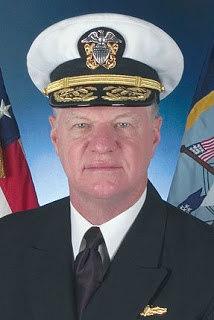
Something worth noting. It appears the top echelons of command in the Navy have opened up to the good folks at InsideDefense, because even more than usual a new article is coming out daily with remarks straight from the top leaders in the Navy... but only in that publication. From one point of view, good for the reporters and editors at InsideDefense landing the stories, you are doing a great job.

On the other hand, that only the InsideDefense folks are quoting, or have access to quote... the top Admirals in the Navy highlights how few people the Navy is actually reaching with its message. True, the Navy doesn't say much that gets people excited, but when they do, more people should hear it. Dan Taylor of Inside The Navy (subscription) published an article on Monday CNO: Navy Shipbuilding Community Must Fight To Win Back Credibility. The article is very good, and the message is very important. Naturally, the vast majority of people who care about shipbuilding haven't heard about what Admiral Roughead said.
“We must . . . regain our credibility when it comes to talking about shipbuilding and costs associated with shipbuilding,” Roughead said Sept. 25 during a speech at the “Engineering the Total Ship” conference, hosted by the American Society of Naval Engineers in Falls Church, VA. “We have lost our credibility. We have got to get it back, and we have got to get it back by making the right decisions and being absolutely forthright, direct and honest when we talk about our shipbuilding programs.”
How was the credibility lost?
“We reduced a lot of the oversight that exists, [such as] the technical oversight [and] the on-scene oversight,” he said, noting that when he first visited the second Littoral Combat Ship -- a program that has encountered burgeoning costs -- only five people were there exercising oversight on its construction.
How will the Navy restore its credibility?
“I believe that we need to tap into our Navy civilians, young men and women who understand the business, who understand how to articulate and control and monitor and work closely with the acquisition community,” he added.

“I think we also have to, in our costing, call the costs like we see them,” he said, “and that might not be an easy thing to do -- perhaps not the political thing to do. But that’s what we have to do.”

The shipbuilding community should keep in mind that “you’re going to hear me talk about requirements, and requirements doesn’t mean we’re going to have enough money to go out and buy everything,” Roughead said. “We’re going to define the operational concept, and then when you look at the funding we have you decide what you can do and what you’re not going to do, but the requirement is the requirement.”
If it wasn't for Dan Taylor, these words would probably never see the light of day. I am encouraged the Navy recognizes there is a problem, unfortunately this is the first time I've read the navy leadership acknowledge it, and ultimately that acknowledgment was behind closed doors in a private speech.

I am also encouraged the Navy hasn't been scared off by the concept of utilizing civilian specialists for these types of acquisition projects. They have the skills and there are plenty of folks who would tackle the hard work, but it isn't about finding only qualified, dedicated people. It is about finding the right match for the work at hand, no easy task.

Finally, where can I find the transcript of this speech, or perhaps a podcast? The speech was given to an audience of engineers, so one would think the use of a recording device for the CNOs speech wouldn't intimidate them. It would certainly increase the size of the CNOs audience, and perhaps even, allow those who don't subscribe to InsideDefense to actually get inside the information loop of the top US Navy leadership.

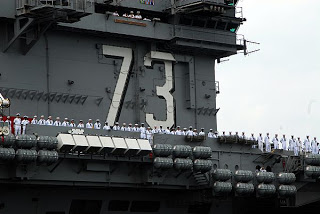
7th Fleet Focus: Welcome to the Neighborhood

Within a week of her arrival, the USS George Washington (CVN 73) is already back to sea.
The USS George Washington aircraft carrier left its new home port south of Tokyo on Wednesday on its first mission from Japan.

The nuclear-powered carrier is expected to stop in Busan, South Korea, and then head farther south into the Pacific for drills and patrols.

The George Washington, the only U.S. carrier that has its home port outside the United States, is the centerpiece of the U.S. 7th Fleet, which is based in Yokosuka.

Time to say hello to the neighborhood. The ship has spent plenty of time in port following the fire, already has a fresh coat of paint, and needs to get back in the groove.

Besides, it will give the Chinese something new to take pictures of.

More Somalian Piracy Discussion

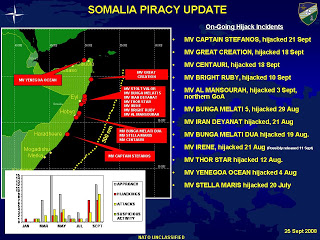
Eagle1, the must read place online for the piracy off Somalia, and who makes everyone else (including me) look like a rookie, found another brilliant gem to add to the discussion. Below is the September 25, 2024 report from the NATO Shipping Centre.
During the past week there were 7 new incidents reported including 3 hijackings
This slide shows the last known position for the hijacked vessels, the majority of which remain IVO Eyl.

IMB reports they are still awaiting confirmation of the release of MV IRENE, this vessel has, as a consequence, been put back on the list of currently hijacked vessels.

Previously

Thailand-flagged Bulk Carrier MV FONARUN NAREE was involved in an approach by pirates on 7 Sept.

Singapore-flagged LPG Carrier MV SIGLOO DISCOVERY reports that she received multiple attacks from pirates on 6 Sept, though her position at the time of the attack was not reported.

Bahamas-flagged Crude oil tanker MV FRONT VOYAGER reports she was attacked by pirates on 6 Sept.

St Vincent & Grenadines-flagged General Cargo vessel MV JIN YUAN MEN was attacked by pirates on 5 Sept.

Panamanian-flagged General cargo vessel AL MASOURAH was hijacked in northern GoA 3 Sept, 17 miles south of Yemeni coast. She was last located IVO Caluula.. There are 25 crew members on board, and 10-12 hijackers. NFI at the present time.

Private yacht, Carre D’AS IV was hijacked by pirates, 2 Sept. Vessel departed Cocos Islands, 5 Aug, on route Aden with 3 crew, (2 French national and 1 Australian national) on board. She was attacked IVO Caluula northern Somali coast.

On 29 Aug, Chemical/Products tanker, MV BUNGA MELATI 5 was hijacked in northern Gulf of Aden while on route from, Yanbo Saudi Arabia to Singapore.

(NU) Antigua & Barbuda flagged, general cargo vessel, MV BBC TRINIDAD was hijacked by pirates, 21 Aug while in central GoA, and is now assessed to be anchored IVO Eyl

(NU) Iranian-flagged Bulk Carrier IRAN DEYANAT was hijacked in northern GoA on 21 Aug, while on-route China-Netherlands carrying cargo of chemicals and minerals. There are reports that after being hijacked by one group of pirates, a rival group tried to capture the vessel and a fire fight ensued. The vessel is now believed to be anchored IVO Eyl. There are 29 crewmembers on board.

(NU) Panamanian-flagged combined chemical/oil tanker, MV IRENE was hijacked in northern GoA on 21 Aug. She is currently anchored IVO Eyl with 15 pirates on board

(NS) Malaysian-flagged chemical tanker BUNGA MELATI DUA was hijacked on 19 Aug while in central GoA. She was en-route Indonesia-Rotterdam carrying 30,000 metric tonnes of crude palm oil, and has 39 mainly Malaysian and Filipino crew on board. One of the Filipino crew members was reportedly killed in an accident during the time of boarding. Phone records released by the vessel’s owner show that, following their take over of the vessel, pirates on board the BUNGA MELATI DUA made repeated phone calls to MV STELLA MARIS, indicating that the same group of pirates is involved with both hijackings. As of 30 Aug, the vessel was believed to be moving south, away from Eyl and making for a possible rendezvous with STELLA MARIS.

(NU) Latest known position of MV THOR STAR is 07-53N 049-54E, anchored just off the coast IVO Eyl. Negotiations are in progress for the safe release of the crew and the vessel. Pirates have reduced an initial demand for 10 million dollars down to 3.5 million dollars

(NU) As of 20 Aug the MV STELLA MARIS had been moved to a new location and is now anchored at 07-01N 049-27E. Negotiations are still in progress.
Original PPT here.

Keep in mind some of this information is almost a week old. It does not list the MV Faina, and the Malaysian tankers have been released, but it does give a point in time reference and highlight the hell of a month for piracy September was. By the way, did you note that NATO has observed a firefight over the MV Iran Deyanat? Is it possible that is how people died, and not the 'mysterious circumstances' that has been reported?

There are also two outstanding articles on the subject. The first is by J. Peter Pham of World Defense Review, who suggests it is Time to Hunt Somali Pirates. The second is a new article in Popular Mechanics by David Axe called 4 Fronts for Pirate-Navy Battle as U.S. Descends on Captured Ship.

Holy Scouting Requirements Batman

Some brilliant reporting from Geoff Fein in Defense Daily, reminding us that warfighter requirements in the 21st Century change assumptions quickly. Just as quickly, the Marines adapt. Wow...
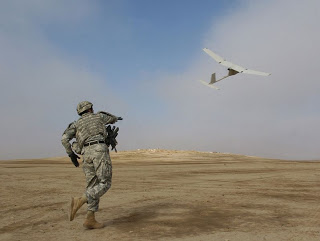
In the past 60 days, the Marine Corps has bought almost 2,000 unmanned air vehicles (UAV) from the Army and Air Force, in response to a warfighters' urgent needs requests, a Navy official said.

In order to quickly get systems to Marines in theater, the Navy and Marine Corps leveraged preexisting systems, Capt. J.R. Brown, program manager, small tactical unmanned aerial systems (STUAS), told Defense Daily Thursday.

"We have close relationships with both the Army and Air Force offices. We work with each other very well. I am very proud of that relationship," he said.

The Marine Corps has put on contract 1,993 air vehicles, Brown said. That number translates into: 13 of AAI Corp.'s Shadow air systems, 467 of AeroVironment's Raven B and 135 of its Wasp UAS, Brown added.

The systems include the air vehicles and ground stations, among other things.

Each Shadow and Wasp system has four air vehicles. The Raven B system has three air vehicles, Brown said.
1,993 air vehicles in 60 days! The concept for use the Navy and Marine Corps have in mind in for these small unmanned systems is the idea of landing the air vehicle on a rooftop, overhang, or some other landed position and leveraging the camera system to transmit video pictures for up to six hours, according to the article.
"And then just when it has enough battery power to get back home, it takes off and flies back home," he said. "It's that perch and stare they are looking at, because the video transfer doesn't draw as much power on the battery. So instead of having the vehicle loiter or hover, you basically shut the engine off and let the video do the work."
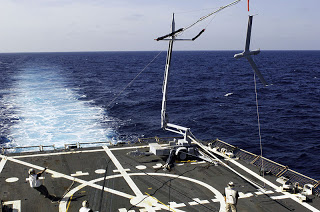
How many unmanned aircraft will be required per ship for extending the scouting radius of a surface ship in the next war? Every AEGIS battleship needs this capability, because the necessity to reach out and inspect ships closely before sending manpower, or putting one of our expensive battleships too close to a dangerous vessel exists today. However, these very small UAVs may not be the right platform to support ships at sea. We note Boeing's ScanEagle is much bigger and has better endurance. More importantly, it is better suited to operate in the more difficult weather conditions one might find flying at sea. The ScanEagle is expensive though.

The addition of new technologies, like the example of UAVs able to increase the survalliance reach of any individual ship, is a good example of the small evolutionary changes that all new ships need to be intended to support. I'm specifically thinking about platforms like the DDG-51, which must be able to support 24/7 ScanEagle operations as part of daily naval operations in the future, and that could potentially mean 3-4 ScanEagles per ship in wartime.

If the Navy is unable, or unwilling to put UAVs on every ship, then we must revisit the mothership. While the LCS will carry a few of these unmanned vehicles, the LCS is also becoming too expensive to justify its lack of firepower in large numbers under the current concept of operations. How would the Navy move massive numbers of unmanned vehicles into a theater to support naval operations of many ships over a large area? The answer is motherships, a large HVU capable of deploying all types of unmanned systems including large numbers of aviation vehicles that can cover enormous distances in support of regionally distributed forces.

Finally, this capability is a warfighter requirement derived from the Marines during a time of war. One would think, given the investment we are seeing here, that this means we have yet another Marine requirement that will be added to the mix of Marine capabilities necessary to be deployed from the sea. With weight requirements increasing for amphibious ships, and now new capability requirements continuing to add up, the Marines are facing a potential necessity to change the MEU, or at minimum increase the size of the amphibious ship force. There are options, and they do not have to be as expensive as one might think.

Where is the "UAV Jeep Carrier" concept? One would think that by now someone in the NWC, NPS, or even Proceedings would have an engineering idea to discuss the necessity of a Jeep carrier platform for these emerging air vehicle technologies. Essentially, the ability to launch and recover Reapers (as an example) from the sea, support large numbers of smaller UAVs, and generally be an aircraft carrier with pilots who are more joystick than jock seems like a no brainer. Give them brown shoes if you must, but a cheap flight deck and hanger specific to supporting unmanned vehicles need not be built to high survivability because the increased range of unmanned vehicles should allow these ships to operate well behind the defenses of task forces in major war, and stay out of dangers path in small war.

In other words, apply a concept for survivability that makes sense. Instead of building ships that operate close to shore with low survivability requirements, why not build ships that can operate even further from the shore with the lower requirements? Reduce survivability requirements and costs on the ships less likely to be easily engaged by the enemy, not the ships most likely to be engaged by an enemy.

What function would a ship like this serve in the battle line? Seems like the necessity to make the sea transparent in places where shore facilities don't exist for that function would be a good start. Admiral Ulrich's concept makes use of the coast lines of willing partners, but doesn't that leave a requirement for those ungoverned spaces where transparency is only enabled by a similar capability supporte at sea? A "UAV Jeep Carrier" concept is one of several ways that role can be filled.

Disciples of Strategy and Disciples of a Strategist

I am not an expert on John Boyd, but as a JCL on the subject, I intend to catch up. There is a small group of thinkers whom, since I began blogging, I visit daily to learn from. I call these bloggers mentors, and although I can find myself in disagreement as I browse daily, I also always find myself thinking on the subject matter. Can't beat that!

Four of these mentors (Thomas Wade, Daniel Abbott, Mark Safranski, and Dr. Thomas Barnett who wrote the foreword) recently published a book with Nimble Books called The John Boyd Roundtable: Debating Science, Strategy, and War. A book about a roundtable? Yep, and after I purchased the book from Amazon.com this evening I decided to go ahead and blog on the subject.

I find John Boyd interesting, and I've read enough of the general information to know that I should do research, but it wasn't until I sat down and read all the way through this conversation over at the Small Wars Journal that I decided to give in and buy the book. In particular, this comment from a less than enthusiastic commenter is what sucked me in.
Indeed, the most irritating thing about Boyd's work is that he left us next to nothing. Those briefs are hollow shells without his verbiage ("speaker notes") behind it. Or even the man behind it, as he could handle questions quite well. There's no body of work that he's written. So we rely on "the disciples" to interpret him and expand upon what he said. Christ wrote not a single book of the Bible and we know of him through his disciples and the interpreters ever since. Yup, the religious aspects really do appear to apply here.

People's frustration ("What's the big deal?") is certainly relevant and germane because--to those well-read in the art of war--we read Boyd's interpreters and shrug our shoulders. So what? Don't we all know that? Didn't we all know that? Like I said, if you don't have the kind of itch that Boyd's ideas were meant to scratch, he doesn't do much for you.
A military strategist who has published briefs I can read? Am I really supposed to believe the Air Force has had a modern strategist? Oh, you mean they ignored him? Now you have my attention... j/k.

To be honest, the OODA Loop and the F-16 was never enough to attract my attention to John Boyd. Decision science might be important, but it isn't exactly mainstream. What I'm finally learning about John Boyd that has my interest is that he is an interpretted strategist, lending ideas to the necessity of interpretation by those who study those ideas. I find this appealing, because as should be evident on the blog by those who read consistently, I believe there is value in strategy that can scale beyond the execution to the domain inacted. In plain English, a strategy developed in Iraq has a lesson on the sea. A strategy developed for the air force has a lesson for the Navy. Good strategy always scales.

In December I intend to do a book review of all the books I've read this year, and I have a really good list I think. It will be about 20 books, the first 20 days of December as a "just in case" for someone who is looking for an idea on what to tell that nagging family member what they can get you for Christmas.

If you are a Boyd "disciple" please leave a comment, and tell me how you think Boyd applies to the strategic discussion on this blog. I'll be unconvinced by your comment until I do my homework, but nonetheless I was talking to a very smart guy in the Pentagon last month, and we were discussing naval strategy for small wars and small ships. During the conversation I got unnerved when he brought up John Boyd in his arguments. He didn't introduce anything I had not previously heard about Boyd, but when talking strategy I intend to always be the guy well rooted in history and study.

---

JCL= Johnny Come Lately