Friday, February 22, 2024

Float the Buoy to Send Mixed Signals

I'm starting to think the Navy consolidated Mine Warfare with the Submarine service so they both would be easier to control as they are downsized. I'm not sure there is another way to interpret these statements by Adm. Roughead.

"If you look globally at submarine growth and submarine sophistication, we are not the only ones thinking along those lines because submarines are proliferating significantly around the world," Roughead said.

Roughead said the current fleet of nearly 70 submarines serves a range of missions--- from high-end warfare to involvement in the war on terror.

Roughead said he'd like to bring out about 30 new fast-attack submarines. Half of them would be built in Connecticut.

So 30 more new fast-attack submarines will be sufficient? Lets do the math here.

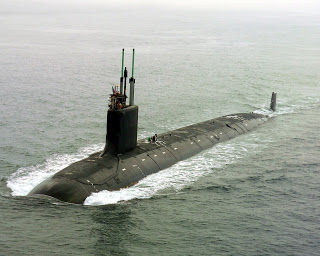
There have been 10 Virginia class submarines funded to date. Thirty more would be 40 total for the class. You can then add the three Seawolf class submarines, and because there is no planned replacement for the Ohio SSGNs, those can not be counted.

That means the future submarine force will be around 43 submarines under this 'strategy', five below the stated (reduced) requirement of 48, and this is seen as the way ahead at a time when Adm Roughead obviously observes there is a global growth in the proliferation and sophistication of submarines around the world.

I almost said I don't think that plan for submarines has any relationship whatsoever to the Maritime Strategy, however upon further review, there are no specific threats or challengers identified in the Maritime Strategy. I guess you can claim every purchase is ideal for the challenges at sea facing our nation, because whether its a Virginia class submarine or a yellow submarine, it's all fighting the same unspoken, unidentified threat that is so top secret the Navy cannot even identify it to the citizens of the United States. With such secrecy, the uninformed, uninterested taxpayer might question whether such a threat exists. Under those conditions, it sure seems easier for Congress NOT to spend money on the Navy, or more applicable, spend money for the Navy as THEY see fit because there is nothing enabling the taxpayer to say to Congress their actions are counter to strategy.

The words "inconsistent" and "incomplete" appears to be applicable to the strategy the Navy is executing. Can anyone in the Navy identify an actual "strategy" for fleet constitution, why a specific number of submarines is required, or is the current fleet constitution strategy simply a shipbuilding plan determined by what is affordable in a fiscal year? Is the current plan the way ahead because is is seen to be what keeps the industry stable from the perspective of the Navy?

We believe the future fleet should be constituted based on a "strategy of the means" to best address the desired 6 ends and support the 6 ways as outlined in the maritime strategy. Absent evidence of a publicly identified, open source "Strategy of the Means" regarding fleet constitution, we don't believe there is a strategy in the US Navy for fleet constitution.

Thursday, February 21, 2024

Reflecting Upon US 193

Today was a great day for the Navy. If you are feeling proud of your Navy, make sure you drop an email to say thanks to the good folks on the USS Lake Erie (CG 70).

This event is a reminder that the United States Navy is the most capable, smartest, most educated Navy in the world. The US Navy is an all-volunteer service, conscripts and draftees won't do. This event, particularly with the media attention and success, is a reminder that the US Navy remains very capable to the challenges that face our nation. In this case a unique mission presented itself, and yet the Navy was able to overcome the technical challenges in a short amount of time to hit a small piece of a school bus sized target, a fuel tank, which was reportedly only 40 inches wide, and hit it at around 133 nautical miles above the ground while it was racing across in orbit at a speed of over 4.7 miles per second.

Regardless of intentions or politics, that is a powerful capability no other country in the world can accomplish. While this isn't a capability that scales into a naval tactic, it highlights extraordinary flexibility of US naval forces at the high end of warfare. The inventive spirit of Lt Col James Doolittle is alive and well today in our armed forces.

In the context of the Maritime Strategy, we believe this event sends a powerful signal of deterrence to those who threaten with ballistic missiles, indeed it could be said a signal was sent that these new unsophisticated ballistic missiles like those being deployed by North Korea and Iran were highlighted as obsolete upon delivery. This doesn't mean the Navy can let down its guard or pull back its research and development, but we see an opportunity for the Navy to reassess its capabilities on a comprehensive level.

Based on the success of this event, particularly with the media attention focused on the event, conventional wisdom implies the Navy should move full speed ahead with more of this type of capability. The existing program for AEGIS ballistic missile defense will produce 18 capable warships by 2010, and follow that up with AEGIS ballistic missile defense modernizations on all 62 Arleigh Burke class destroyers. In our opinion, this builds an extraordinarily capable fleet, and unless the Missile Defense Agency would like to increase funding for the Navy, we see no need to adjust these plans.

What we do observe however is the need for the Navy to insure its capabilities in other areas of warfare are as flexible and capable in facing the nations challenges as the surface fleet proved it is today. As we look around, we are not so sure we believe that is true. The nation is at war, and we observe the naval capabilities required to fight the nations current war are woefully inadequate.

Take brown water capabilities for example, we continue to hear about the Riverine forces and their importance to the Navy in the 21st century. We observe the rotation of squadrons to Iraq, and how these rotations get plenty of media attention in the Navy, but few realize a riverine squadron is only 12 boats and around 200 sailors. The Navy has the expectation to control a river in a country the size of Iraq with a single squadron, with its 12 old reused boats, and hypes this as a priority capability?

We would suggest to the Navy to recognize the incident with US 193 demonstrates that the high end of the fleet capability mix has an amazing degree of flexibility. We believe the Navy should utilize its sizable technological lead over competitors to build up other aspects of the force that lack the same flexibility. We find the argument that this demonstration validates the investment of more large destroyers as counter to logical application of what we witnessed, as the existing force appears quite capable.

We see this demonstration as an opportunity for the Navy to invest in the low end of its capabilities mix, which clearly lacks flexibility. We believe this investment will help 'polish the edges' in dealing with other aspects of the Maritime Strategy, many of which focus on the low end of the warfare spectrum and are more likely scenarios in the near term. A few years of resource dedication at the low end of capabilities can go a long way, in fact for the cost of a single DDG-1000, the Navy could upgrade existing Riverine squadrons and actually build many more with modern equipment.

Roughead has been using the word balance often with the media recently, but we observe that there is no balance within the force, as everything weighs towards the most capable aspect of the existing fleet, and away from the forces that require a few years of attention with budgetary resources in a sound way that reflects the desires of the new Cooperative Maritime Strategy for 21st Century Seapower.

Wednesday, February 20, 2024

It's a Hit, Updated

Nice job!

A missile launched from a Navy ship struck a dying U.S. spy satellite passing 130 miles over the Pacific on Wednesday, the Pentagon said.

It was not clear whether the operation succeeded in its main goal of destroying a tank aboard the satellite that carried a toxic fuel that U.S. officials said could pose a hazard to humans if it landed in a populated area.

"Confirmation that the fuel tank has been fragmented should be available within 24 hours," the Pentagon said in a written statement.

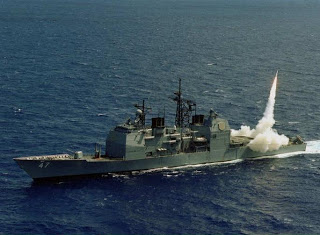
The USS Lake Erie, armed with an SM-3 missile designed to knock down incoming missiles—not orbiting satellites—launched the attack at 10:26 p.m. EST, according to the Pentagon. It hit the satellite as the spacecraft traveled at more than 17,000 mph.

The satellite was traveling much faster than a ballistic missile, much harder target with no heat source, and at an altitude the Naval ballistic missile defense was not intended to intercept.

That is impressive.

Updated: The papers are running with two stories. First, it looks like it may have been a direct hit.
In a briefing today, Marine General James Cartwright, vice chairman of the US Joint Chiefs of Staff, told reporters that the SM-3 missile had been launched from the USS Lake Erie in the Pacific at 10.26 pm local time (0326 GMT), and had struck the satellite at 22,000 miles per hour.

He said that it could take another 24-48 hours to know for sure that the tank containing the hydrazine had been destroyed - but added that the chances of any debris, or hazardous gasses, breaching the earth's atmosphere and harming humans below were remote.

"The intercept occurred. We are very confident that we hit the satellite," he said. "We also have a high degree of confidence that we got the tank."

He added that images of a fireball when the missile struck the satellite, which were shown to journalists, indicated that the hydrazine tank may have been struck. "We have a fireball, and given that there is no fuel, that would indicate that that is a hydrazine fire," he said.

Confirmation is expected by the end of the day, but the same story is also highlighting the other angle.

However, Moscow and Beijing complained that the missile strike smacked of hypocrisy as the US had rejected a joint attempt by the two countries from banning weapons in outer space only a month ago.

A Chinese state newspaper, the People's Daily, criticised Washington for hypocrisy for rejecting a treaty to ban weapons in space proposed by Russia and China and then firing a missile at the spy satellite. Washington claims it had rejected the proposed treaty as unworkable, and said it instead favoured confidence-building efforts.

"The United States will not easily abandon its military advantage based on space technology, and it is striving to expand and fully exploit this advantage," said the newspaper commentary said.

Speaking at a press conference this morning, Liu Bianca, a Chinese foreign ministry spokesman, said, tersely: "The Chinese side is continuing to closely follow the US action which may influence the security of outer space and may harm other countries."

The political fallout is dependent upon one thing, whether or not the debris lands in someones yard. There is no evidence this administration is going to play this game, after the veto in the UN regarding the militarization of space, the Bush administration has made clear their policy is no treaty. I'm mixed on this. I do not want to see the militarization of space, but that this incident is being seen as an example of what would violate such a treaty, under those terms, I'm not sure I would agree with the terms of such a treaty. ICBMs can potentially travel at much higher altitudes, I don't think there is any wisdom in adopting a treaty that prevents the development of a defensive system against an existing weapon, particularly when that existing weapon system is the most dangerous in the world, and being proliferated by countries like North Korea.

On the political issue, I believe reasonable people can disagree.

Update2: Press conference transcript. Good questions, good answers.

That Other AEGIS Warship Story

While Americans are observing the AEGIS Cruiser USS Lake Erie (CG 70) as it may or may not shoot a satellite down tonight, there is a strange 'other' AEGIS story in the news. Specifically, somehow the JDS Atago (DDG-177), as in the new Atago class AEGIS destroyer recently commissioned by Japan, was returning to Japan from Pearl Harbor when it ran over a fishing boat and most likely killing the father and son crew.

Crew on board the Japanese destroyer that collided with a fishing boat before dawn on Feb. 19 may have seen the smaller vessel 12 minutes before the crash, the Japan Times said, citing a Defense Ministry report.

A crew member on watch saw a green light on the fishing boat at 3:55 a.m., the report said. The crew took evasive action at 4:06 a.m., one minute before the collision, the Times reported. Maritime law requires boats operating at night to display a green light on their starboard side and a red light on the port side to aid other traffic, the paper said.

The Atago navy destroyer is equipped with the Aegis missile tracking system. It collided with the fishing boat in calm waters off the coast of Chiba prefecture, southeast of Tokyo. Prime Minister Yasuo Fukuda criticized defense officials after they took more than two hours to notify him of the collision.

Very strange. As can be expected, this story is getting a lot of attention and comment in Japan.

The destroyer reportedly hit the brakes only one minute before the collision -- suggesting it only spotted the small boat very late.

"If they cannot act in an actual case like this, it is a problem no matter how high quality their equipment and training," said Hisao Iwashima, a military analyst and professor at Seigakuin University Graduate School.

But another military expert, Tadasu Kumagai, said it was a common misunderstanding that ships with the Aegis system were looking at threats in the immediate vicinity.

"It has an advanced radar for air defence, but its navigational radar is about the same quality as that of a fishing boat," he said.

Kumagai said however worries over suicide attacks from small boats going undetected were very real.

"A small boat is difficult to find on a navigational radar," he said. "That would be a problem."

This ship may one day be upgraded to the same capability on display with the Navy's ballistic missile defense capability in the Pacific. If that happens, one hopes they invest in a better navigational radar at the same time.

This is the most powerful warship in the world outside the United States in terms of technology and firepower, a first-rate battleship by our ship rating system, and it had trouble seeing a fishing boat at night? Odd.

The Gorshkov Guessing Game

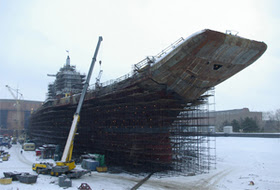
It is anyones guess what will happen, but I continue to get the impression Russia is looking for a reason to keep the Gorshkov.

A source in the Russian military establishment confirms to RBC.ru that Russia and India currently are trying to re-negotiate an agreement from 2004, according to which India was to take over the vessel after an upgrade process in 2008.

The two countries might however not be able to agree about the issue. According to the defence source, Russian authorities demand that India pay about one billion USD extra for the vessel. India on the other hand demands the takeover of the vessel as agreed upon in 2004.

Should the parts fail to agree, Russia is likely to return the aircraft carrier to its Navy.

The negotiations are going to be difficult, because India and Russia both have leverage. India can choose to tie it to any number of other purchases, from civilian nuclear power to the multi-role aircraft purchase that has everyones attention. I believe the US will be an indirect factor in the outcome. I also still think the Kitty Hawk is in play.

Bloomberg has a good article on US soft power and its influence in India. India has a chance to leverage the US in its Russia negotiations, and could score with that card. Russia and India are about 600 million apart on the negotiation price for the Gorshkov. That is a lot of money, for $600 million the Kitty Hawk can be ready to go much sooner than the 4 years Russia is offering the Gorshkov, and with F/A-18s in the multi-fighter deal, India would have a capability well beyond what Russia is offering for a many years into the future.

I get the impression Russia is resigned to the fact they are slowly losing India to competitors in military sales. After having already lost China, this will require Russia to take a closer look at their own needs, and to either find new markets or cut deals to maintain India as a market. The second part might not be possible. In a perfect world, Russia would find something besides military equipment to export. It could be the market pushes this reality sooner rather than later. One can hope.