It has been suggested the day after the Super Bowl is one of the least productive work days in the US. My office would prove that theory in anecdotal evidence alone, with half the staff calling in "sick". Thus is life in upstate NY on the day of disbelief.
Last night I was invited to an Elk Lodge. Don't laugh, I am a self proclaimed computer geek, which means I live with an innate social disadvantage, but before last night if someone asked me what an Elk Lodge was I would have answered it is what Yankees call a hunting lodge. For those like me who hadn't heard of an Elk Lodge, basically it is a social club both men and women can join. At $15 a head at the door, the final tally was 359 paid to enter. I was impressed, the bar was first class and there were big screens everywhere, even though I didn't drink more than soda it was an excellent atmosphere for the game.
In the end, it was one of the strangest feelings I have ever been apart of. As a life long Cowboy's fan, I have no love for the Giants, although I preferred them to the Patriots. As the game finished, it was like the fourth of July with one exception, it was noticeably quiet. A cloud of disbelief had hit this congregation of sports fans, with a competition of who was more stunned in disbelief, the Patriots fan for losing or the Giants fan by winning.
I left quickly after the game, and stopped at a coffee shop on the way home. The coffee shop is near a bar and a hospital, and as I pulled up there was a sea of people in the streets, but again nearly 20 minutes after the game had finished I observed a quiet hum with an occasional shout from a college aged man. Everyone was celebrating, but it was tempered by the same cloud of disbelief that apparently was not unique to the lodge. As I drove the 7 miles home, I observed small pockets of people who felt drawn into the chilly night in neighborhoods as I passed. I would roll down the window to listen when sitting at a stop light, and yet despite hoards of people, there was silence.
In losing the Patriots had done what no human who observes Albany could ever do, they left the the capital of communication, rhetoric, and big talk for New York State lost for words, probably for the first time in centuries.

Monday, February 4, 2024

Admiral Kuznetsov Photo Album: From Recent Deployment
Photography of the Admiral Kuznetsov from the recent deployment.

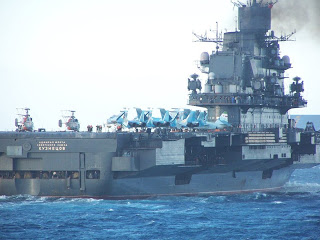
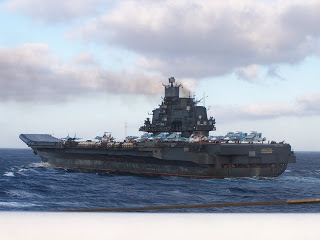
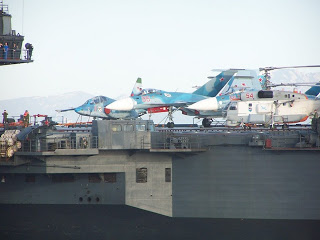

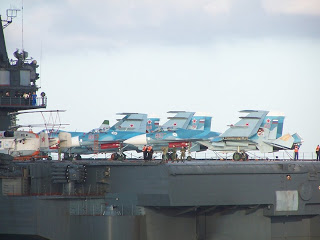
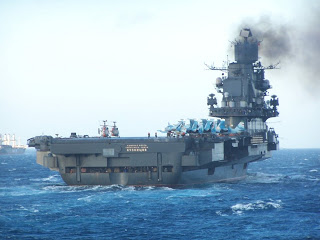
 Click to enlarge photos.
Sunday, February 3, 2024
Expeditionary Warfare, Soft Power, and Naval Strategy

The expeditionary character and versatility of maritime forces provide the U.S. the asymmetric advantage of enlarging or contracting its military footprint in areas where access is denied or limited. Permanent or prolonged basing of our military forces overseas often has unintended economic, social or political repercussions. The sea is a vast maneuver space, where the presence of maritime forces can be adjusted as conditions dictate to enable flexible approaches to escalation, de-escalation and deterrence of conflicts.
The speed, flexibility, agility and scalability of maritime forces provide joint or combined force commanders a range of options for responding to crises. Additionally, integrated maritime operations, either within formal alliance structures (such as the North Atlantic Treaty Organization) or more informal arrangements (such as the Global Maritime Partnership initiative), send powerful messages to would-be aggressors that we will act with others to ensure collective security and prosperity.
United States seapower will be globally postured to secure our homeland and citizens from direct attack and to advance our interests around the world. As our security and prosperity are inextricably linked with those of others, U.S. maritime forces will be deployed to protect and sustain the peaceful global system comprised of interdependent networks of trade, finance, information, law, people and governance.
-- Cooperative Maritime Strategy for the 21st Century
The Cooperative Maritime Strategy for the 21st Century defines the Maritime Strategic Concept to be one of strategic defense in the spirit of Julian S. Corbett. Corbett's writings and perspectives on Maritime Strategy focused primarily on the strategic defensive instead of the decisive battle or strategic offensive, but he emphasizes within the context of his strategic defense concept that one must go on the offensive at the operational level as opportunity allows.
In The Long War, we observe the major surface combatant fleet and underwater service have taken a posture based on a strategic defense. This defensive posture enables potential competitors to build naval forces that can potentially challenge for Command of the Sea in the future, or build a future maritime environment for Uncommand of the Sea in the spirit of Corbett. This is natural in peacetime when there is strong maritime competition among the nations with the worlds largest economies. With the major war forces operating in a strategic defensive posture, we observe Expeditionary Warfare forces being configured as the offensive force at the operational level, and we also observe this is directly in line with the expeditionary spirit of the new Cooperative Maritime Strategy.
In particular, and by name, we observe the new concepts attributed to Sea Basing emerging as the tip of the spear for the offensive at the operational level in The Long War. What we have not observed is an offensive strategy, including an official definition and requirement for these Sea Basing operational concepts that defines the objectives of the offensive at the operational level.
We believe the importance of expeditionary forces has increased with globalization and due to the current environment of dispersed, well funded violent extreamlism, but in the process we observe the prominence of amphibious assault within the context of expeditionary forces has decreased. The reason for the decrease in prominence of amphibious assault has nothing to do with the requirement for assault from the sea, rather is due to the nature of the offensive being developed at the operational level to fight The Long War. In the Cold War, maritime expeditionary forces were tailored and deployed to deliver major war firepower to perspective enemy forces.
In The Long War, maritime expeditionary forces are being tailored and deployed to deliver soft power to prevent or mitigate disruptions and crises. The forces for offense in The Long War are completely different, they include traditional amphibious platforms for Global Fleet Stations and Afloat Staging Bases, but also introduce new platforms in Humanitarian Ships and Logistics ships supported by other non-combatant forces. The combination of traditional and non-traditional maritime forces form the material resources required for the offensive in The Long War at the operational level. The new force structure for the required operational level offensive explains why amphibious assault has lost its prominence in expeditionary warfare, but it requires a new definition set to explain how amphibious assault forces and Global Fleet Stations are equal offensive concepts at the operational level within a defensive strategy. This graph is a work in progress that we are tinkering with to establish the relationship.
 We contend this graph represents Expeditionary Warfare's emerging role within the context of 21st century challenges. At the far right of the curve, we observe a soft power requirement for phase 0 operations being met by the Global Fleet Station and other nontraditional naval deployments like the use of Hospital Ships. Global Fleet Stations, what has been defined within the context of Sea Basing in the past, is a presence mission conceived as an affordable ship for "engagement" operations up and down a coast and as a springboard for humanitarian and small scale military operations.
We have also observed an "at-sea" aspect of expeditionary warfare emerging, which has also been described as Sea Basing, which I have termed using the historical based term "Afloat Staging Base". An example is the system of platforms that helped conduct the pirate operations off the coast of Somalia at the end of last year, and represents a presence mission at sea and into the littoral for the Navy similar to the presence operations on land that Global Fleet Stations provides. We predict that as both concepts evolve, the Afloat Staging Base will become the Sea Based logistics and support for the Global Fleet Station in certain theaters.
As is illustrated by the graph, we see both Global Fleet Stations and Afloat Staging Bases as part of the Strategic Defense Strategy of the US Navy today in the spirit of Corbett, however both also represent the offensive at the operational level aspect in the Long War that Corbett discusses. We see these operational level offensive concepts as on par with other offensive concepts like Amphibious Assault and the proposed Transshipment Dock that General Conway believes is Sea Basing. The major difference of coarse is scale of conflict, from Phase 0 all the way up to and including Major War. We also note that as the line on the graph goes higher, the cost for operations goes up.
Cost creates the largest challenge facing the US Navy and Marines today in developing Expeditionary Warfare for the 21st Century. Major War requirements demand both the Navy and Marines plan and fund the highest requirements, particularly in the budget constrained environment of today. This raises the challenge of finding platforms at very low cost for anything on the right side of the graph, and indeed anything that is high cost contributing to missions on the right side of the graph must contribute to its cost level all the way to the top of the left side of the scale.
 We note that the challenge is philosophical as well, the question becomes whether the Navy will invest in the low end of expeditionary warfare to create the capability to influence more regional areas simultaneously for peacemaking, or will they choose to spend the bulk of budget funding on the Transshipment Dock to support the highest end requirement of Expeditionary Warfare for the warfighter. Under a constrained budget, the Navy will not be able to afford both, so it will be interesting to see at what level of war, major war vs soft power, the Navy decides to invest their limited material resources.
This is also why we see a naval humanitarian response to disaster, or a hospital ship deployment, as a means of grabbing the initiative and going on the offensive at the operational level within the Strategic Defensive context of the Cooperative Maritime Strategy for the 21st Century. Just as the method and means of war has changed for the Army on the ground in both Iraq and Afghanistan, we observe the method and means of war has changed at sea for the Navy as well.
JHSV Program Design Winners
The JHSV program is an effort between the U.S. Army and the Navy to acquire vessels for fast intra-theater transportation of troops, military vehicles and equipment. The JHSV program combines the Army's Theater Support Vessel (TSV) program with the Navy and Marine Corps High Speed Connector (HSC). The Navy's Program Executive Office, Ships is conducting acquisition for both the Army and Navy, but each service will fund its own ships. After delivery, Below is a closer look at the three designs chosen for the current phase. One of the following designs will be selected by the Navy for contract in the 4th Quarter of FY08.
Austal USA Press Release
Incat Press Release
General Dynamics Press Release (Bath Iron Works - Rolls-Royce)
We don't have a preference in this competition, but we do observe all three designs are basically evolutions of existing designs. In that regard, we have a high degree of confidence of the program and process to date, and will observe to see if this program experiences the cost growth we have observed in other shipbuilding programs. Note, the Army and Navy may choose different designs, so more than one may ultimately be chosen in the long run.
Austal USA Press Release
Austal is pleased to announce the award of a Preliminary Design Contract for the Joint High Speed Vessel (JHSV) programme for the US Navy and Army. The JHSV requirements and concept of operations are similar to those of the Austal built “WestPac Express”, which has been successfully serving the III Marine Expeditionary Force in Okinawa, Japan for more than 6 years.
Executive Chairman, John Rothwell commented on the achievement, “As one of three companies down-selected for the Preliminary Design Contract, Austal has a strong chance of advancing to final selection given its large skilled workforce and world class facilities in Mobile, Alabama.”
At the conclusion of the six-month JHSV Preliminary Design Contract, Austal will submit a proposal for the Detailed Design and Construction Contract. This contract will include the award of a construction contract for the first ship and options for a further seven ships set to be awarded between US FY09 and FY12.
If successful, the JHSV programme will be supported by the existing Austal labour force and facilities, and with the current facility expansion underway at Austal will allow the construction of a combination of JHSV and LCS platforms concurrently.
Austal USA CEO, Bob Browning said, "The JHSV design is right in the middle of the Austal breadth of experience. We are the only shipyard in the United States to have built a high speed aluminium ship larger than 100 metres in length, and therefore feel justifiably confident that Austal is best placed to deliver a low risk JHSV platform to the US Army and Navy."
Incat Press Release
Incat Tasmania Pty Ltd and Revolution Design Pty Ltd are pleased to announce they have been awarded one of three US multi-million dollar design contracts by the US Department of Defense.
The Tasmanian based companies are part of an international consortium responding to the United States Department of Defense (DoD) acquisition program for the Joint High Speed Vessel (JHSV). The JHSV program brings together United States Navy, Army, Marines, and SOCOM to pursue a multi-use platform.
The consortium is led by Incat's United States partner, Louisiana-based Bollinger Shipyards, Inc., and includes Australia's Incat and Revolution Design, Incat Chairman Robert Clifford explained.
"As one of three companies chosen for the Preliminary Design Contract, the Incat consortium is well placed to proceed to the next build contract phase thanks to its vast and successful experience providing three vessels for intensive U.S. military service," Mr Clifford said.
The Australian Incat-built High Speed Vessels, HSV-X1 Joint Venture, TSV-1X Spearhead and HSV-2 Swift, have already been employed by the DoD for experimentation and demonstration of high speed vessel technologies as well as for logistics support. These craft have been used to support operations in the Global War on Terrorism and during Operation Iraqi Freedom. They have been deployed to the Horn of Africa, Persian Gulf and Southeast Asia.
Additionally, HSV-2 Swift supported relief operations in Indonesia and in the GulfCoast region following hurricane Katrina. In both cases, Swift's high speed and shallow draught combined to make it an ideal platform for the delivery of relief supplies and support of other platforms operating in the area. During operations following Katrina, Swift was able to access ports inaccessible to other ships in the logistics force, and therefore played a critical role in the early delivery of supplies.
The Australian Navy has also experienced the benefits of Tasmanian-designed vessels, operating the Incat 86 metre WavePiercingCatamaranHMASJervisBay during the East Timor crisis.
The JHSV is a new generation, multi-use platform capable of transporting troops and their equipment, supporting humanitarian relief efforts, the ability to operate in shallow waters and can reach speed in access of 35 knots fully loaded.
The Incat 112 metre, which forms the base of the consortium's submission, is the largest catamaran ever built in Australia. Already proven in commercial service it provides unparalled seakeeping and comfort even on rough open sea routes. Power is supplied by four diesel engines, each rated 9000 kW at 1000 rpm and consuming <190g/kwh.
General Dynamics Press Release (Bath Iron Works - Rolls-Royce)
The U.S. Navy has awarded Bath Iron Works, a subsidiary of General Dynamics (NYSE: GD), a $3 million contract to develop a preliminary design for the Joint High Speed Vessel (JHSV) Program. Work to be performed during the next six months by Bath Iron Works and its teammate Rolls-Royce includes the functional definition of the ship structure, systems and general arrangements of ship spaces.
The JHSV program is an effort between the U.S. Army and the Navy to acquire vessels for fast intra-theater transportation of troops, military vehicles and equipment.
The ship concept proposed by Bath Iron Works and Rolls-Royce is based on a Rolls-Royce design for a roll-on/roll-off passenger vessel. The steel monohull design features a combined diesel and gas turbine propulsion plant, water jets, self sustaining roll-on/roll-off and load-on/load-off capabilities, a large cargo area and a flight deck for helicopter operations.
Bath Iron Works President Dugan Shipway said, “We are extremely pleased that the Navy has selected the BIW/Rolls-Royce Team to further develop our JHSV concept. We have a strong relationship with the Rolls-Royce family that extends back to the very beginning of the DDG 51 program. This award allows us to bring the experience and success we have shared in the course of building 29 Aegis destroyers into this very important program. We’re ready to get to work on more fully developing our concept and we’re confident that we have an excellent solution for the needs of the Army and the Navy.”
Bath Iron Works of Bath, Maine, is a leader in the design and construction of surface combatants for the United States Navy and is the lead designer and builder of the Arleigh Burke (DDG 51) class of AEGIS destroyers. The company employs approximately 5,800 people. General Dynamics, headquartered in Falls Church, Va., employs approximately 83,500 people worldwide and reported 2007 revenues of $27.2 billion.
Rolls-Royce, a world-leading provider of power systems and services for use on land, at sea and in the air, operates in four global markets - civil aerospace, defense aerospace, marine and energy. Rolls-Royce has a broad customer base comprising 600 airlines, 4,000 corporate and utility aircraft and helicopter operators, 160 armed forces, more than 2,000 marine customers including 70 navies, and energy customers in 120 countries.
We don't have a preference in this competition, but we do observe all three designs are basically evolutions of existing designs. In that regard, we have a high degree of confidence of the program and process to date, and will observe to see if this program experiences the cost growth we have observed in other shipbuilding programs. Note, the Army and Navy may choose different designs, so more than one may ultimately be chosen in the long run.
Type 39 Mod (Type 39C?) - New Pictures
We have previously covered some of the adjustments taking place with the Type 39 submarines. The Yuan class, also known as the Type 39A, was supposed to be a replacement for the Type 39 and Type 39G Song class. However we previously compared the differences between the Type 39A and what we are calling the Type 39B. We also previously highlighted what appears to be a Type 39C under construction in Wuhan.
We observed yesterday new pictures of the Type 39C on Chinese BBS. These three pictures are better quality than the Type 39C pictures previously posted on the internet, but because the angle we still require long angle pictures to make definitive assessments. Regardless, it should be noted that since the last Pentagon military report on China, there are at least 2 new Type 39 submarine versions. The rate of PLAN submarine construction continues to be at least 4x that of the United States.


Click the pictures to enlarge. Also check out Feng's place (fix your pics Feng) where we are seeing confirmation of Yuan being an AIP submarine. If the Type 39A is considered to use 2 AIP engines for 100kw power, then the modifications to the Type 39C speculated by some of our submarine observers who believed the mods were to increase power output could be correct. Still, there isn't enough information yet to do much beyond speculate.
We observed yesterday new pictures of the Type 39C on Chinese BBS. These three pictures are better quality than the Type 39C pictures previously posted on the internet, but because the angle we still require long angle pictures to make definitive assessments. Regardless, it should be noted that since the last Pentagon military report on China, there are at least 2 new Type 39 submarine versions. The rate of PLAN submarine construction continues to be at least 4x that of the United States.
Click the pictures to enlarge. Also check out Feng's place (fix your pics Feng) where we are seeing confirmation of Yuan being an AIP submarine. If the Type 39A is considered to use 2 AIP engines for 100kw power, then the modifications to the Type 39C speculated by some of our submarine observers who believed the mods were to increase power output could be correct. Still, there isn't enough information yet to do much beyond speculate.
Subscribe to:
Posts (Atom)