Wednesday, October 3, 2024

Dog and Pony Shows

I guess I'm not political enough, I hadn't even heard of the whole Rush Limbaugh episode until today, and even then it took about 5 minutes to realize it was a dog and pony show. I guess I don't watch enough TV, but the media would have to omit major sections of this story to sound credible in support of the Democrat efforts. The guy was convicted of being phony, what else is there to say? I'm not a Rush fan, but anyone dense enough to buy what is being said about him on this issue is a drone.

But why the distraction?

Because the Senate passed the 2008 Defense Bill by a vote of 92-3 very quietly late on Monday, and only 17 news articles were listed in Google as of 24 hours later. Make enough noise, cause enough distraction, and nobody will notice I guess. Either the left in the US is truly stupid, or the Democrats think they are and can treat them like they are stupid without consequence. Regardless, the only thing all this noise does is improve the credibility of Limbaugh and validate claims the Left still aren't serious players in any aspect of the Iraq discussion, and have to resort to circus over substance.

The final tally: $648 billion. I'll cover details once it becomes law, which is after committee and a presidential signature. If things stay as they are, this could end up the best defense budget for the Navy to date in the Bush administration, in my opinion anyway... more later.

Tuesday, October 2, 2024

Littoral Combat Ship: More Dollars, Less Sense, and Critical Gaps

Defense Industry Daily has 2 new articles up on the LCS, specifically an update of recent events in the current Littoral Combat Ship program and news of Navy approval of the SUW module.

Starting with the Surface Warfare Module, NavyNewstand lists the SUW module components:

"...electro-optical/infrared sensors mounted on a vertical take off unmanned air vehicle [the MQ-8B Fire Scout] to provide over-the-horizon detection; 30mm guns to kill close-in targets; four [4] non-line-of-sight launching system [NLOS-LS/ "NetFires"]... container launch units, with each system containing 15 offensive missiles; and the MH-60R armed helicopter for surveillance and attack missions. The SUW mission package has software that interfaces with the LCS command and control system to maintain and share situational awareness and tactical control in a coordinated SUW environment…. The first two [2] SUW mission packages assembled for developmental and operational testing use the Mark 46 30mm gun made by General Dynamics Amphibious Systems."

DID goes on to ask the question for me:

The $400-500 million question is, will this be enough?...

As other DID articles have noted, this array plus a 57mm naval gun is a slim attack punch for a $400 million frigate-sized ship, with no torpedo launchers for snap engagement of submarines, and no missiles that could seriously threaten other warships. Even smaller designs like Denmark's SF300 FlexShips, which inspired the LCS' mission module design, pack both anti-shipping missiles and torpedo tubes.

The Navy continues to move forward despite cancellations and program cost troubles as both classes approach sea trials next year. The evaluation process leading to a Flight 1 design will be interesting to observe for a number of reasons, but beginning to top my list is that the choices for a Flight 1 LCS design have expanded considerably since the original Flight 0 order. While there are gains in modularity, the question that needs to be asked during the fiscal crunch is whether modularity is value for cost, the answer to which may be in the negative as costs continue to rise.

I have previously covered both the General Dynamics Multi-Mission Combatant and Lockheed Martin Multi-Mission Combatant export brochures that arm up the LCS design beyond the US Navy model which focuses on modularity. One of the interesting notes in the DID module article is the brochure for the LCS-I, the Israeli LCS that utilizes a lot of technology India has purchased into, which is noteworthy given a recent announcement that India is interested in the LM version of the LCS. Presumably, India and Israel are interested in the same version of the ship, something that could substantially lower cost.

Also relevant however is the interest of Saudi Arabia in the General Dynamics design. The primary difference in the armament of the two LCS designs lays in the type of VLS cells, the General Dynamics version has 16 tactical length cells for up to 64 RIM-162 ESSM anti-air missiles, while the Lockheed Martin version has strike length cells that could accommodate anti-ship missiles.

However, DID links to this article explaining that the General Dynamics version has recently hit a snag in construction.

Navy inspectors have documented numerous problems with construction of a next-generation vessel known as the littoral combat ship, or LCS, according to government records obtained under the federal Freedom of Information Act.

Among the concerns singled out in more than 180 "corrective action reports'' filed between late 2005 and this May: botched welding, employees doing work for which they were not qualified and potentially dangerous misapplication of sound-dampening material.

Both the Navy and the lead contractor, Virginia-based General Dynamics Corp., downplay the significance of the reports. Neither, however, would say how much the rework, as repairs are commonly known, has contributed to the ship's ballooning price tag, now more than $100 million higher than originally expected.

....

When the General Dynamics/Austal team won the Navy contract to build the Independence almost two years ago, the ship was supposed to cost $223 million, with delivery set for this October. Now, delivery won't happen until next June, according to General Dynamics.

In addition, the cost will be at least 50 percent higher, Navy officials say, although they will not furnish a more precise number. In a separate forecast released last month, the nonpartisan Congressional Budget Office pegged the tab for the ship at $630 million, although that figure wraps in outfitting and other expenses not included in the Navy's original projection.

Many of the problems flagged in the corrective action reports appear to be minor. But at one point, the Navy faulted General Dynamics for "a lack of oversight'' in ensuring that Austal was meeting contractually required production and quality standards.


The price of the LCS has almost made the ship prohibitive, and one would think the class would already be canceled if the Navy wasn't facing critical gaps that are even more apparent given current events. One of the problems facing the Navy is in fact countering that which most people don't believe would ever happen, a first strike by a nation like China or Iran under any situation. Access to blue water for the US Navy tends to mitigate some of the problems the US Navy faces agaonst China, with the exception of MIW clearance, however Iran is a different problem and a situation the US may not have a choice in should Israel take unilateral action.

In an all out war scenario, the combination of small boats, submarines and mines in a condensed region like the Persian Gulf or the Strait of Hormuz would make naval operations difficult at best. Current US Navy minesweepers are capable platforms, for mine sweeping, but were never designed to operate in a contested environment and are over matched in firepower by even small boats operated by the IRGC. While the LCS is arguably better armed to deal with such threats, the weak initial armament on the modular version of the LCS, not to mention the relatively weak firepower on the modular version designed for surface warfare, is rightly questionable.

As I have pointed out in the past, the LCS is not about ASW, at least for the mid term no matter what some advocates try to say. This leaves the submariners with double duty during crisis against an opponent that operates submarines.

When the lack of realistic ASW support provided by the LCS is combined with the lack of firepower of the LCS on the MIW package, and the shortcomings of the existing SUW packages, and the incredible cost of the modular design the Navy is hopefully asking legitimate questions regarding the future of the LCS program. Unlike what was available at Flight 0, the Navy has several options for Flight 1 including multi-mission alternatives of the LCS hull design, and potentially other low cost precision weapons available. The FFG-7s are getting old, and need to be replaced sooner rather than later as they are slowly becoming less reliable. The Navy may be wasting time and taxpayer money at this point if the Navy doesn't see the LCS as the solution originally intended.

PLAN: Mine Warfare Wolf Packs as an Anti-Submarine Warfare Strategy - Updated

The Winter 2007 edition of Undersea Warfare Magazine had an article regarding the use of Mine Warfare as a 'poor mans solution' to anti-submarine warfare. As I was reading through the article, I was reminded again and again of the various articles written this year regarding the PLAN underwater warfare strategy unfolding through various, but relatively few sources of information. The Undersea Warfare Magazine article is easily the best researched, but it is noteworthy that other sources reinforce the claims, and as the picture is formed us laymen can get a sense of the PLAN strategy.

Recent Chinese MIW exercises have involved air, surface and even civilian platforms extensively. Of particular interest in this forum, however, is that China’s navy also considers mine laying from submarines to be “the most basic requirement of submarine warfare.” Mine-laying has become an integral component of recently enhanced Chinese submarine force training45 in which crews strive to conduct a wider variety of increasingly challenging exercises attuned to local environmental, hydrographic, and weather conditions. Such exercises are documented in some detail in the PLA Navy’s official newspaper, People’s Navy (Renmin Haijun). In particular, China’s navy views submarine delivery of mines as a critical aspect of future blockade operations. By 2002, mine-laying had become one of the most common PLAN submarine combat methods. Accordingly, PLAN crews train to handle submarines loaded with large quantities of mines. Drill variants include “‘hiding and laying mines in deep water.’” Broad and deep mine-laying against port targets is also emphasized.

Chinese naval officers recognize the challenges inherent in “penetrating the enemy’s anti-submarine forces and laying mines behind enemy lines.” According to one PLA Navy captain, “Secretly penetrating the combined mobile formation deployed by the enemy’s anti-submarine forces is a prerequisite to fulfilling the mine-laying task.” There is some evidence that China may rely on centralized control of its submarines when conducting offensive mining missions. In carrying out offensive mine blockades, notes one Chinese analysis, “…if there is a shore-based submarine command post to handle command and guidance of the submarine for its entire course, it will not only ensure its concealment but also improve the strike effectiveness of the mines… that are laid.”

The Chinese Navy is working hard to improve the quality of its submarine officers and sailors, including their proficiency in MIW. China’s official radio cited PLA Navy submarine detachment torpedo and mine officer Chao Chunyi for achieving sixteen research results in underwater mine-laying training, cutting mine loading time in half, and developing a mine movement control device. Song Submarine 314 Commander Ma Lixin, a celebrity in China’s naval press, recently led an East Sea Fleet submarine detachment to “develop tactical innovations.” In the past year, Ma researched and developed over ten new operational methods “including how to carry out a blockade and how to lay mines using conventional submarines.” In early 2005, Ma “led his unit to participate in live exercises at sea… they arrived at a designated area to… [lay] mines.” In an early 2005 mine exercise, Ma was charged with evading ‘enemy’ ASW airplanes, a mine field, and - most difficult of all - an adversary submarine, in order to lay mines in a nearby area. He used his mastery of the local environment, adopted minimum noise navigation speed, eluded the ‘enemy’ submarine and shore radar and accomplished the mine laying mission on time. In summarizing such achievements, a source notes, “This year there occurred even more enhanced submarine mine exercises with step-by-step progress….”

One of the interesting items that came out after both of these articles were written is how the PLAN has been deploying submarines in exercises. Good content is hard to come by, so I have had to rely mostly on my first hand sources from Asia that base their opinions on mostly their own research. The China Defense Blog reported one such story back in May.

One day in mid May, reporters witnessed a confrontation training involving multiple submarines staged by a submarine flotilla of the East China Sea Fleet. According to the chief of staff of the flotilla, with its successful leap from the primarily single submarine training to the multi-submarine joint training under complex conditions, the flotilla has noticeably hoisted its striking performance.

  Recent years saw this submarine flotilla growing full-fledged in the course of stretching its reaches from south to north and from the offshore to the open seas.

  In the evolution from the single-submarine training to the multi-submarine joint training under complex conditions, its sense of mission and sense of responsibility in boosting energetically the transformation of military training are epitomized. With its resolve to drop the traditional "guerillaist" method of single-submarine training, the flotilla spares no effort to seize the initiative in acquiring the long-distance joint maneuver capability. To this end, it has advanced from technical training to tactical training, from element-by-element and separate training to integrated training involving the whole system, from training under uncomplicated battlefield environment to confrontational training under complex battlefield circumstances, which resulted in the all-round rise of its abilities in command and control, rapid response, joint strike and integrated training.

This is a theme I have been reading and hearing a lot about lately. Originally, as one of my Aussie friends puts it, no one believed China had the capability to operate in Wolf Packs because the prevailing assumption was China lacked the technology in undersea communications to coordinate an attack. However, as exercises have been continuously observed, there are observations regarding the Chinese Wolf Pack worth noting. The nuke boats tend to be hunters, and the prevailing theory is the Wolf Pack tactics are being developed for MIW operations as apart of the larger sea denial strategy.

When you consider the presence of an older Ming in these Wolf Packs, one of the common theories in simulation circles is these submarines would be utilized as lures, or bait, for enemy submarine forces to bring them into minefields specifically designed to defeat enemy submarines. In an area denial strategy, these older conventional submarines would optimally be deployed as lures in mined areas where a denial strategy exists against airborne ASW assets.

It was recently reported the Yuan (039A) class has hit mass production, if this is indeed true the Ming's would likely be replaced by the Song's in this role. The use of Kilo's and Yuan's in these type of Wolf Pack roles for MIW would make it very difficult on adversary submarines to operate freely in contested waters without reliable, organic MIW detection capabilities.

The same authors also contributed to the Naval War College Review 2007 paper China's future nuclear submarine force: insights from Chinese writings, which has some overlap but also a lot more content and additional observations regarding the PLAN nuclear submarine strategy specifically. It would be interesting to get an updated opinion from these authors. With the recent photography of the 093 showing the submarine is closer to a Western design as opposed to a Russian design (see picture to right), and word of the 095 now under construction, I would be curious if they would adjust any of their analysis based on new information.

Update1: Just thinking out loud here, but I wonder if Song Submarine 314 is the same Song class submarine able to penetrate close to the Kitty Hawk CSG in November 2005. If you read the story as claimed in the article, well..., it certainly reads like the same incident.

Monday, October 1, 2024

The Royal Navy Faces Irrelevance

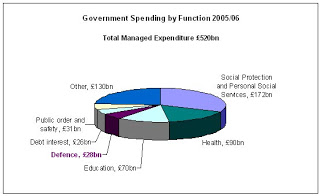
The storm clouds are gathering over the worlds oldest Navy, and several are starting to sound the sirens. While the government is spending record amounts of money, the MoD is suffering from a variety of priorities, several of which are politically driven, some of which are driven by the war, and all of which appears to be the result of the absence of a clear and consistent national defense strategy.

In 1998, the MoD released a Strategic Defense Review that brought into focus the need for the Royal Navy to renew its naval carrier capability. At the time this was considered a banner moment for the Royal Navy as it prepared to revitalize itself as a dominant Naval power in the 21st century. The results have been quite the opposite.

Today the Royal Navy is an underfunded shell where capabilities only exist on paper. From the top down, the Royal Navy has enormous voids that blur the lines between theoretical capability and reality. Consider this, the Royal Navy has 2 VSTOL aircraft carriers, but are now forced to deploy their carriers with no aircraft. The Sea Harrier FA.2 has been retired. The sole operational naval air squadron (800 NAS) uses the Harrier GR.7/9 and is about to deploy to Afghanistan, providing land-based close air support to NATO forces there. HMS Illustrious recently made a deployment to the United States, where it was used by USMC Harriers, not as a trial, but because the Royal Navy doesn't have any planes.

While the Harriers are in Afghanistan, HMS Illustrious will be deployed with only helicopters, becoming nothing more than an over sized and expensive LPH. The problems in the Royal Navy aren't limited only to current carriers however, indeed the entire fleet both future and past is suffering from financial neglect.

Consider the retirement of HMS Norfolk after only 15 years, HMS Marlborough after 14 years, or HMS Grafton retired after only 10 years, all three of which were sold at considerable discount and now serve admirably in the Chilean Navy today. These Type 23 frigates rank among the best, most modern anti-submarine platforms in the world, but also highlight a void in long term strategic thinking by the MoD regarding the Royal Navy. Indeed, ships are purchased only to insure jobs, and in retrospect repeatedly have proven to have little to do with strategy.

In the October 2007 edition of Proceedings, Vice Admiral Sir Jeremy Blackham, RN (Ret.), and Gwyn Prins warn that things will get worse, not better:

The hemorrhage of numbers of DD/FF, down from the 32 specified in the Strategic Defence Review, has been justified with the “Technology Fallacy.” This asserts that the improved capability inherent in each modern unit renders obsolete the old-fashioned view that numbers matter. This strategically illiterate opinion ignores the obvious fact that one ship, however capable, can only be in one place at one time; and the rising importance of presence missions demands many, many more hulls. It also ignores the fact that the opposition’s capability also improves with time.

On this formal logic, we believe that the future is being sold short. Just as the current Navy is the product of Navy Board decisions made 20 years ago, so today’s build rate will determine the fleet 20 years hence. It takes time to build ships. The record of the last decade speaks for itself. The low building rate since 1997 has been unprecedented since well before World War I. It has been even lower than it was during the Treaty restricted years 1921-36. (See table)


Commissioning Rates Royal Navy Cruisers And Destroyers
1918-1936; Commissioning Rates Rn Destroyers And Frigates 1980-2008
Year
Cruisers
Destroyer
Leaders & Destroyers

Year
Destroyers &
Frigates
1918
7
57
1980
2
1919
7
33
1981
2
1920
1
3
1982
3
1921
1
0
1983
1
1922
3
2
1984
2
1923
0
1
1985
3
1924
1
4
1986
1
1925
1
1
1987
1
1926
2
2
1988
3
1927
0
0
1989
2
1928
5
0
1990
2
1929
4
0
1991
2
1930
3
8
1992
1
1931
1
10
1993
2
1932
0
5
1994
3
1933
2
5
1995
1
1934
2
10
1996
1
1935
3
8
1997
2
1936
2
17
1998
0


1999
0


2000
1


2001
1


2002
1


2003
0


2004
0


2005
0


2006
0


2007
0


2008 0
Five Power Washington Naval Treaty—negotiated November 1921-February 1922

London Naval Treaty—five powers agree to extend capital ship moratorium to 1937, but the Axis powers start to cheat

Second London Naval Treaty—nugatory without Japan, Germany and Italy

Sources: Jane’s Fighting Ships 1919, 1930, 1939, 1991-92, 2002-2003, 2006-2007
Alan Raven & John Roberts British Cruisers of World War Two (Arms & Armour Press London 1980)

By 2003, all DD/FF ordered by the previous government were in service; the Royal Navy has received none since then. By the time all six Type 45s presently on order enter service in 2014, the commissioning rate for the period 2003-14 will be one ship every two years. Given a nominal service life of 25 years this implies a DD/FF force of about a dozen ships. The steep drop in numbers is matched by dramatic aging of the fleet. In 1997 the average age of the DD/FF force was a little under 10 years. Today it is almost 17 and by 2010 it will be 19. Why do we emphasize the importance of destroyers and frigates? Because without these classes of ship, and the capabilities they represent, the fleet loses its principal patrolling, maritime security, escorting, joint sea-base protection, and littoral effect-capability. They are, in fact, the glue which holds the fleet together; the most visible face of maritime capability.

One of the key points the authors make in the same article is that building two carriers is not a strategy.

Ordering two carriers is not a strategy any more than buying a frozen chicken is cordon bleu cuisine. Yet senior figures in the British defense and political community do not seem to understand that difference. What, after all, is the essential capability without which you have no navy? Not ships; not people; not bases; not even traditions and organizational forms. “The fundamental element of a military service,” wrote Samuel P. Huntington in a May 1954 Proceedings article, “is its purpose or role in implementing national policy. The statement of this role may be called the strategic concept of the service. . . . If a military service does not possess such a concept, it becomes purposeless . . . and ultimately it suffers both physical and moral degeneration.” Astonishing as it may seem to an American readership, as it is to us, Britain currently risks losing a hard-headed sense of its national interests—a loss of nerve, one should firmly notice, from which our Islamist enemies do not suffer—at a time when the scale of maritime risks and threats to general Western security is sharply increasing.

Additionally, maritime force has always had a special utility in times of general and multiple risks. It comes precisely from its capacity—which it possesses more than other forms of military force—to position globally, poise motionless, and provide silent but visible presence without any specific threat while at the same time being able to react quickly to changing circumstances.

But this case is not being made clearly enough. It is of course part of a strategic concept, and therefore not readily reducible to targets, performance indicators, and “value for money” assessments derived from them, which are the dominant management tools of the accountant’s mentality that now runs the British Ministry of Defence. This “Accountant’s Fallacy” is one of several afflicting British defense policy. The Royal Navy is at the brink for more reasons than overstretched people manning insufficient, worn, and diminishing stocks of equipment faced with rising numbers of missions during the last ten years. Our anxiety about these is matched by a more general anxiety about the poverty of maritime strategic thinking.

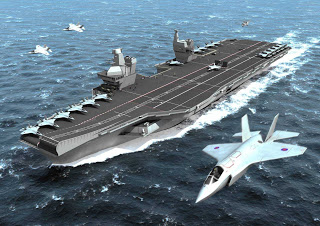
I completely agree, however it is difficult to say the MoD thinks otherwise. The situation does not improve simply replacing the current VSTOL carriers with the CVF, the questionable number of escorts that will be available combined with the split time strategy of Joint Strike Fighters raises doubt that even the CVF will be able to deploy with enough aircraft to be relevant to its size, cost, and most importantly, role in context with national policy.

The CVF cost is climbing while the carrier itself continues to sit on the design pages. All indications are pointing to only 80 F-35Bs being purchased by the MoD, all RAF. The RAF has already begun discussions that envision eight 9 plane squadrons, but in reality should the RAF use the F-35Bs in the same manner they use the GR.7/9s, one has to question if a CVF will ever actually embark more than one or two squadrons on a deployment. Without the F-35B, also suffering from cost overruns, the CVF is nothing more than a 65,000 tonnes £1.9 billion LPH, nearly £1.6 billion more expensive than the French Mistral class which would be able to perform that role.
So what is the answer? Don't ask the MoD, already they are looking to reduce the fleet further to save money. while also planning new surface combatants and other big ticket future warships sure to keep the industry satisfied. None of these projects, current or future, actually represent a strategy. Richard Beedall makes a similar point today when he pointed out MARS is in trouble,the logistics ships intended to support the CVF stalled, and the Maritime Airborne Surveillance Capability (MASC) now under perpetual study and delay raises legitimate questions regarding what the Royal Navy will look like in ten years.

The sirens sound the alarm, storm clouds are indeed on the horizon, but it might be too late. Despite the ignorance widespread among the people of Britain, the UK is a maritime nation dependent upon maritime trade, and more vulnerable to disruption than most nations because of its critical requirement for imports. I believe the Royal Navy faces irrelevance in the very near term due to the MoD mismanagement of priorities and the governments conscious action in underfunding the MoD, and it will not be prepared for the next major world crisis.

SNMG1 Rescues Yemeni Sailors

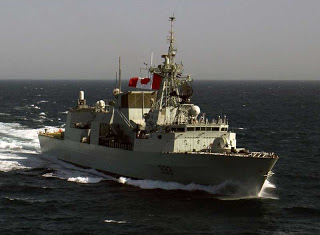
Yesterday a volcano erupted on an island where Yemen has a naval facility. It was reported that SNMG1 was going to assist with the search of several sailors who evacuated the island after the eruption. From the Canadian press on board the HMCS Toronto:

A Canadian navy ship has rescued a Yemeni soldier and recovered the bodies of two others following a volcanic eruption on a small island in the Red Sea. A total of four survivors were pulled from the water.

HMCS Toronto was part of a NATO fleet sailing north of the Suez Canal when the Yemeni government asked them to assist in the search for eight soldiers believed at sea after the volcano.

Navy spokesman Ken Allen, aboard HMCS Toronto, told The Canadian Press the survivors were found this morning as the ships were leaving the area after the Yemeni coast guard no longer required their services.

Allen said that HMCS Toronto rescued one of the eight missing Yemeni soldiers and recovered the bodies of two others.

Three more survivors were pulled from the water by Dutch and American ships.

Twenty nine soldiers were based at the island, located about 140 kilometres off the Yemeni coast, that is used for naval control and observation because large cargo ships pass nearby.

The SNMG1 tour is wrapping out without much fanfare, indeed about the only news until today up to this point was the exercise where the South African submarine scored major success in an exercise. This rescue indeed is press, but I think there is an inverse relationship between press coverage and success in naval deployments like this.

My guess would be this is one of the most successful NATO maritime deployments in a long time, and certainly one of the most useful from an engagement perspective.