Showing posts with label army. Show all posts

Tuesday, December 23, 2024

Maritime Denial and Land-Based Missiles, Revisited

Last month I wrote a bit about the idea that U.S. ground forces should field ‘area denial’ missile systems of their own to defend allies’ frontline maritime territories as well as constrain potential adversaries’ wartime abilities to use adjacent waterspace and airspace. I believe land-based anti-ship and anti-air missile systems can do much to support strategic concepts for broad-spectrum conventional deterrence within maritime theaters. Even so, I noted in my post that these systems’ hypothetical combat utility—and thus their value as part of a deterrent—depends greatly upon when and how they would be deployed to wartime positions, how those positioned on territories within a hotly-contested maritime zone would be logistically sustained throughout a protracted conflict, and how anti-ship over-the-horizon targeting would be performed.

The comments I received on that post pointed out an additional consideration that I had overlooked: the underlying business cases. Given finite budgetary resources, the U.S. Army would have to trade the opportunity costs of developing and then fielding these kinds of systems against the opportunity costs of developing or fielding other types of ground units.

For example, a strong business case can be made for the Army to field relocatable wide-area air defense systems, as they are quite useful for protecting bases, other types of U.S. and allied ground forces in the field, and critical civil/economic infrastructure sites from aerial attacks. The original Patriot system was, after all, developed specifically for these purposes. It is not much of a leap, then, for the Army to use these systems to protect maritime bases, forces, and infrastructure. Nor is it a stretch to use these systems in ways that would lessen the demand on naval surface combatants to provide air defense coverage over islands or mainland coastal areas, thereby granting the warships more maneuvering room or otherwise freeing them for other tasks. Lastly, it is perfectly reasonable to use these systems where geographically possible to create barriers the adversary’s air forces must ‘break through’ in order to achieve their operational objectives. The preceding logic applies to Army BMD systems, as well. It follows that the Army’s existing Patriot (and THAAD) missile forces provide organizational, tactical, technical, and logistical foundations for any expanded (or new) air and missile defense capabilities the Army might choose to field in the coming years. This greatly lessens the associated opportunity costs the Army would face in doing so.

It seems somewhat more difficult, though, to make a business case for the Army to field advanced ASCMs. Since the Army does not presently possess ASCM forces, there would be some opportunity costs in establishing the requisite organizational, tactical, technical, and logistical foundations. Developing an ASCM capability from scratch would also likely trade from a budgetary standpoint against expanding (or maintaining) existing ground force structure. Prior to this year, one might have rationalized this kind of trade based on a strategic assumption that global demands for ‘heavy’ U.S. ground forces would be low over the next ten to fifteen years. That assumption has been called into question by the Russo-Ukrainian War, not to mention Moscow’s increasingly aggressive military posturing against NATO’s eastern and the EU’s Scandinavian members. It is therefore harder to justify development of any new type of Army capability without a better understanding of how it might affect the service’s capacity for major ground combat in Europe.     

I have little doubt land-based ASCMs (with satisfactory over-the-horizon targeting support, of course) could be quite useful in defending America’s allies and constraining potential adversaries’ wartime operations along the First Island Chain in East Asia, the coasts of the Black and Baltic Seas, and perhaps the northern Norwegian coastline. However, I think there needs to be a critical examination of the trades that likely exist between developing new Army ASCM forces and maintaining/expanding the service’s existing combat arms. It also seems to me that an Army ASCM business case analysis should examine whether it makes more sense for America’s allies to field land-based ASCM capabilities themselves. Many of the allies the U.S. is committed to defend in the aforementioned regions already deploy such missiles, whether through indigenous production or through sales by other countries. Rather than duplicating what these allies are already doing, perhaps it would be better for the U.S. to provide the needier ones with financial assistance for establishing, improving, or expanding land-based ASCM arsenals. Or perhaps the U.S. might sell certain allies maritime surveillance/reconnaissance systems or C3 systems that would enhance their existing ASCM capabilities as well as allow them to better coordinate tactical actions with U.S. or other allied forces during wartime. It is even possible the U.S. might find mutually-beneficial opportunities to cooperate with key ASCM-producing allies on researching and developing selected advanced ASCM component technologies. 

Ultimately, I am not opposed in principle to the Army (or Marine Corps for that matter) developing land-based ASCM capabilities. I do believe, though, that their doing so requires a broader analytical basis that addresses the operational issues I previously noted as well as establishes a sound business case.

Friday, November 7, 2024

Some Thoughts on the Use of Land-Based Missiles for Maritime Denial

Eric Lindsey of CSBA published an excellent monograph last month examining how the U.S. Army might field land-based anti-ship missiles and rockets, not to mention air and missile defense systems, to defend forward U.S. allies from aggression. I strongly agree with the concept in principle. Such capabilities would be extremely useful for constraining an adversary’s wartime use of the waters and airspace adjacent to a U.S. ally’s territory. They would definitely increase the adversary’s potential costs and risks of hazarding transits through maritime chokepoints controlled by the ally, conducting close blockades against the ally, or executing amphibious/airborne assaults against the ally. They would provide valuable layers for defense-in-depth against an adversary’s attempts to strike forces and infrastructure located on the ally’s territory or in nearby areas at sea. They could certainly help with carving out temporary ‘pockets’ that support friendly air and naval operations within a contested zone.

There are a few key details, however, that I think require more analytical attention. First, the use of anti-ship missiles for over-the-horizon engagements depends upon scouting. Surveillance could be performed using land-based radiofrequency direction-finding systems or over-the-horizon radars, but neither can positively and confidently verify that a given contact is in fact something worth expending scarce missiles. Reconnaissance assets such as fishing boats, submarines, aircraft, or unmanned vehicles are better suited for the tasks of classifying contacts and cueing missile attacks, but this raises the question of whether their information would be processed through a fusion center that generates a shared situational picture for the entire defense or whether it would be provided directly to the missile units. There are advantages and drawbacks for each that ought to be weighed; my own preference is that missile units would be supported by dedicated scouts (example: light UAVs that are organic to those units) that can also provide their information to a shareable situational picture. All this says nothing of the challenges of preventing the adversary from detecting, interpreting, and exploiting the communications between scout and shooter. The bottom line is that looking at maximum missile ranges alone is insufficient; one must also consider maximum effective scouting range and networking architecture.

Second, while land-based missile systems do have some on-station endurance advantages over warships and aircraft, they are entirely dependent upon the security of the sea and air lines of communication that provide sustenance for their crews, repair parts, and replacement rounds. Hardened, peacetime-prepositioned stockpiles of materiel near these units’ operating areas can help with this, but during wartime these supplies will likely be consumed at a fast rate and certainly will not hold out any longer than they were sized to.

The lines of communications problem is less pressing for continental allies who, by virtue of territorial depth (or friendly neighbors), can access airfields and ports far from the adversary’s effective reach. However, this is a campaign-critical issue for defending allies who are not blessed with that strategic gift. As archipelagoes, Japanese and Filipino lines of communication are solely maritime. Given that they lie within a few hundred miles of continental Asia, their sea lines are inherently vulnerable to interdiction by submarines, and their airfields and ports are inherently vulnerable to aerospace bombardment. The situation is much the same with South Korea, a peninsular country whose hostile northern sibling denies it overland lines of communication. Taiwan’s circumstances should be self-explanatory.

Whereas China’s military clout is not yet sufficient to heavily degrade logistical flows to and then amongst the main Japanese and Philippine islands, there should be no illusions that these flows will be unpressured in a major war. The imposed degree of pressure would likely be greater on the margins for flows from Japan to South Korea. Flows from Japan (or from across the Pacific) to and amongst the central and southern Ryukyus could conceivably be at grave risk. I strongly support emplacing land-based defensive missiles in the Ryukyus as a means of reinforcing conventional deterrence, but unless these weapons are intended to be a wasting asset much more thought needs to be dedicated towards how they would be sustained throughout a protracted conflict. Lines of communication protection would be a central role for naval and land-based air forces; in a Western Pacific contingency it might be their most strategically important task in the aftermath of war initiation. I’ll be writing about this issue again in a few weeks.

Third, some thought needs to be dedicated towards when and how these missile forces would be deployed to the field. Using the Japanese example, let’s say the bulk of such forces were maintained in garrison in the main Japanese islands (or further to the rear in U.S. territories) for deployment to the Ryukyus only in a crisis. This would raise questions of whether crisis deployments could be done quickly and how the Chinese might interpret and react to such movements once they were detected. I would prefer permanent forward garrisoning of missile units on the islands they would be defending, but this would be not be inexpensive and would require significant political capital and resolve. Indeed, as is already evident with our existing forces in Okinawa, it might mean basing U.S. units in localities that may not be thrilled about serving as indefinite hosts.

None of this should be interpreted as hits against what I believe to be a very important tool for strengthening our extended conventional deterrence, and if necessary for defending embattled allies. I do believe, though, that if Army maritime missile force concepts are to gain the traction they deserve the issues above will need to be addressed.

Thursday, January 16, 2024

The Cost of an Army Path in the Pacific

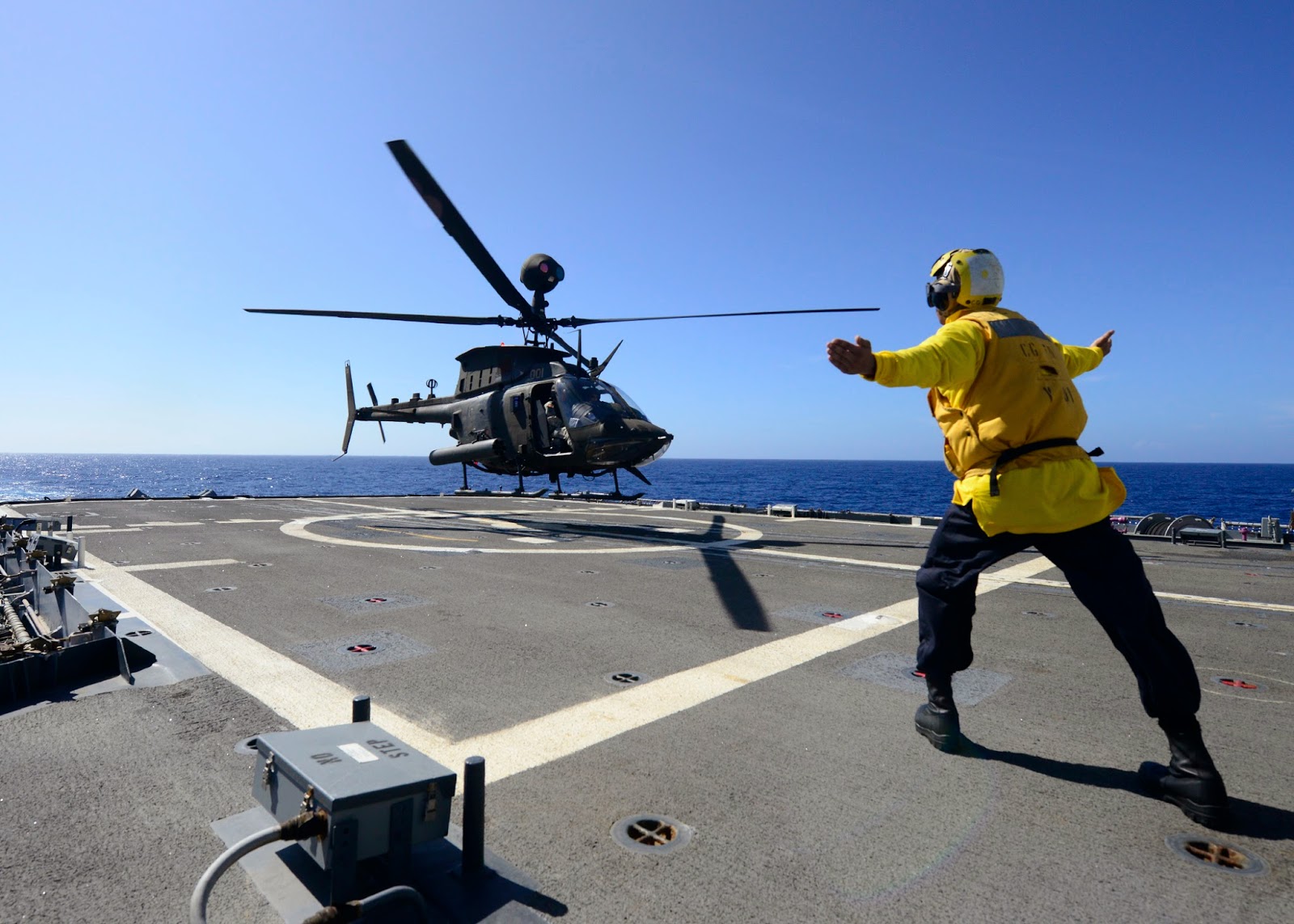
PACIFIC OCEAN ( Dec 9, 2024) Sailors aboard the guided-missile cruiser USS Lake Erie (CG 70) direct an Army OH-58 Kiowa Warrior helicopter from the 25th Combat Aviation Brigade (25th CAB) off the coast of Hawaii during joint training operations. The 25th CAB is expected to participate similarly in other training exercises in 2014. (U.S. Navy photo by Chief Mass Communication Specialist John M. Hageman/Released)
The following contribution is submitted by Major David Andersen, US Marine Corps.

Recently, Rajiv Chandrasekaran discussed the Army’s efforts to become more expeditionary and maritime capable.  Yet, as Mr. Chandrasekaran points out; the United States already has a maritime expeditionary force: the Marine Corps. 
   
In business, new initiatives are challenged by various barriers such as cost, equipment design, licensing, and market saturation. If a hardware store wants to expand its business, it’s unlikely to diversify into car tune-ups. Just because a handyman can turn a wrench doesn’t mean he can drop an engine.  However similar the Army and Marine Corps may appear to the untrained eye, the same may be said regarding amphibious operations. While the Army did amphibious landings quite well in World War II, they involved a short time at sea as a preamble to the sustained operations ashore that armies are designed for. Today’s amphibious operations are more diverse and require a force designed, trained and equipped to operate at and from the sea over extended periods—as Marines are.
 
The Army’s current barriers include:

Cost: Army equipment is not “marinized;” a process where everything from engine intake systems to the metals and paints used are designed to withstand high levels of salt water so that corrosion can be minimized and service life extended. This is why several Army aircraft were scrapped after Operation Uphold Democracy in Haiti, as Mr. Chandrasekaran pointed out. The Army subsequently explored the price of marinization and concluded it was cost-prohibitive.

Equipment design: The majority of Army helicopters have neither rotor brakes nor folding blades and tail booms. These features are unnecessary for land-based operations but essential for safety, shipboard stowage, and operational tempo reasons in sea-based operations. Without brakes rotor blades continue spinning for extended periods of time, gradually drooping as they slow and endangering crews and equipment on a pitching flight deck.  Without folding components most Army helicopters take up an inordinate amount of precious deck space on an amphibious ship. A few do have manually folding blades to permit occasional embarkation in C-17 transport planes, rather than the faster and less manpower intensive automated type found in Marine aircraft.  As a result, in the time it takes to tow, spread, spot and start a single Army H-60, a typical Marine squadron can launch two full waves of six aircraft.
  
Licensing: Most of the Army’s aviation weapons systems are not certified for shipboard use or storage. Why does that matter?  Because the many emitters aboard the ship could make them launch, fire, or detonate prematurely.  Sure, the ship could turn off those emitters, but then it can’t see or communicate with other ships, or identify threats, making operations in hostile or congested waters unsafe.

Market saturation:  Plenty of global business exists for expeditionary crisis response forces, so the market is not saturated.  What is in short supply, however, is the number of Navy ships capable of projecting forces in “ready to fight” condition. Amphibious ships, specifically designed for that purpose, are obviously the preferred platforms. Unfortunately, the Navy does not have enough amphibious ships to lift the force specifically designed to operate from them: the Marine Corps. While aircraft carriers may appear a viable alternative, the Navy’s inventory is smaller today than it was during Operation Uphold Democracy, meaning that the ability to replicate that model without disrupting existing deployment and maintenance cycles is problematic and likely to occur only in the event of a dire national emergency. What about the USS Lake Erie as cited in the article? She had space because she was at home. When a cruiser, destroyer or frigate, deploys, she does so with a detachment of Navy helicopters designed for sea going missions, like anti-submarine warfare. So, while the market is not saturated, the current budget environment and underfunding of the fleet means the shortage is not sea-based expeditionary forces, but the ships from which they operate.

So, why go to the hardware store to change your muffler?

Rather than trying to diversify its business, what if the hardware store found another means to deliver its existing products? The Army and Marine Corps have experimented with high speed logistics vessels since 1999. The Westpac Express, leased from Austal Marine, has internally transported Marines, aircraft and vehicles throughout the Pacific theater.  The Army conducted similar operations aboard TSV-1X Spearhead.  With these logistics ships, aircraft and other equipment can be carried internally, requiring no special equipment or training. While they are not capable of conducting sea-based operations, they provide a means to project forces via austere port facilities. Upon arrival, vehicles are driven off and stowed aircraft are craned off and reassembled for operations. These ships and others like them are available for contract for a fraction the cost of marinizing Army capabilities, allowing the Army to improve their expeditionary responsiveness without attempting to become a second Marine Corps.


Maj Andersen is a Marine Corps AH-1W Super Cobra pilot who has conducted three Marine Expeditionary Unit (MEU) deployments, twice as a pilot where he served in the squadron Maintenance Department (OIC of the Airframes and Quality Assurance Divisions) and once as the MEU Air Officer where he was responsible for all MEU aviation operations. During these deployments he conducted extended amphibious operations into Iraq, Kuwait, the Horn of Africa, Bangladesh and the United Arab Emirates. In Bangladesh he was responsible for all MEU aviation operations in support of Humanitarian Assistance/Disaster Relief operations for Operation Sea Angel II following Typhoon Sidr. Maj Andersen also participated in one of the first deployments which utilized the Westpac Express during which his squadron deployed a detachment of 4 AH-1W and 3 UH-1N helicopters as well as required support equipment aboard the vessel, along with additional ground combat equipment, to support exercises in the Commonwealth of the Northern Marianas, the Republic of the Philippines and Thailand. Maj Andersen has also completed combat tours in Iraq and Afghanistan.

Sunday, September 29, 2024

Whither Coastal Artillery

Readers of this blog who know me know that I travel - a lot.  If schedule permits on these trips, I try to take in a bit of the local military history - be it ships, museums, or what-not.  Over the last year or so, my travels have taken me to several locations where coastal artillery emplacements were employed, or at least emplaced for various wartime contingencies.  Some of these batteries were used to protect narrows, but others were set in prominent positions facing the open ocean.  From the early history of the United States through the late 1940s, batteries with guns up to 16” dotted the east and west coasts.  At Fort Hunt and Fort Washington along the Potomac, I saw coastal fortifications where 10 and 12-inch guns and submarine mines were used to protect the Capital from hostile fleets.  These guns were never employed and removed as obsolete in 1917.  In Hawaii, the batteries I visited around Diamond Head crater were never fired, even during the attack on Pearl Harbor.  And at Battery Point Loma in San Diego, the giant 16" unused guns were removed after World War II.

Blücher sinking in the the Drøbak Sound.
In other cases, coastal guns achieved more strategic effects.  In Oslo, I learned that during the invasion of Norway, on 9 April, 1940 two old 11” guns assisted by land-based torpedo batteries sank the German heavy cruiser Blücher.  The loss of this ship stalled Germany's advance to Oslo allowing Norway's royal family to flee to the United Kingdom, where they ran resistance forces in exile for the remainder of the war.

Several technological shifts in warfare brought about the wholesale demise of coastal artillery shortly after the Second World War.  Aerial bombardment out-ranged all guns no matter what caliber, and in the case of North American coastal fortifications, Soviet nukes simply reduced them to irrelevancy. 

But could current trends become the impetus for a resurgence in coastal "artillery" for the world's navies?  To some extent this has already happened, as relatively low cost and mobile surface to surface anti-ship missiles have proliferated to both state and non-state forces.  Lebanese Hezbollah set the precedence for their use against Israel's Hanit in 2006. China and Russia have held a monopoly on producing and selling these systems, but Western powers are starting to take notice. Kongsberg's Naval Strike Missile is ground, air, or sea launched and has been acquired by Poland for coastal defense.  Another possibility for future coastal batteries are rail guns.  The U.S. Navy has been working for years to develop this capability for surface combatants, but one of the main challenges with their implementation at sea is the significant electrical requirement.  Might a mobile ground rail gun be viable, taking advantage of more readily available power sources?

Coastal urbanization is an unstoppable demographic trend.  Future wars of both the state-on-state and irregular flavor will likely be fought near or in megacities that dot coastlines from West Africa to East Asia.  Whereas fixed coastal defenses arrayed near cities were vulnerable to air attack, the survivability of new anti-ship batteries is based on their ability to shoot and scoot.  Mobile launchers can also be camouflaged from air attack or hide in plain sight, taking advantage of placement inside population centers where counter-targeting would risk undesirable and highly visible collateral damage.  Depending on what force is employing them, modern coastal batteries can be cued by large or small combatants, UAVs, or simply friendly fishing boats with a radio and GPS. 
The shrinking U.S. Army is hunting for relevancy in a defense establishment fixated on Air Sea Battle and a bad COIN hangover.  Large-scale ground force deployments are unlikely until our collective memory fades over the next couple of decades and we unlearn painful lessons from Afghanistan and Iraq.  Perhaps the Army should examine rapidly deployable and mobile coastal missile and rail gun batteries.  The precedence for this type of system exists.  Patriot air defense batteries have been high demand assets during the past twenty years.  Their small footprint makes them discretely deployable to countries where large army formations are simply not welcome.  HIMARs is another modern mobile artillery system that has seen successful use in recent conflicts.  While providing fire support missions to special operations forces, the army has gradually succumbed to its aversion to deploying individual missile systems without bringing along the whole enchilada (brigade).
 
Improved anti-surface weapons systems can play both offensive and defensive naval roles.  The tactical use of these weapons would vary between denying chokepoints, defending against amphibious raids, and harassing enemy merchant shipping.  They could be collocated with Patriot batteries to defend against enemy air attack or hidden in dense urban terrain.  Inevitably, future adversaries of western navies will employ these weapons.  The exchange ratio between a relatively low cost mobile ASCM and a multi-billion dollar combatant is just too economically favorable to ignore.  So in an environment of shrinking defense resources might we also consider going on the asymmetric offensive?

The opinions in this post are those of the author's alone, presented in his personal capacity.

Friday, September 6, 2024

Apache's at Sea

Two AH-64D Apache helicopters from the 36th Combat Aviation Brigade and two riverine command boats from Coastal Riverine Squadron 4 conduct exercises in the Persian Gulf alongside the afloat forward staging base Ponce. (Sgt. Mark Scovell / Army)
Count me among those who see this as training that will be used in theater for action one day.
The Texas Army National Guard’s 36th Combat Aviation Brigade has been testing Army helicopters’ capabilities in a littoral combat environment, taking off from Navy ships, firing on targets and practicing deck landings, to see what Army aviation might be able to contribute to the future of maritime surface warfare.

From March through August, the soldiers spent time aboard the amphibious transport docks Ponce and Green Bay, dock landing ship Rushmore and aircraft carrier John C. Stennis.

Experts say Army aviation and the Navy have always worked together, but as current land wars draw down and the military turns focus to the Asia-Pacific region, while maintaining security in the Middle East, the services are looking at more ways to work together over water.

“What we are are trying to do now is continue that lineage of maritime operations,” said Maj. Scott Nicholas, the 36th CAB future operations chief.

“We’re trying to develop tactics, techniques and procedure for the littoral fight” — specifically, he said, TTP for countering fast-attack craft and fast-inshore-attack craft, or small boats that might approach a larger Navy ship along a coastline.
In the 1980s the US Army deployed small special forces helicopters on US vessels in dealing with Iran during the Tanker War. Those Army helicopters did very well against small boat combat, and it is worth the effort to put Apache's into that role today to see what Navy needs to do to support it.


Over the last decade there have been a number of sea base proposals that never panned out. One of the proposals I was always particularly found of was developing the capability to field the 101st Airborne division from a Sea Base. I'd like to think this activity helps the Army clarify what needs to be done in support of that eventual capability.

Friday, January 11, 2024

Unimaginable Statements and Signs of Surrender

Defense Secretary Leon E. Panetta and Army Gen. Martin E. Dempsey, chairman of the Joint Chiefs of Staff, discuss the effects of sequestration during a news conference at the Pentagon, Jan. 10, 2013.
As Leon Panetta approaches retirement I just want to say that I believe he has been one of the great public servants in modern American history. Until he retires however, he is still the Secretary of Defense and unlike some folks who approach retirement, he has not 'checked out' mentally and is still actively engaged in the responsibilities of his job. This time sequestration.
“We really have no choice but to prepare for the worst,” Defense Secretary Leon Panetta told reporters at a Pentagon news briefing Thursday. “Regardless of what Congress does or fails to do, we still have an obligation to protect this country...”

Earlier this month, Congress came to an agreement to avoid the so-called fiscal cliff, but instead of eliminating the threat of sequestration, the deal simply delayed the automatic, across-the-board cuts until March 1.

“Postponing sequestration doesn’t prevent, it just prolongs the uncertainty for our force and for our military families,” said Gen. Martin Dempsey, chairman of the Joint Chiefs of Staff. “Readiness is what’s now in jeopardy. We’re on the brink of creating a hollow force, the very thing we said we must avoid.”

Absorbing billions of dollars in cuts nearly halfway through the fiscal year would be even more damaging to the military, Panetta and Dempsey said, which is why the military must take steps now to prepare.
I get to this point in the article discussing sequestration and I'm feeling pretty good about how the DoD is handling the immense challenge and burdens the sequestration process has placed on the DoD. My glass is half full until...
If sequestration does take effect, Dempsey said, troops in combat, those about to deploy to combat and wounded warriors will be protected.

“But for the rest of the force, operations, maintenance and training will be gutted. We’ll ground aircraft, return ships to port, and sharply curtail training across the force,” he said. “Within months, we’ll be less prepared. Within a year, we’ll be unprepared.”
If you are the top General in the United States Armed Forces, and you know something is coming that must be planned for, and you have been telling everyone that you have been preparing for that something going back over a year now, if you are not prepared when it arrives is that not a failure of leadership to be prepared?

Brett Friedman said it best. "Can you imagine a USMC 4-Star ever saying "we'll be unprepared'? Never"

It is comments like these that have me concerned that US Army leadership is unprepared for the fiscal situation that is about to hit that great institution harder than the other services. I get it that Dempsey is CJCS and not fully engaged with the US Army anymore, but his comments sound depressing, defeated, hollow...

The US Army really does need to be the most innovative and motivated service of the three major branches of the military if they are going to manage the upcoming budget cuts well. General Odierno is a brilliant tactician, operator, and warfighter but I have not been able to find much media reporting where he is discussing sequestration, or any comment whatsoever where he is able to articulate a compelling strategic vision for a smaller US Army heading into the 21st century.

The US Navy today has this incredible depth on the bench of remarkably brilliant one and two star Rear Admirals, which for the record, makes me think that suggestions the Navy has lost the best and brightest of this early 80s graduation generation of sailors is a bunch of nonsense. When the current group of three and four star Flag Officers in the US Navy retire over the next 2-4 years, which include the remaining group of sailors who come from graduation classes in the late 70s, I strongly believe the Navy is going to be in fantastic hands with a collective cadre of the smartest, strongest leadership the fleet has had in modern naval history - for good reason too, their system of promotion collectively required them to be educated more than any previous generation, and it shows. These Rear Admirals were all doing their DH tour during the post cold war contraction of the US Navy, and if you think about it that gives them a lot of insight regarding what needs to be prioritized. The US Navy has extremely strong leadership right now, and I think there are signs of it everywhere.

As for the Army, not so much. I can't remember the last time I read something from a General in the US Army and thought to myself how smart it was, indeed nearly every really bright idea from an Army officer these days comes from someone in a field grade. I have to believe (or maybe I just want to believe) that after over a decade of war, and because they are of the same generation of military officer, the US Army has depth on their bench of brilliant one and two star Generals that most of us never see or hear from. OSD needs to be more keenly interested in this issue, and make it clear it is time for that generation of US Army officers to step up for their service and their country in what is clearly a significant challenge that will require significant changes forced almost entirely by fiscal stress to the US Army, because from my perspective most of the three and four star Generals in the Army today not only physically look defeated, they are starting to sound defeated.

Wednesday, September 12, 2024

Five Points

The National Security Discussion has entered a political phase as the election approaches, and both parties are attempting to make political points about National Security in the context of a policy discussion that appeals to their respective voter bases. The lack of detail distorts these discussions almost as much as the absence of context, and very few politicians know how to educate voters with their public speech talking points - particularly in the context of national security. Below are 5 7points of thought I believe are important to keep in mind while observing the political rhetoric related to National Security for the duration of the election season.

1) A bigger Army is not necessarily a better Army. The same theory of overwhelming force used in the 1991 Gulf War was remarkably effective the last decade of the 20th century, but the United States had evolved beyond that theory of warfare by 2001 when it took ~1/1000 the number of troops to overwhelm Afghanistan and 1/5 as many troops just 12 years later to defeat the entire organized Iraqi military in 2003. Over the last two decades the Joint Force of the US military has rediscovered that it takes fewer military personnel to be lethal and effectively destroy an enemy in war, but it takes significantly more resources to stabilize territory towards peace. This isn't some new theory of war, but the disparity gap between the resources necessary to kill and destroy with conventional military power and to stabilize the territory of a defeated enemy after using such power has expanded considerably over historical norms, and this gap has yet to be rationally demonstrated in a US Army force structure policy plan. The bottom line is this - to defeat enemies of the United States, a larger Army is not needed - indeed the US Army could afford to shrink in terms of manpower quite a bit and actually become a far more lethal military service. With that said, if the US Army will be called upon to occupy territory outside the United States after fighting the next war, a larger US Army is indeed needed. The future is hard to predict, but circumstances that will require occupational Armies can be predicted, and it is time to start discussing those circumstances in theory to forward a legitimate discussion for the Army regarding what we - as a superpower - want the US Army to be capable of doing, thus be.

2) The Pivot to Asia is not about shifting military power to Asia as many falsely describe it, rather the Pivot to Asia is actually about the modernization of military infrastructure capabilities in the vast Pacific region. Despite what very vocal critics like Thomas Barnett claim in various articles, there is no evidence at all of any significant military shift outside the CONUS to the Pacific region, unless those critics are now somehow suggesting that the replacement of minesweepers and old frigates with the Littoral Combat Ship is a major military power shift, or replacing existing older aircraft with new aircraft is a surge. The strategic pivot can be described as a move away from concentration of force towards geographical distribution of force, but the increases to the Pacific region represent little more than an expansion of infrastructure, not an increase in total force. I tend to think the Pivot to Asia is one of the most hollow, hyped political Foreign Policy slogans we have seen since the cold war, because there simply isn't anything specific one can point to from the DoD that suggests a significant increase in capabilities - as every migration of military force to the region is simply a replacement for a retiring infrastructure or system. To quote another slogan, where is the beef? The lack of specific details regarding the Pivot to Asia is intentional, because the power in the policy is only truly increased via political diplomatic rhetoric - not substance represented in force. In many ways, because the policy is rhetoric and not substance, the Pivot to Asia is evidence of effective Strategic Communications - which makes the Pivot to Asia more about diplomatic shifts rather than military shifts. It surprises me folks like Thomas Barnett have failed to recognize the distinction between rhetoric and reality when it comes to this over hyped political policy, but at some point during this election my sense is folks will reset Pivot to Asia in a more diplomatic context.

3) The Pivot towards Persia in 2012 is the most under reported major military buildups in modern media history, which is ironic considering the amount of hype in the media regarding Iran every day. The media has gone out of their way not to cover with any real attention the significant US and European military forces operating in the Persian Gulf region. The US Navy is now forward operating between 50-66% of all deployed aircraft carriers in the Gulf region. The US Navy is currently operating 66% of all US Navy minesweepers in the Persian Gulf. The US Air Force is now continuously rotating several of the most advanced aircraft squadrons in their inventory, including the F-22, to the Persian Gulf region. Nearly the entire training, workup, and deployment routine of every single East Coast Aircraft Carrier, Cruiser, Destroyer, Submarine, and Amphibious Ship is specifically tailored towards operating around the Middle East. Nearly all of the major defense budget adjustment increases for FY12 to date for the Air Force, Navy and SOCOM involve increasing capabilities or sustaining infrastructure in the USCENTCOM AOR. At the same time, the Europeans are reducing deployments to the Pacific and Western Hemisphere to focus naval forces for deployment to the Mediterranean Sea and Middle East regions. Despite the rhetoric that suggests there are numerous National Security issues facing the United States, there is only one national security question facing voters in 2012, and it is who they want their President to be during the hot and likely costly, bloody war between Israel and Iran that every measurable indicator one can use observing military force movements by European countries and the United States suggests is coming very soon.

And because predictions sure to go wrong can be entertaining thought exercises for bloggers, I'd wager a high quality Belgium wheat beer pint that if Israel attacks Iran before the election, with a 2 day margin of error I would say the date is October 13th.

4) The single most important element of United States national power related to National Security in need of increasing in both size and capability lies not in the Department of Defense, nor in the Department of State, but in the US Coast Guard. China is fighting a cold war in the South China Sea using their civilian agency maritime security forces backed by the implied support of military power. Unless the US intends to get asymmetrical in dealing with these tough diplomatic issues - which is sure to create unnecessary tension in the region; the appropriate symmetrical response would be to increase the presence of the US Coast Guard around the world to engage and assist towards the quality improvement of the regional maritime security forces. Whether one looks at Africa, South America (including the US coast), or Asia - the national security solution to most state diplomatic challenges and nearly all non-state security challenges facing the global economy lies at sea, but these are not solely a naval centric challenge. If we really believe the 21st century is going to be a maritime century - and I believe this 100% - the first step is to increase the size of the Coast Guard, and that starts with doubling the size of the large, deployable National Security Cutter fleet that can be sent forward to engage with civilian agencies globally and help improve the capabilities of our partners in Africa, Asia, and South America. I am not opposed to reducing the budget of the DoD, but it only makes sense as long as the civilian agencies needed for peacetime maintenance are funded to increase their capabilities to actually maintain the peace - and that beings with expanding the US Coast Guard. The peacetime Global Fleet Station of the 21st century might be a US Navy amphibious ship in certain situations, but it should also be the National Security Cutter. The maintenance of peace is a manpower intensive, thankless security role that ALSO belongs to the civilian security agencies, not solely the DoD. It is past time the US government forwards national security of this country by recognizing this reality, and balances the reduction of DoD capabilities with an increase in US Coast Guard capabilities for the offshore engagement role the US Coast Guard has a long history of performing. This needs to start now - not later - because while today's challenges might be piracy and illegal oil bunkering off Africa, territory disputes in the Pacific region, the global narcotics trade that is creating significant challenges off our own southern border, or the polar regions of this planet - there are several regions that are going to get more competitive sooner than later, and the offshore economy is expanding at a pace far greater than maritime security forces globally are adapting. While Mitt Romney wants to reconstitute the US Army by 100,000 and grow the US Navy, President Obama would be wise to counter by expanding the US Coast Guard - because the lesson of 10 years of war has taught us that if the objective is peace, the nation needs strong civilian security capabilities. It is time to apply the lessons of the last war towards the future being shaped.

5) It is often suggested that the US needs to help foster some sort of alliance in the Pacific similar to NATO, but it is my hope that long before that rhetoric is explored towards some reality the US gets more deeply engaged and serious with South America. In a global economy, the Monroe Doctrine doesn't work for us anymore for the same reason the Monroe Doctrine with Chinese characteristics is failing China in the Pacific - there are too many interconnected economic relationships in today's global economy for security interests to be conceded by great powers. China, among others, is coming to South America as we speak, indeed I fully expect China's first carrier deployment to be to South America in early spring of 2016 - namely Brazil, not the Middle East as is commonly speculated. Brazil, India, China, and Russia are all poised for difficult, but productive decades ahead. The rise of the BRIC nations combined with an impending era defined by energy and resources - including water - of the next two decades will change the national security landscape globally. Unfortunately, every Powerpoint I have seen produced by the DoD fails to reflect what that change means to force posture, and ignores the key role South America is going to play regarding the national security landscape of the mid-term future. The time is now to start thinking about the BI in BRIC, and what they truly mean to national security for the United States in the 21st century.

Monday, July 30, 2024

The Expeditionary... Army

The cold war is over and the wars in southwest Asia are ending, so the Army is making moves as it prepares for the future. The New York Times has a few of the details.
Plans call for the brigade-size stock of armored fighting vehicles now stored in Europe to be brought home, although other infantry and support equipment would remain. A primary mission for the gear to be stored in Europe would be to supply multilateral training exercises among American and allied troops.

The Army wants to locate sets of equipment that could be pulled from storage for multilateral training exercises and other contingencies in the Asia-Pacific region, most likely aboard ships and perhaps in Australia, officials say. Other Army storage sites around the world may see an increase in gear designed for humanitarian assistance and disaster relief.

The Army emptied many of its overseas weapons warehouses to fight the wars of the past decade and is using the end of combat in Iraq and the drawdown in Afghanistan to analyze where the gear — officially called Army prepositioned stocks — should be located, and exactly what types of equipment should be included to carry out the shifting Army mission. 
This is noteworthy.
The Army is planning for a significant portion of the prepositioned stocks to be afloat, an effort that would include eight ships. Two vessels would be dedicated to munitions, with one assigned to the Pacific and one to the Middle East.

The other six ships, which could be sailed to conflict zones as required, would carry equipment for an infantry brigade with MRAPs, and a sustainment brigade. The vessels would carry equipment necessary for transforming a commercial port into a dock that could load and unload military equipment. 
This accounts for some wargaming as reported by other media sources that has revealed that the Army struggles to get ashore without a fully capable port.

I don't really have much to say on this because right now I am not impressed with the policies that are guiding the US Army towards the future, nor am I very impressed with the transformation plans of the US Army is executing heading into 2013. Here is the problem as I see it.

The US Army is organizing around 71 brigade combat teams and 212 support brigades by next year. 43 of those BCTs are in the active component, with the rest in the National Guard. If you look at the Pacific and the Middle East, and you accept that the long range, precision missile threat is the primary threat in both places, then one must ask what becomes a critical function of the US Army in that environment. When I ask these questions, the answer leads me towards the most important capabilities being Air Defense, Airborne, and Air Assault.

The future active duty Army is expected to be 15 Armored Brigade Combat Teams, 8 Stryker Brigade Combat Teams, 10 Infantry Brigade Combat Teams (light), 6 Infantry Brigade Combat Teams (Airborne), and 4 Infantry Brigade Combat Teams (Air Assault) for a total of 43 active duty Brigade Combat Teams. When I look at the first month of the next big war, without another nation successfully contributing significant force, only 10 of these Brigade Combat Teams are relevant in the first 60-90 days of the conflict (the 6 Airborne and 4 Air Assault) and nearly every bit of the Army's underfunded and low priority yet critical air mobility defense assets will be dedicated to those 10 brigade combat teams, and fixed locations necessary for the US Army to transit to the battle zone.

In other words, in my opinion the US Army is basically being structured to fight the next war exactly like the last war in Iraq with 15 Armored BCTs, 8 Stryker BCTs, and 10 Infantry BCTs that cannot enter the fight without counting on Saddam Hussein level of incompetence that allows for an Army buildup to occur, or more likely, a fully manned and equipped Marine Corps with enough ships to kick down the door - which for the record isn't something that will organize and happen any quicker than 60-90 days.

What strategic genius it is to pay homage to the parity of the DoD iron triangle when 75% of the standing, active duty US Army has to operate on Navy time to join the next war of significance. Tell me again why the major assets of the US Army, which will take 60-90 days to put in place under ideal conditions anyway, is in the Active Duty Army and not the Reserves? The US Army force structure organizational chart is written to insure the US Army is important to the US Army, but in general it really doesn't do anything meaningful for the nation.

When one looks at the size of an Army one needs for 21st century in both war and peace, it becomes clear the United States needs the US Army sized to at least 100 BCTs - roughly 30% larger than current plans. Yes, that means the Army will need to be bigger, and thus be more expensive to maintain, but I also think it is fairly obvious that only 25 of those BCTs are needed in the active duty force and the rest could be moved to the Reserves without any loss of options for the President of the United States in using the US Army.

The US Army reinvented itself for the war in Iraq in 2005, and reinvented itself again in 2009 in Afghanistan - and bought completely new gear both times specific to each conflict. This isn't new, the Army did the same thing in Vietnam and WWII. Relative to the Navy and Air Force, the US Army can be raised and reinvented very quickly when the money for war is provided.

However, all the money in the world isn't going to help industry invent new ships or aircraft faster, much less allow either service to reinvent themselves in the next war. For the Air Force and Navy, what you have when the conflict starts will likely be all you will have to decide conflict. This theory of naval war was true for WWII, if you believe the results of Midway decided the conflict at sea in the Pacific.

Why rant on all of this based on a news report on prepositioning forces? Because, all of these topics should be discussion points for the upcoming debate of consequence facing the DoD over the next 5-10 years - the recapitalization of the DoD following the conclusion of two wars in southwest Asia.

Friday, September 2, 2024

Why Do We Still Need a Huge Army? - Round II

I’ve received significant feedback on this post , ranging from private emails calling these ideas “brilliant” to a blatant dismissal of any arguments that recommend cutting the army by a single soldier. More importantly, regardless of one's opinion on my arguments, the discourse on this topic has been energized. Since my post, a few timely articles were written discussing this debate. Looks like the Army itself is talking about eliminating 10 out of 45 active BCTs, which is just short of the 25% SWAG I recommended (no, I didn’t have inside information on this).

Was I too parochial? Guilty as charged, except that I’m also defending the Marine Corps, Air Force, and multi-service SOF community over the Army conventional force. However, I’m not sure how one can take a position on force reductions without being parochial, unless one thinks that across the board cuts make any sort of strategic sense (I don’t). I was also accused of coming to the right conclusion for the wrong reasons. Fair point, but I didn’t intend to capture all of the reasons that the army should be reduced before the other services in a single post. Those arguments have been made extensively at every draw-down, most recently during the early 1990s, post-Cold War/ODS era.

For someone much more eloquent than this author on the value of of sea power to America's security, I recommend reading Bryan McGrath. But I will make a few points here to round out the case for a large decrease in the size of the active component army, while leaving the other services relatively unscathed by future budget cuts:

-The Navy/Marine Corps (and SOF) are nimble and able to respond quickly to global military contingencies. Despite repeated efforts at trying to correct this, the army is too bulky and inflexible to provide a global on call response force when it counts. Furthermore, neither the US people nor international community will show any appetite for a large US military combat footprint anywhere for at least the next couple of decades. As one of the commenters noted, it's best to "start small and stay small." To paraphrase another responder, having a large army provides us a convenient excuse to use a large army. Going in big is not always the best strategic COA, especially when other political or military options are available.

-Post Afghanistan, the Army will withdraw to garrison and do little to counter ongoing irregular threats, while the other services (and SOCOM) remain forward engaged. It’s not in the US Army's culture or capacity to do otherwise. For those who might disagree, what is the Army’s strategy to counter non-state actors short of a full scale ground invasion with follow-on extended COIN operations?

-Yes, SOF-Airpower, the air-sea battle, and other future warfighting concepts are still in nascent stages of development (some more than others). However, we've seen enough benefits from these ideas in combat the past decade or so to make a decision on investing more in air, maritime, and SOF capabilities, even at the expense of traditional ground combat force structure.

- Finally, the Navy has already taken significant hits to manpower and readiness the past few years, while continuing to support the war efforts in Iraq, Afghanistan, and against al Qaeda in a variety of ways. One way these personnel shortfalls manifest themselves is through the boots-on-the-ground individual augmentees the Navy provides to make up for a supposed lack of army capacity in certain areas. In some cases, this augmentation has been thoughtful and logical. In others, it’s just plain stupid. Additionally, the Navy continues to pull Sailors from what are already “optimally manned” ships to deploy in support of the Army. The most egregious IA example I've heard of is deploying highly trained, highly compensated nuclear qualified submarine junior officers to Afghanistan to run army postal units. First, the Navy must take a hard scrub on these IAs. Second, the Army Chief might want to consider doing what the Marine Corps Commandant did a few years back; scour the Pentagon and all other DC staffs (not to mention those homesteading comfortably in Europe and Asia) to find the embarrassing number of Army field grade officers and senior NCOs -- regardless of rank or specialty-- who have never deployed to Iraq or Afghanistan and put them on the next rotator to Bagram Air Base with a postal scale in their ruck.

Defense reductions should be made strategically, not on the basis of some sense of fairness. Why should the other services take further cuts when the Army pulls back to garrison post-Afghanistan? Why shouldn’t the conventional army take the lion’s share of any defense cuts?

The opinions and views expressed in this post are those of the author alone and are presented in his personal capacity. They do not necessarily represent the views of U.S. Department of Defense, the US Navy, or any other agency.