Several different posts have gone up in topic areas of interest. As I am still working out my posting (and overall) schedule, I am going to link to them by general topic here. Read at your leisure if interested., and comment, please. I will get back to these items as I am able over the next several posts.
Piracy
Courtesy of GCaptain.com, the International Sailing Federation (ISAF) has some strong advice (Here):
"Do not sail in the western Indian Ocean, Arabian Sea, Somali Basin and Gulf of Aden. ISAF robustly endorses this position. It considers that sailing in these waters is highly irresponsible"
Arctic Policy
EagleSpeak discusses the USCG Commandant's recent testimony on Capitol Hill regarding USCG Arctic preparedness. A quote,:
"Our current Arctic capabilities are very limited. We have only one operational ice breaker. We do not have any coastal or shoreside infrastructure."
Then there is this port visit press release from the two days later, where the only mention of the state of the USCG icebreaker fleet is:
"The nation’s largest ice breaker, Coast Guard Cutter Healy"
From Dark Roasted Blend, some photos of the Russian Icebreaker fleet in action
Cutter Fleet
Chuck Hill over at CGBlog.org, discusses an item that I have followed closely, the Offshore Patrol Cutter (OPC) program.
CGBlog also discusses how strategic communication (or lack thereof) can impact the future cutter fleet. This well-written piece also ponders how could USN and USCG fleet construction efforts be better coordinated (this overall discussion is also relevant to Arctic policy)
Maritime Interdiction
Chuck Hill also discusses how the Israeli Navy applied lessons learned in a high profile interdiction effort.
Please take a look at these links. We'll discuss these and other topics in the near future.
The views expressed herein are those of the blogger and are not to be construed as official or reflecting the views of the Commandant or of the U. S. Coast Guard.

Showing posts with label Piracy. Show all posts
Showing posts with label Piracy. Show all posts
Saturday, July 30, 2024

Sunday, July 24, 2024
West African Piracy
The Benin pirates are at it again. Since March, 12 tankers have been attacked in West African waters. Previous attacks by these pirates have been more violent than their East Coast brothers, such as those in May of this year and in the fall of 2009, which both killed crewmen. It is no surprise that piracy has escalated West Africa. Successful operations beget imitators.
Unfortunately the local countries involved shouldn't expect much assistance in fighting this growing problem, with the preponderance of Europe's navies heavily involved in countering the Somali pirates and stuck in a protracted maritime embargo against a north African dictator who knows better than to quit. Even for the USN, West Africa presents a challenging presence and logistics problem. We've been able to maintain a presence in the Indian Ocean mostly because the ships deploying for CP ops can be tasked for other CENTCOM and AFRICOM missions. However, other than APS, scheduled naval deployments to the other side of the continent are non-existent. Regrettably, West Africa presents a number of irregular challenges that cannot just be wished away: growing piracy; insurgent groups bent on disrupting the flow of oil; an increasingly militant Islamist movement in northern Nigeria (Boko Haram); and a burgeoning narcotics trade that in part, supports AQIM's broadening reach across North Africa. AFRICOM's naval requirements are growing, and US force structure is not. It's past time to buy ships we can afford in a quantity that can meet current and future demands for maritime security operations and security force assistance.
The opinions and views expressed in this post are those of the author alone and are presented in his personal capacity. They do not necessarily represent the views of the U.S. Department of Defense or any of its agencies.
Unfortunately the local countries involved shouldn't expect much assistance in fighting this growing problem, with the preponderance of Europe's navies heavily involved in countering the Somali pirates and stuck in a protracted maritime embargo against a north African dictator who knows better than to quit. Even for the USN, West Africa presents a challenging presence and logistics problem. We've been able to maintain a presence in the Indian Ocean mostly because the ships deploying for CP ops can be tasked for other CENTCOM and AFRICOM missions. However, other than APS, scheduled naval deployments to the other side of the continent are non-existent. Regrettably, West Africa presents a number of irregular challenges that cannot just be wished away: growing piracy; insurgent groups bent on disrupting the flow of oil; an increasingly militant Islamist movement in northern Nigeria (Boko Haram); and a burgeoning narcotics trade that in part, supports AQIM's broadening reach across North Africa. AFRICOM's naval requirements are growing, and US force structure is not. It's past time to buy ships we can afford in a quantity that can meet current and future demands for maritime security operations and security force assistance.
The opinions and views expressed in this post are those of the author alone and are presented in his personal capacity. They do not necessarily represent the views of the U.S. Department of Defense or any of its agencies.
Wednesday, July 6, 2024
The United Nations Just Told Reuters What?
 Richard Lough of Reuters has just opened the ugly can of worms no one in the maritime shipping industry ever wanted to see opened. Make no mistake, the Obama administration didn't want to see this report either.
Ransoms paid to Somali pirates to free merchant vessels are ending up in the hands of Islamist militants, laying shipping groups open to accusations of breaching international sanctions, U.N. officials told Reuters.Remember, this is the United Nations, which is not so small a thing.
John Steed, the principal military adviser to the U.N. special envoy to Somalia and head of the envoy's counter-piracy unit, said links between armed pirate gangs and Somalia's al Qaeda-affiliated rebels were gradually firming.
"The payment of ransoms just like any other funding activity, illegal or otherwise, is technically in breach of the Somalia sanctions regime if it makes the security situation in Somalia worse," said Steed.
"Especially if it is ending up in the hands of terrorists or militia leaders -- and we believe it is, some directly, some more indirectly," said Steed, a retired military officer.
The U.N.'s Office on Drugs and Crime (UNODC) says pirates are increasingly launching their cross-ocean raids from the al Shabaab-controlled southern coastal city of Kismayu. Recruitment for pirates from the region was also on the rise, it said.How about some excellent investigative reporting.
"Detained pirates tell us that some level of cooperation with al Shabaab is necessary to run a criminal enterprise," said Alan Cole, piracy programme coordinator at UNODC.
Al Shabaab sources agree.
"If there was no relationship between us, there is no way the pirates would be able to operate, or carry their weapons within zones we control," said an al Shabaab militant based in the pirate haven of Haradhere, north of Mogadishu.
A Reuters investigation found the following payments had been made to al Shabaab's "marine office":There is more - read the entire article.
On Feb. 25: $200,000 from the release of the Japanese-owned MV Izumi after pirates received a $4.5 million ransom.
On March 8: $80,000 from the $2 million release of the St Vincent & Grenadines-flagged MV Rak Africana.
On March 9: $100,000 after the Singapore-flagged MV York was freed for $4.5 million.
On April 13: $600,000 from the release of the German ship Beluga Nomination after a $5.5 million ransom was paid.
On April 15: A $66,000 share of the $3.6 million ransom handed over for the Panama-flagged MV Asphalt Venture.
On May 14: $100,000 from the release of two Spanish crew of the Spanish-owned FV VEGA 5.
The amounts were corroborated by pirates, al Shabaab militants and residents of Haradhere.
Piracy just took a strange turn, and it would be nice to hear from someone whose title begins with "Admiral" or whose name is Ray Mabus.
Do people realize that it is a big damn deal that the United Nations would casually discuss the connections between Somali pirates and Al Shabaab? No government has ever officially claimed such a link exists. This would mean piracy is a direct funding mechanism for Al Qaeda, and every ransom payment is illegal.
We appear to now be at a point in time with piracy where if a company tries to free captured mariners with ransom money, the company would be subject to prosecution for illegally financially supporting global terrorism. That's a pretty big deal, and really bad news if you are a hostage.
Wednesday, June 29, 2024
Footage Of Dutch Freeing Pirated Vessel
On April 2 the Dutch rescued an Iranian vessel from Somali pirates.
The MoD has now released footage of that rescue, during which 2 pirates were killed after they opened fire on the Dutch sailors.
Wednesday, June 22, 2024
Criminal Challenges and Military Capabilities
 Secretary of State Hillary Clinton visits Guatemala on Wednesday, and among the topics to be discussed is the challenge of dealing with narcotic trafficking in the region.
The chief US diplomat, aides said Monday, will visit Guatemala City to discuss a counter-narcotics strategy with the leaders of Guatemala, Belize, El Salvador, Honduras, Nicaragua, Costa Rica and Panama.This issue is becoming more and more important to the United States as it is the fuel to the violence just off the southern United States border. In politics the border is too often discussed in the context of immigration, but if you ask me the real challenge of the US-Mexico border today has almost everything to do with narcotics trafficking. It was disheartening when CNN celebrated the 40th anniversary of the war on drugs in America, and the chart on the TV showed that for the trillion dollars spent over that 40 years - all the trends related to usage and violence were heading in the wrong direction.
President Laura Chinchilla will join the other Central American leaders in Guatemala's capital to discuss how the region can better combat organized crime and drug trafficking.
The leaders will discuss implementing strategies for crime prevention, rehabilitation and prison security and specific visions for each country. In addition, the presidents will be looking for ways to finance these plans through other countries, international organizations and the Central American Bank for Economic Integration (BCIE).
"This meeting will be an opportunity for other countries to turn their eyes with more determined efforts toward the countries of Central America in the fight against narcotrafficking," Chinchilla said in a press release. The president will be accompanied by Costa Rica's foreign minister, public security minister, the vice minister of the interior and the head of the country's anti-drugs commission.
Other leaders or top officials attending the talks will represent Mexico, Colombia, Chile, Spain and the European Union, they added.
I am one of those folks who does not see a future war scenario between the US and China, although similar to the relationship between the Soviet Union and the United States during the cold war, I do believe there will be considerable stress and tension in the US-China relationship before any genuine cooperation or partnership is achieved - if it is ever achieved.
The other end of the military spectrum is where I see the most common threats facing military forces in the near-to-long term future - specifically in the emerging shadow zones throughout Africa and South America that blur the lines between criminal activity and military capabilities as non-government organizations leverage the advances made in technology faster than government law enforcement can adapt. I strongly believe that in the future - and potentially continuing next month in southern Sudan, US military forces are going to continue to be asked to undertake roles that address stabilization and security in troubled regions.
At sea, that means the US Navy must find ways to continue and leverage the partnership with the US Coast Guard to become more effective - indeed more proactive - in addressing challenges like narcotics submarines. This problem isn't getting smaller, and like piracy it pays enough to sustain growth trends that lead to uncomfortable levels down the road if real solutions aren't found. We are already seeing another evolution in the narcotics submarine efforts as they transition from being capable of crossing seas in the Gulf of Mexico and littoral Pacific towards being able to cross oceans - like the Atlantic.
Latin American cocaine traffickers may be using submarines to move the Europe-bound drugs across the Atlantic Ocean, a top official said Monday during a conference aimed at stemming the flow of the drugs through Africa.Enforcement of narcotics smuggling through traditional methods like small aircraft and small boats from South America to Africa has improved over the last few years (although corruption is still a major problem), but seizures are down while cocaine use is up. That suggests narcotics are now being moved by different means, and submarine technologies are one possibility. It makes sense, because in the big picture capabilities for finding low observable simisubmersibles - much less a fully submerged capability - simply do not exist in sufficient numbers among West African nations to be even marginally effective.
Alexandre Schmidt, the head of the West African branch of the United Nations Office on Drugs and Crime, said drug cartels are known to have already used submarines off the South American and Caribbean coast. Even though no submarines have been seized in West African waters, there is anecdotal evidence to suggest they are in use there as well, he said.
"We are not talking about military vessels here, but rather smaller ones which can be bought freely on the international market by anybody who has a couple of million dollars to spare," said Schmidt, who spoke during the inaugural session of a policy committee, dubbed the West Africa Coast Initiative.
The street value for 1 kilogram of cocaine in the United States can be averaged at $20,000. These simisubmersibles can transport between 3 and 7 tons of cocaine, and one short ton contains about 907 kilograms. That puts the street value of one simisubmersible full of 3 tons of cocaine at just over $54 million. At $54 million the transport costs using simisubmersibles with a 3 ton payload from South America to the United States is below 1% of the total street value. Similar cost estimates can be scaled to Europe.
Over the last decade in both narcotics smuggling and piracy we have seen remarkable adaptation and use in technology that has significantly increased the challenges for what have traditionally been law enforcement problems. Obviously technologies in narcotics smuggling has advanced pretty far when full blown submarines are now in use, but technologies being leveraged by Somali pirates are just as remarkable when one considers how many millions are being made leveraging five guys with AK-47s and old fishing boats with an outboard motor. Will there ever be a shortage of guys, guns, and outboard motors? If not, it's time to adapt.
The budget for the Coast Guard is just as strained as the Navy, indeed perhaps more strained given the cost problems that so many Coast Guard acquisition programs currently have. Without political leadership first, supported by both services and a great deal of investment in innovation by everyone involved; the challenges already found in the maritime shadow zones today will continue to outpace responses, and left unaddressed the problems will simply continue to grow.
Friday, June 3, 2024
Piracy Costs Soon To Increase By Billions
A very interesting article on the financial impacts of piracy on the shipping industry.
The piracy insurance costs for the old zone that impacted the 22,000 ships was around $3.3 billion in earnings for insurance companies. The new zone will add an additional $4.2 billion annually in insurance costs to shippers in the region. The 300% increase in insurance costs due to piracy has to date, hurt the region more than it has hurt the global market. That might change though as the piracy zone continues to expand, and in all cases those costs eventually get passed down to the consumer.
What I find interesting is the insurance costs would soon be around $7.5 billion annually in Somali piracy alone. Following the money from Somali piracy, insurance companies are easily the largest source of costs, and I do wonder how much tax revenue Great Britain is earning from those insurance company earnings.
India has made significant strides in fighting piracy along their west coast over the last 5 months, but they are inaccurately taking credit for the recent decline in piracy near Indian waters. It would be more accurate to highlight that the weather has been the primary factor keeping pirates off the west coast of India the last several weeks, and for the foreseeable future those weather conditions are unlikely to change, meaning piracy is simply moving elsewhere - currently towards the Red Sea, among other places.
India is lobbying Lloyd’s of London to reverse its expansion of the area judged prone to pirate attacks to cover almost all of the nation’s west coast after insurance costs surged as much as 300-fold this year.The article is worth reading, and goes on to note that 52% of all maritime trade to India takes place in western ports that could be impacted by the new zone.
“There is no longer any threat along the Indian coast,” Shipping Secretary K. Mohandas said in a May 23 interview, adding there had been no attacks within 800 kilometers (500 miles) of the coast due to stepped-up naval patrols. The Joint War Committee, which assesses insurance risks, extended the zone in December about 900 miles east as the hijacking range grew.
A reversal by Lloyd’s would reduce insurance costs after some premiums skyrocketed to as much as $150,000 per voyage from $500, the Indian National Shipowners’ Association said, hurting shippers’ earnings. Essar Shipping Ltd. and Varun Shipping Co. are among companies that say the move is eroding margins as they struggle with overcapacity and rising costs.
“Typically ships bought insurance for the three days they were moving through the Gulf of Aden -- now they have to pay for the additional 10 days” through the Indian Ocean, said Sean Woollerson, an insurance broker at London-based Jardine Lloyd Thompson Group Plc (JLT), which specializes in shipping. The larger zone means about 28,000 more journeys a year are liable to higher premiums than the 22,000 made in the old zone, he said.
The piracy insurance costs for the old zone that impacted the 22,000 ships was around $3.3 billion in earnings for insurance companies. The new zone will add an additional $4.2 billion annually in insurance costs to shippers in the region. The 300% increase in insurance costs due to piracy has to date, hurt the region more than it has hurt the global market. That might change though as the piracy zone continues to expand, and in all cases those costs eventually get passed down to the consumer.
What I find interesting is the insurance costs would soon be around $7.5 billion annually in Somali piracy alone. Following the money from Somali piracy, insurance companies are easily the largest source of costs, and I do wonder how much tax revenue Great Britain is earning from those insurance company earnings.
India has made significant strides in fighting piracy along their west coast over the last 5 months, but they are inaccurately taking credit for the recent decline in piracy near Indian waters. It would be more accurate to highlight that the weather has been the primary factor keeping pirates off the west coast of India the last several weeks, and for the foreseeable future those weather conditions are unlikely to change, meaning piracy is simply moving elsewhere - currently towards the Red Sea, among other places.
Tuesday, May 24, 2024
Al Qaeda and the Threat to Tankers
 Count me among those who think there has been too much information released regarding the raid to kill Osama bin Laden. One of the surprises, I think, has been the amount of intelligence from that raid discussed in public. Perhaps I am reading it wrong, but it seems to me when this much collected intelligence in reported in the press, what it really means is we didn't get much useful intelligence at all. Still, this is noteworthy.
"In 2010, there was continuing interest by members of al Qaeda in targeting oil tankers and commercial infrastructure at sea," Department of Homeland Security spokesman Matt Chandler said in a statement Friday. He added that "we are not aware of indications of any specific or imminent terrorist attack plotting against the oil and natural-gas sector overseas or in the United States," and said "it is unclear if any further planning has been conducted since mid-last year."It is very difficult to sink a tanker, but it is proving to be very possible to hijack one - at least based on what we have seen from Somalia. Lloyds List ran a story several days ago about how the mariners who work on several tanker lines that ship out of the Gulf are getting very frustrated and are thinking about boycotting working on unprotected tankers moving through the pirate infested region. A refusal by the civilian mariner crews to work on tankers is essentially the same effect of shutting down oil in the Gulf.
Last summer, a Japanese oil tanker was attacked while passing through the Strait of Hormuz, though it suffered only minor damage. Investigators concluded that was a terrorist attack.
The materials gathered by U.S. Navy SEALs in the raid earlier this month in Abbottabad, Pakistan—including Osama bin Laden's personal journal—sketched a broad picture of targets the terror group would like to attack, but provided little detail about actual plans to carry out such missions, officials said. The targets revealed so far, including commercial aviation and railroads, have long been in al Qaeda's playbook.
Oil tankers and oil-industry infrastructure also have been a preferred target for al Qaeda and associated groups, in keeping with the militants' stated goal of causing economic disruption to the West and to Arab regimes they consider hostile. In 2002, militants used a small skiff packed with explosives to blow a hole in the side of a French-owned oil tanker off the coast of Yemen in 2002.
As a result several companies are putting aside their concerns about security teams and will potentially be arming up large tankers moving through the region. One side effect of adding security teams on tankers would be to potentially further protect tankers from Al Qaeda style attacks. Another side effect is that we may now have a new permanent cost added to energy supplies traveling at sea from the region.
In that context, I am not sure which is the bigger threat. Is the possibility of Al Qaeda terrorist attacks against tankers a significant threat or just one more attack vector to be concerned about? I tend to think the refusal of civilian mariners to work on ships without security protection from pirates presents a bigger concern over time, because the extra costs associated with either paying mariners more to work without security or paying for the constant presence of security on tankers is a cost that simply gets passed on to the consumer.
Those costs come before adding insurance costs and potential legal costs that may get applied as shippers put dudes with guns on ships loaded with petroleum and other highly flammable materials.
Sunday, May 22, 2024
Finding Piracy’s Tipping Point
After several unproductive years of dithering in the Indian Ocean, navies and shipping companies are slowly changing their mindset towards countering piracy. Unsurprisingly, this shift has begun to produce a positive outcome. For 2011, the number of attempted Somali pirate attacks has continued to increase as in previous years; however, it appears that to date this year, the rate of successful attacks has actually begun a decline. What is contributing to this change? First, shipping companies have started to put aside their fears of liability and embraced the only foolproof deterrence against successful attacks - embarked armed security. Eaglespeak’s post here demonstrates the higher incidence of armed security defeating attacks.
Last week, Intertanko, the association of independent tanker owners, revealed a reversal in its earlier position by releasing guidelines on contracting armed security. The tanker industry had no choice but to get tough on piracy, as loaded tankers are especially susceptible to boarding due to their slower speed and low freeboards. Additionally, with the skyrocketing cost of bunkers, the four or so more days of transit that crude carriers from the Arabian Gulf use in an effort to hug the Indian coast is beginning to take a toll on profits. One of the oft-heard reasons against using armed security is that it will escalate the amount of violence in piracy. This argument holds little water as attacks by automatic weapons and RPGs, the torture, and execution of crews by pirates demonstrate the level of violence in these crimes is already quite unacceptable. Furthermore, I’ve heard industry executives mention that there are rumblings that crews might soon refuse to sail in the Indian Ocean if something isn’t done to protect them. The economic consequences of this sort of reaction couldn't be ignored by anyone, much less the shippers themselves. What additional armed security will do is force the pirates to seek out softer unarmed targets. Inevitably, other components of the shipping industry will have no choice but to tell their lawyers to pack sand and embrace this positive measure to protect their crews and cargoes.
The second factor contributing towards a tipping point in piracy is that the coalition navies have abandoned worthless catch and release tactics and increased their own level of violence. Some of the more aggressive European navies have set the standard for proactively stopping pirates, and even the USN has begrudgingly begun to see the value in killing pirates caught in the act.
In addition to more aggressive tactics on the part of navies and the shipping companies, what else needs to be done to rid the Indian Ocean of the scourge from Somali Piracy? First, we need to continue to target pirate facilitators. As I’ve noted, detaining teenage criminals and cajoling various jurisdictions into expanding their jails is ineffectual and tantamount to flushing taxpayer money down the CHT system. Finally, we should:
Although the monsoon season is about to begin, given the pirates' use of motherships, we should expect the number of attacks to not fall as severely as in previous seasons. Nevertheless, with the hardening of many targets and the realization by most involved that lawfare doesn't work, we are now presented with an opportunity to tip control of the seas in the Indian Ocean towards rule of law and away from hapless youths with AKs. Taking the fight to the pirates' leadership and sanctuary ashore is the logical next step.
The opinions and views expressed in this post are those of the author alone and are presented in his personal capacity. They do not necessarily represent the views of U.S. Department of Defense, the US Navy, or any other agency.
Last week, Intertanko, the association of independent tanker owners, revealed a reversal in its earlier position by releasing guidelines on contracting armed security. The tanker industry had no choice but to get tough on piracy, as loaded tankers are especially susceptible to boarding due to their slower speed and low freeboards. Additionally, with the skyrocketing cost of bunkers, the four or so more days of transit that crude carriers from the Arabian Gulf use in an effort to hug the Indian coast is beginning to take a toll on profits. One of the oft-heard reasons against using armed security is that it will escalate the amount of violence in piracy. This argument holds little water as attacks by automatic weapons and RPGs, the torture, and execution of crews by pirates demonstrate the level of violence in these crimes is already quite unacceptable. Furthermore, I’ve heard industry executives mention that there are rumblings that crews might soon refuse to sail in the Indian Ocean if something isn’t done to protect them. The economic consequences of this sort of reaction couldn't be ignored by anyone, much less the shippers themselves. What additional armed security will do is force the pirates to seek out softer unarmed targets. Inevitably, other components of the shipping industry will have no choice but to tell their lawyers to pack sand and embrace this positive measure to protect their crews and cargoes.
The second factor contributing towards a tipping point in piracy is that the coalition navies have abandoned worthless catch and release tactics and increased their own level of violence. Some of the more aggressive European navies have set the standard for proactively stopping pirates, and even the USN has begrudgingly begun to see the value in killing pirates caught in the act.
In addition to more aggressive tactics on the part of navies and the shipping companies, what else needs to be done to rid the Indian Ocean of the scourge from Somali Piracy? First, we need to continue to target pirate facilitators. As I’ve noted, detaining teenage criminals and cajoling various jurisdictions into expanding their jails is ineffectual and tantamount to flushing taxpayer money down the CHT system. Finally, we should:
Disrupt and Dismantle Pirate Bases Ashore - Piracy at sea can only be abated if pirate bases ashore are disrupted or dismantled. We have obtained appropriate authority from the United Nations Security Council and agreement from Somali authorities to do so. We will work with concerned governments and international organizations to disrupt and dismantle pirate bases to the fullest extent permitted by national law.Interestingly, this passage is an excerpt from National Security Council’s December 2008 policy on Countering Piracy Off the Horn of Africa. Granted, this document was created under a previous administration, but it’s still the most current US counter-piracy policy openly published. Lacking the will to enforce our own policies is an indicator of a disfunctional bureaucracy at best.
Although the monsoon season is about to begin, given the pirates' use of motherships, we should expect the number of attacks to not fall as severely as in previous seasons. Nevertheless, with the hardening of many targets and the realization by most involved that lawfare doesn't work, we are now presented with an opportunity to tip control of the seas in the Indian Ocean towards rule of law and away from hapless youths with AKs. Taking the fight to the pirates' leadership and sanctuary ashore is the logical next step.
The opinions and views expressed in this post are those of the author alone and are presented in his personal capacity. They do not necessarily represent the views of U.S. Department of Defense, the US Navy, or any other agency.
Friday, May 20, 2024
NATO's Quiet War Off Somalia
 Last weekend I noted several strange and inconsistent reports of anti-piracy actions taking place off Somalia. There were numerous reports, some saying it was NATO while others claiming it was the EU, then we got word of others involving an Iranian vessel. This doesn't even count the recent USS Buckeley (DDG 84) helicopter incident where a handful of pirates learned about Davy Jones locker.
NATO put out a press release describing some of their activities last weekend (PDF).
This doesn't really explain much of anything, and I believe transparency regarding anti-piracy operations continues to be a major problem the EU, NATO, and the US is ignoring. Lack of transparency gives more credibility to other versions of events.NATO action frees hostages and defeats pirates
London: Recent disruptions of several Pirate Action Groups by NATO forces within the Somali Basin have freed a significant number hostages from captivity and denied the pirates their motherships.
By careful co-ordination of his available forces Commodore Michael Hijmans, NLD (N) NATO’s Commander of its Counter Piracy task force was able to seize the initiative and engage known pirate motherships. NATO was then able to disrupt them by either forcing their surrender or removing their capacity to attack merchant ships by the destruction of their attack skiffs.
In the most recent pirate disruption on 16th May the USS BAINBRIDGE was tasked to investigate a report of a pirate attack by the MSC Ayala. The Ayala was well prepared and had good self protection measures in place to deter the attack and the pirates broke off. The BAINBRIDGE however was by then in the area and quickly located the dhow which had launched the attack and observed ladders being thrown into the sea. The US ship questioned the crew over VHF radio and initially they tried to deceive them by denying that they were pirates but then changed their story and agreed to leave the ship in their attack skiff. Once clear of the dhow it was observed that the skiff was unseaworthy and the pirates were themselves then rescued by the BAINBRIDGE. The dhow, which had been hijacked four days previously, was cleared and then allowed to go about her lawful business on the high seas.
In two other separate incidents last week the American ship USS STEPHEN W GROVES and the Danish ship HDMS ESBERN SNARE and both encountered armed pirate gangs actively hunting for targets of opportunity.
During an engagement between the USS STEPHEN W GROVES and the Taiwanese fishing vessel Jih Chun Tsai 68, a known pirate mothership, shots were exchanged before the pirates surrendered. Subsequently a boarding team from the STEPHEN W GROVES was able to access the fishing vessel where they found 4 dead and 2 injured people. The dead were identified as the master/owner of the fishing vessel and 3 pirates and the injured were 2 of the pirates. The surviving pirates have been returned to Somalia. The event is under review to determine how the fatalities occurred and no additional information is available at this time..
When the HDMS ESBERN SNARE approached a suspicious dhow she was fired upon without warning and returned fire in self defence while manoeuvring to increase the distance between the ships for safety. After the pirates surrendered ESBERN SNARE sent her armed boarding team to the dhow to secure it and assess the situation. The boarding team discovered 4 dead pirates and 10 with injuries of varying degrees of seriousness as well as 14 uninjured pirates, none of the 16 Iranian hostages of the dhow’s crew was hurt. The injured pirates were transferred to the ESBERN SNARE for medical treatment along with the remaining pirates. The freed hostages have been repatriated to Iran.
Speaking today Rear Admiral Hank Ort NLD, Chief Of Staff at MC Northwood said of the task force’s successes “This has been a busy week but through these actions we have clearly demonstrated the resolve of NATO to press home the advantage we have of disciplined crews, excellent support from our maritime patrol aircraft and co-ordination with other international counter piracy forces to suppress piracy. We are sending the message that piracy is a criminal activity that the international community will not tolerate. Of course we are very concerned about the decision by pirates to open fire on our forces and the loss of life is very regrettable which is why we investigate the circumstances on every occasion.”
With more engagements we are finding that a lot more people are getting killed, and not only pirates but civilian mariners are getting killed in the cross fire while the western anti-piracy naval forces aren't mentioning that these actions are even taking place at all until several days later.
There continues to be a lot of evidence that NATO is engaged in a lot fighting and killing at sea off Somalia nobody is really talking about. Does that bother me? You bet it does, because it means NATO is being used as a blanket to conceal US military operations in a quiet war off the East coast of Africa. I'll be honest, I really don't care if we kill pirates engaged in piracy, but we are doing something wrong and sending the wrong message if we have to hide that we are doing it.
Thursday, May 19, 2024
Rules of Engagement Change for Piracy
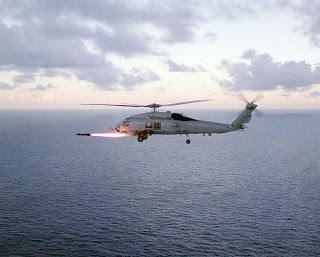 This Navy Times story about a helicopter from USS Bulkeley (DDG 84) engaging pirates attacking a crude carrier is excellent reporting.
The crew of a Navy helicopter launched from the destroyer Bulkeley fired upon and is believed to have killed four pirates who were in the process of attacking a crude oil carrier while it was transiting the Gulf of Oman on Monday, according to Combined Maritime Forces."Extended Unit Self-Defense?"
The interdiction took place at 10:35 a.m. local time. The Norfolk, Va.-based Bulkeley, assigned to Joint Task Force 150, had received a mayday call from the German-owned, Panamanian-flagged crude carrier Artemis Glory, which said it was being chased and attacked by pirates.
Bulkeley responded to the mayday call, first heard by a Royal Fleet Auxiliary ship and relayed to Combined Maritime Forces, by launching an SH-60B Seahawk helicopter assigned to Helicopter Squadron Light 48, Detachment 4, to investigate. When it arrived on station — a command spokesman could not provide the distance or transit time — the crew saw four individuals in a skiff firing at Artemis Glory, using small arms.
The helicopter crew opened fire on the skiff under what command spokesman Lt. Cmdr. Sam Hearn of the Royal Navy said was the principle of “extended unit self-defense” on behalf of the crude carrier. All four pirates are believed to have been killed, Hearn said. Hearn said he did not know which weapon system was employed but noted that the SH-60B is equipped with a single M-240 machine gun.
Give that a ponder, because that sounds to me like we are observing an evolution in the Rules of Engagement regarding piracy where a helicopter can now treat an attack on a merchant ship the same as if it is an attack against the helicopter. That is a big deal, because it means that helicopter pilots can engage any pirate target that is attacking a commercial ship.
This could be a game changer in the fight against piracy, because now it makes armed helicopters and armed UAVs more useful as an active deterrent when responding to mayday calls from merchants.
Sunday, May 15, 2024
Vessel Sunk Off Somalia by Missile
This report is claiming NATO blew up a ship off Somalia last night.
The Somalia Report is guessing it was EUNAVFOR. I'm hearing that isn't correct either.
Some folks in the private intelligence community are telling me the ship sunk was the FV PRANTALAY 12, which is really weird because earlier this week was claimed to be close to release. FV PRANTALAY 12 was reportedly en route from Ceel Dhanaane towards the Hobyo area. All 24 hostages were thought to be on the ship. This is also yet to be confirmed, but is one of the stories.
Now there are Somali sources saying India blew up a dhow, and that hostages of a pirate mothership are thought to have died in the attack. The missile is said to have rapidly consumed the ship in fire and only a few people who were on the ship, and were blown off the ship, survived the attack. Again, this is yet to be confirmed.
All we know for certain is that a ship was sunk killing 3-5 Somali's, and 4-6 Somali's survived the attack. Most people are describing the action as a missile attack.
I guess we will have to wait and see.
Update: Hard to figure how people are claiming to get information from pirates in a hospital in Somalia when all the injured are being treated on the ship, but I think this is the incident in question? Either way, the pirates learned an important (and what should be an obvious) lesson - do not attack Danish warships with machine guns.
Somali pirates and a foreign warship clashed off the coast of the town of Hobyo in central Somalia, killing at least three of pirates and wounding four others, witnesses said Saturday.Something is wrong though, because it does not appear the ship was sunk by NATO as the article claims.
Hassan Ilka-asse, a a fisherman in the coastal town of Hobyo told AHN by phone that the firefight erupted after one of the foreign warships approached the pirates’ boat.
“Heavy gun fire and shoulder launched missiles could be heard throughout the coastal area nearby. I think the ship was among [the] NATO Navy patrolling off Somalia coast” Ilka-asse explained, citing that he saw a NATO flag upon the top of ship.
He also said the ship completely destroyed the boat with a "big missile".
The Somalia Report is guessing it was EUNAVFOR. I'm hearing that isn't correct either.
Some folks in the private intelligence community are telling me the ship sunk was the FV PRANTALAY 12, which is really weird because earlier this week was claimed to be close to release. FV PRANTALAY 12 was reportedly en route from Ceel Dhanaane towards the Hobyo area. All 24 hostages were thought to be on the ship. This is also yet to be confirmed, but is one of the stories.
Now there are Somali sources saying India blew up a dhow, and that hostages of a pirate mothership are thought to have died in the attack. The missile is said to have rapidly consumed the ship in fire and only a few people who were on the ship, and were blown off the ship, survived the attack. Again, this is yet to be confirmed.
All we know for certain is that a ship was sunk killing 3-5 Somali's, and 4-6 Somali's survived the attack. Most people are describing the action as a missile attack.
I guess we will have to wait and see.
Update: Hard to figure how people are claiming to get information from pirates in a hospital in Somalia when all the injured are being treated on the ship, but I think this is the incident in question? Either way, the pirates learned an important (and what should be an obvious) lesson - do not attack Danish warships with machine guns.
Monday, May 9, 2024
MV Full City: The Rest of the Story
 Last week I discussed the international cooperation involved in the MV Full City piracy incident. Navy News has the rest of the story.
Guided-missile cruiser USS Bunker Hill (CG 52) boarded a suspected pirate vessel in cooperation with international forces while responding to a distress call May 5.It wasn't said so we must assume... the pirates were released. I wonder where the real owners of the dhow are, because odds are good they are dead, and the US Navy just let the pirates go in a stolen dhow.
The United Kingdom Maritime Trade Organization received a distress call from the Panamanian-flagged merchant vessel Full City and passed the information to U.S. 5th Fleet.
An Indian maritime patrol aircraft was able to locate the vessel, and
broadcast that warships were on the way. The crew had locked themselves in
a secure space from which they could control the ship, known as a 'citadel.'
Bunker Hill and aircraft carrier USS Carl Vinson (CVN 70) were the closest naval vessels to the Full City and set course to intercept. The Turkish ship Giresun, part of NATO's counter piracy operation Ocean Shield, also responded.
While Giresun boarded Full City, Bunker Hill approached a dhow in the area believed to be the 'mothership' for the pirate attack. An SH 60 Sea Hawk helicopter from Helicopter Anti-Submarine Squadron Light 49, deployed with Bunker Hill, fired warning shots to stop the dhow and instructed the suspected pirates to move to the bow of the vessel. In the early evening, a visit board, search and seizure team from Bunker Hill boarded the suspected pirate dhow.
The team found and destroyed paraphernalia on the dhow, including weapons, excessive fuel and other equipment commonly used in the commission of acts of piracy. They also sank a small skiff towed by the dhow; these skiffs are often used for actual attacks and boardings by pirates.
US policy towards piracy needs to concentrate on making two things happen:
- All equipment, including vessels, must be confiscated.
- Pirates must encounter some form of punishment.
Friday, May 6, 2024
The Rescue of MV Full City
 Yesterday there were a lot of unofficial reports and rumors surrounding the hijacking of the MV Full City, a Panama flagged, Chinese owned ship with a crew of 24 Chinese nationals. Reports were sketchy though, suggesting several ships including 2 Chinese warships were bearing down on the ship.
The only detail known was that the crew had successfully barricaded themselves inside the citadel - setting up a potential confrontation between naval forces and pirates. The race was on, and India got there first.
New Delhi/Mumbai, May 6 Prompt action by the Indian Navy staved off a pirate attack on a Chinese cargo vessel far out in the Arabian Sea, forcing the brigands to flee and earning kudos from the authorities in Beijing, a senior naval official said Friday.But the Chinese skip that part of the story, and tell only the rest of the story.
An Indian Navy TU-142 maritime reconnaissance aircraft made several low sorties over the MV Full City, 450 nautical miles (850 km) off Karwar in Karnataka, warning the pirates to immediately leave the vessel or face the wrath of Indian Navy and Coast Guard ships that were fast closing in.
The warnings worked and the pirates scampered into the skiff from which they had boarded the vessel and sailed toward a nearby mothership, which immediately set off toward Somalia at full speed, the official said, requesting anonymity due to service rules.
The aircraft stayed on station for four hours till the Indian combat vessels arrived on the scene in an operation that was closely coordinated with a NATO Task Force, a Chinese Task Force and the Maritime Rescue Coordination Centre at Beijing, highlighting the international cooperation in the anti-piracy efforts in the Indian Ocean, the official said.
The 24 Chinese sailors on board a Panama-flagged bulk cargo ship, hijacked by pirates yesterday at the Arabian Sea, have been rescued, as Turkey and U.S. navy ships in the nearby rushed to them and chased away the pirates, Xinhua News Agency reported.Obviously China is intentionally not giving India any credit, at least on the domestic consumption side, but has no problem giving Turkey and the US credit. The Indian aircraft was probably the only way the pirates new that naval forces were bearing down on their location, and almost certainly was the single largest contributor to the pirates fleeing the ship before naval forces arrived.
About seven suspected Somali pirates have left the ship, "Full City", and the 24 Chinese workers are found safe, locking themselves in the safety vessel of the ship, the report said. Guarded by U.S. Navy ships, a group of Turkey Navy commandos boarded the pirated ship.
The pirates attacked "Full City" at midday on Thursday local time, and seized it about 450 nautical miles off the coast of Mumbai in India.
The China Sea Rescue Center earlier reported two Chinese navy ships patrolling in the Gulf of Aden were alerted of the hijacking and rushed to its rescue yesterday. The center also sent liaisons to nearby patrolling ships for help.
Despite the absence of a public acknowledgment regarding Indian efforts, India learned of the hijacking somehow, so there is a lot of evidence of excellent communication and coordination at the government level on pirate activities. There was coordination between China, India, Turkey, and the United States against a pirated vessel 450 nautical miles off the coast of Mumbai in India. These small victories are adding up.
It doesn't matter how the various national media outlets tell the story, the job by the crew to protect themselves in the citadel and the cooperation by so many different nations in response to the hijacking of a ship is the story I see.
The pirates got away though, as is not uncommon, meaning another attack is almost certain to take place in the very near future unless someone stops them. Based on recent anti-piracy activities in the area and ongoing disputes between India and Somalia, I have a feeling India is not done yet with this group of pirates.
Tuesday, May 3, 2024
Piracy: Spain Sentences, Denmark Releases, The Netherlands Prosecutes
A Spanish judge has ruled in the case against 2 Somali pirates that were caught in 2009 after they held a tuna fishing boat and its 36 crew members for 47 days.
The pirates have also been ordered to pay €100k to every crew member. Like that is going to happen.
This Sunday Denmark put 15 Somali men back on shore, after the Public Prosecuter found no grounds for prosecution.
The Dutch, on the other hand, have decided to prosecute 9 of the 16 men captured when they freed an Iranian fishing dhow. The 9 will be charged with piracy and the use of firearms.
A Spanish court has sentenced two Somali pirates to 439 years in jail each for their role in the hijacking of a tuna fishing boat.Maximum time to serve in Spain is 30 years.
The pirates have also been ordered to pay €100k to every crew member. Like that is going to happen.
This Sunday Denmark put 15 Somali men back on shore, after the Public Prosecuter found no grounds for prosecution.
The Dutch, on the other hand, have decided to prosecute 9 of the 16 men captured when they freed an Iranian fishing dhow. The 9 will be charged with piracy and the use of firearms.
Tuesday, April 26, 2024
What Did He Just Say?
 So I am reading this article by David Axe recently published in Warships International Fleet Review about the murders of the Americans off the coast of Somalia earlier this year. I don't see the US doing anything in response to those murders that hasn't already been done, and I believe that means we can expect the same thing to happen again.
But what caught my attention is this video David Axe took while apparently on a VBSS mission from USS Donald Cook (DDG 75). I believe that video was taken during a trip David Axe went on earlier last year when USS Donald Cook (DDG 75) was part of NATO counter piracy.
Watch the video.
Did you watch it? Ugly, right?
The problem in Somalia is the lack of jobs, and even though there are no jobs, we can't find anyone in Somalia who speaks English that would work as an interpreter for our VBSS missions? We could probably find plenty of Somali+English speaking interpreters in Yemen currently living there as refuges in a UN tent city. If they really wanted to tell the USN folks something, would the USN folks even understand? Didn't look like it.
I get it that there are other potential languages, but no more than 2-3 possibilities.
Also, it might be worth it, every now and again, to ask to buy fish from folks we know are legitimate fisherman. Just saying.
Saturday, April 16, 2024
Somalia Pirates Targets India
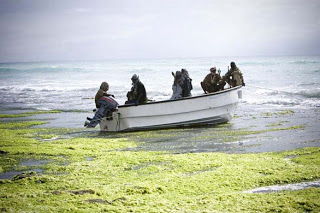 Somali pirates have raised the ante for operating ships operating with crews that have nationalized citizens of India.
India has been cleaning up territorial waters and piracy operating in their EEZ with a great deal of success lately, and after several successful actions going back to February, India has apparently pissed off some of the pirates a great deal.
This is the latest incident:
Somalia pirates said on Saturday they would keep any Indian nationals from freed ships as hostages until fellow pirates held by India are set free.Basically a multimillion dollar ransom was paid for the release of MT Asphalt Venture, and the ship was released, but the pirates kept 8 Indian nationals and are claiming they will keep all Indian nationals hostage until pirates that the Indian Navy and Coast Guard have captured are released. Pirates are no longer operating under normal rules, the spokesman in Harardhere is specifically using the word WAR, meaning they now feel they are in a state of war with India.
Somali pirates, who make millions of dollars ransoming ships hijacked as far south as the Seychelles and eastwards towards India, on Friday released MT Asphalt Venture, but held some of its Indian crew.
"We are holding eight of Asphalt Venture crew. It was a joint understanding among us not to release any Indian citizens," a pirate who gave his name as Abdi told Reuters from pirate stronghold Harardhere.
"India hasn't only declared war against us, but also it has risked the lives of many hostages," he said.
In the language of war, the pirates appear to be offering some sort of prisoner exchange.
Harardhere is the pirate stronghold in the south that many news sources have claimed direct financial agreements exist between pirates and Al Shabaab.
India has over 35,000 nationals who are employed globally as seaman on commercial ships flagged from a number of countries, and there are some very powerful maritime unions that work to protect the rights of those workers. We might also see some issues raised with insurance payments, because if a ransom payment is not valid for an Indian seaman, that could create a pretty big problem for piracy insurance premiums for ships with Indian nationals as crew members.
It will be interesting to see how this unfolds over the next few days.
Friday, April 15, 2024
Observing Modern MSO Squadron Operations
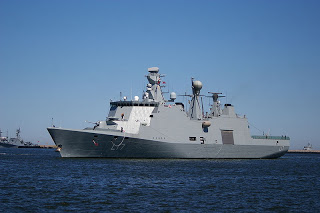 This is an interesting update on the anti-piracy activities of Standing NATO Maritime Group 2 (SNMG2). I see this as representing the other side of what Chris was discussing last night. I'm posting the news release in full (PDF).
NATO Operation Delivers Severe Blow Against Armed PiratesAs per the release:
Earlier this month, NATO counter-piracy forces delivered a severe blow against armed pirates off the coast of Somalia by arresting 34 suspected pirates. The suspected pirates had previously been observed loading up their mother ships and skiffs with fuel and weapons in order to attack merchant ships further out to sea. In a well-planned operation, NATO warships conducted a night-time strike on the known pirate lairs at sea, close to the coast. As well as detaining the 34 suspected pirates, 34 innocent hostages, who had been held by the pirates, were freed unharmed by the NATO forces.
Recent months have seen an increase in pirate attacks, particularly in the northern Arabian Sea, and with the monsoon season coming to an end, and the weather improving, it was seen as crucial for counter-piracy forces to strike to help prevent pirates getting out to sea to prey on merchant shipping transiting the area.
Over an extended period NATO warships HNLMS Tromp, HDMS Esbern Snare and USS Halyburton, observed the known pirate camps, supported by Maritime Patrol and Reconnaissance Aircrafts from the EU Naval Force (EUNAVFOR) and various other counter piracy forces.
On Friday, as part of the focussed operation, crew from NATO warship HDMS Esbern Snare boarded a suspicious whaler and found it to be packed with fuel, AK47 machine guns, a ladder and rocket propelled grenades (RPGs) and 3 suspected pirates. The whaler and weaponry were seized by the warship, and after being questioned, the suspected pirates were taken to a nearby beach.
On Saturday HDMS Esbern Snare then approached a dhow that was suspected to be involved in pirate activity. As the Danish boarding team investigated, the pirates started firing at them, who then fired back in self defence. In the fire-fight several pirates were wounded and as a result, a medical team from NATO flag ship HNLMS Tromp was quickly sent to the scene to render medical assistance.
Shortly afterwards HNLMS Tromp spotted another suspect dhow heading for a known pirate camp and as she closed in to investigate, her boarding team was also fired upon. Gunners on board Tromp and the boarding team returned fire, setting fire to the dhow. Ten pirates tried to escape in a skiff, but were quickly captured. When a team from HNLMS Tromp went to the dhow to assist the innocent crew, they found 2 fatally wounded pirates on board. At the same time, a previously pirated merchant vessel - MV Albedo, lifted anchor and headed straight for the NATO flagship.
After some well-aimed warning shots across her bow, Albedo returned to her anchorage. HNLMS Tromp then escorted the freed dhow and crew to safer waters.
On several occasions during the operation, the NATO warships surveyed the anchorages and the pirate beaches. They will continue to do so for the next few months.
Speaking after the operation, Rear Admiral Hank Ort, Chief of Staff at NATO’s Maritime HQ in Northwood said, “This operation has shown the pirates that we mean business and will not tolerate their criminal activities. By conducting this operation close to the shore we have been able to deprive some pirates of a safe passage back to their anchorages and deprive others of the opportunity to go out and attack innocent merchant ships. We are pleased with the success of this operation but we are not complacent as we know there is still much work to be done.”
NATO Forces currently in Operation Ocean Shield:As a press release, we aren't really getting some of the key operational details, but it does sound to me that NATO has been conducting some form of shore blockade on a specific pirate group.
HNLMS TROMP (Flagship) - Netherlands
HDMS ESBERN SNARE - Denmark
USS BAINBRIDGE - United States of America
USS HALYBURTON - Unites States of America
TCG GIRESUN - Turkey
When I think about the three ships involved in this activity, HNLMS Tromp (F803), HDMS Esbern Snare (L17), USS Halyburton (FFG 40); I see the future of how the Littoral Combat Ship could be used operationally when fielded in numbers. Basically one large ship supports two (or more) motherships that are conducting MSO and harassment operations against the bad guys in the littorals.
This type of operational scenario extends beyond just piracy to potentially include scenarios like current operations off Libya, offshore infrastructure protection, narcotics and anti-smuggling operations, and counter terrorism operations in the South Pacific. It is also very possible in the future we will see NGO operations at sea that require operations not unlike what Israel faces with protest flotilla's. Just about anywhere maritime forces will be utilized for some form of blockade or maritime defense operation, the organization of a single large ship supporting several Littoral Combat Ships focused on sea control in an ungoverned area will be very useful.
An LCS Model Adds Logistics Requirements
Potentially more so for Esbern Snare (L17) and perhaps similar to the way USS Halyburton (FFG 40) is functioning today, there are a lot of moving parts in the mission modules of the Littoral Combat Ship. Stuff breaks, and when (not if) they break, where is the service depot for repairing the equipment?
The Navy is currently building 24 Littoral Combat Ships. As I have said many times, I do not support building more than these 24 Littoral Combat Ships until the concept behind the LCS is rigorously tested and experimented with in operational conditions. The problem is, after 2015, existing Navy plans suggests they simply continue to evolve the LCS and build more. It strikes me this plan has several flaws and is not an optimal use of money, particularly because the Navy will begin the second block of ships before the first block has been thoroughly tested.
I'd like to see the Navy take a different approach towards the years FY16-FY18, and consider slowing the LCS down to 2 ships per year (one of each instead of 2 of each) for that three year period and think about how to build support platforms that enhance the operational capability of the LCS.
One idea would be to build 1 T-AKE type ship per year as a LCS mothership capable of fueling and repairing the Littoral Combat Ship and her modules. For the same cost of two Littoral Combat Ships, the Navy can add that LCS support element that helps keep the hard driving LCS with its rotational crew and forward deployed posture supported effectively forward - adding more time on station instead of in transit to and from port.
Another approach might be to build 2 extra JHSVs per year for three years to serve as an support platform for module repairs and module augmentation in a forward theater. JHSVs may not be able to deploy modules like the LCS, but they can act as additional storage capacity and be designed as a mobile module repair ship for these new unmanned systems that are being distributed to virtually every level in the fleet. While this approach would not add to supporting the extra fuel requirements that can be expected with the LCS, it would add depth to the forward maintenance capability that extends beyond the LCS to the cruisers, destroyers, and submarines - all of which are and will in the future deploy unmanned systems.
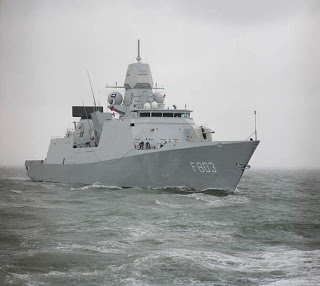 The Right Large Ship
Another question that comes to my mind when examining the NATO organization scenario above in a LCS context is what ship would you want to play the role of HNLMS Tromp (F803)? HNLMS Tromp (F803) is an air defense warship with command and control capabilities - a fantastic warship for exactly this role in a NATO MSO operation. But the question I have is whether the DDG-51 would be the optimal ship for scenarios where the LCS would be used, or if the US Navy requires more flexibility due to the range of capabilities that the United States has in a relative comparison to the Dutch.
Lets face it, in war scenarios the AEGIS ships will be there anyway and there will be value added to any task group organization detaching a destroyer to support LCS operations if the LCS operations are what is required. The dirty secret upon close examination is that the AEGIS ship is not always needed, but combat power in the form of different capabilities is indeed needed.
The way military capabilities are used today is remarkable. Last month the United States basically blew through the entire fixed air defense infrastructure of Libya with the vast majority of combat power being provided by a single submarine: USS Florida (SSGN 728). If someone would have suggested to Ronald Reagan in 1986 that instead of a carrier air strike, "we'll defeat the vast majority of the Libyan defense infrastructure with a submarine," that person would have been laughed out of the room and called a clown. And yet, that was only 25 years ago.
So tell me what MSO looks like in 25 years when a Littoral Combat ship squadron is running around conducting maritime interdiction operations, or defending offshore infrastructure. There will be an enormous number of moving parts in sustained operations, and that is going to keep the crews of the LCS very busy. In many ways, MSO is about killing flies, not shooting birds, so having combat power in the context of the sharpest sword is much less useful than having combat power in the context of a mallet.
When augmenting an LCS force in these operations, the capabilities desired the most for these operations will involve manpower. They will be in the form of Blue-Green cooperation like Enhanced Company Operations, brown water capabilities like Riverine, Naval Expeditionary Security, Special Warfare capabilities, EOD, and even Seabees. These are capabilities that suggest a ship will be needed with capabilities very different than the way we think about traditional surface combatants which today come with combat power almost exclusively focused on air defense.
Just as there was the SSGN represents a hybrid between the SSN and the large missile carrying cruiser, I believe in the future we are going to need a surface ship that is a hybrid between today's modern warships and an amphibious ship - and that hybrid will be a large mothership for manned capabilities.
The LCS enables tremendous opportunity for flexible action in the littorals, but sustained operations on the LCS with the small crew suggests the necessity for augmentation, and when discussing any small ship there are always be several areas where augmentation is required. The Navy and Marines are looking to replace 12 LSDs with 11 LSD(X). Whether the Navy reuses the existing LSDs (like the Navy did with SSGN reusing retiring SSBNs) or simply thinks differently about the design of the LSD(X), there is a lot of room for innovation in the configuration of the future large surface combatant towards increasing combat power in areas other than air defense - where the US Navy fleet today is already strongest.
Thursday, April 14, 2024
Countering Piracy Ashore - A Step in the Right Direction
Late last year, I argued that in order to truly impact Somali pirates, we needed to spend less energy on the pirates themselves and target their key network nodes and facilitators ashore. In January, VADM Fox similary advocated focus on the pirates' networks. Yesterday, the FBI announced that they are doing just that.
The arrest of Mohammad Shibin is a significant breakthrough in the United States’ battle against Somali pirates,” said U.S. Attorney MacBride. “Today marks the first time that the U.S. government has captured and charged an alleged pirate in a leadership role—a hostage negotiator who operated in Somalia. We hope that this indictment will strike at the heart of the piracy business and send a strong message to all pirates that they are not beyond the reach of the FBI, whether they board the ships or remain on-shore in Somalia.
Rolling up a single facilitator is clearly a positive step, but we shouldn't expect major disruptive effects anytime soon unless faciltiators are neutralized faster than they can reconstitute. That said, additional efforts to dismantle the pirates’ logistical and financial network ashore will prove significantly more effective (both operationally, and cost-wise) than CMF's futile interdiction operations in the Indian Ocean.
The opinions and views expressed in this post are those of the author alone and are presented in his personal capacity. They do not necessarily represent the views of U.S. Department of Defense, the US Navy, or any other agency.
Tuesday, April 12, 2024
The Incomplete Details of MV Irene SL
 I was looking for this three weeks ago, but sometime between then and now a PAO published the tale. This is a strange pirate story, unlike others we have seen.
USS Halyburton (FFG 40), part of NATO’s counter-piracy Task Force 508, rescued 13 people from the Greek flagged merchant vessel Irene SL while conducting maritime security operations in the Indian Ocean on March 19.But wait - there were 25 hostages on MV IRENE SL, not 13. This is a strange story confused by the offering of some details, but lacking in full disclosure.
Irene, a pirated vessel being used as a mothership, had a suspected pirate on board in need of urgent medical assistance.
Using bridge-to-bridge communications, the suspected pirates on board Irene contacted Halyburton to request immediate medical assistance.
Halyburton maneuvered to assist the man and requested the suspected pirates release hostages, to which the suspected pirates agreed.
While being transferred to Halyburton for treatment, the injured man stopped breathing. Despite the best efforts of Halyburton’s medical team, he could not be resuscitated.
The body was returned to Irene and 13 hostages were released.
The rescued hostages were transferred to Halyburton where they received food, water and medical attention.
Irene was pirated last month approximately 350 nautical miles South East of Muscat in the North Arabian Sea.
Halyburton is part of Standing NATO Maritime Group Two, a multinational counter-piracy task force operating off the Horn of Africa.
It looks like the US Navy traded the effort of providing medical assistance to a pirate (an that effort failed when the pirate died) and was able to secure the release of more than half (13 of 25) hostages in the process. Last Thursday EUNAVFOR announced that MV Irene SL had been freed, although it is unclear how.
The celebration of the release of 25 hostages is odd though, considering the USS Halyburton (FFG 40) had apparently already freed 13 of them?
Somali piracy is such a strange issue to follow, because I get better information about Chinese military affairs than I do western Naval operations against piracy. I can get up to the hour intelligence on Somali pirate activity from numerous sources, but whenever something good happens it takes forever and we are only informed to bits and pieces of the story. The Danes are the same way, here is today's big news item about an action by Danish commando's that actually took place on April 2nd.
In other pirate news, a German, a Seychelles, and a Thai ship was released, and the UN has finally decided it is a good idea to think about a new legal process specific to piracy. The British appear to be ready for that, because after this latest disclosure the Royal Navy is talking about changing their Rules of Engagement.
Meanwhile, lots of attacks reported over the last week - the monsoon season is over.
Sunday, April 3, 2024
HNLMS Tromp Rescues Iranian Fishing Vessel
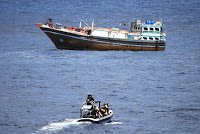 Yesterday HNLMS Tromp freed an Iranian fishing vessel that had been captured by Somali pirates.
When 2 RHIBs approached a suspect fishing dhow they were shot at. Marines in the RHIBs and marksmen from the Tromp returned the fire. After the RHIBs went in for a second approach 10 pirates tried to flee in a skiff. Firing warning shots stopped the skiff from escaping and the pirates, several of them injured, were taken on board the Tromp.
The remaining pirates in the dhow were surrendering after that. On board of the Iranian fishing dhow were it's 16 crewmembers and 8 Somali pirates, 2 of whom were dead. They were most likely killed during the previous firefight.
During the action another pirated vessel came to try and retake the just freed dhow. That vessel left the scene after warning shots from the Tromp.
The 16 pirates are now on board the Tromp.
Subscribe to:
Posts (Atom)