Showing posts with label North Korea. Show all posts

Monday, December 20, 2024

South Korean Military Drill Ends Without Confrontation

It was nice to see so many talented National Security experts and top notch reporters in South Korea on Twitter last night during the South Korean military drill on Yeonpyeong island. One of the first questions that popped up after the drill concluded was "Did Seoul just win a terrifying game of chicken?"

No. Throughout the military exercise there were reports of an enormous show of military force in the air and at sea around the islands. North Korea is not stupid, they will not fight South Korea on the terms of South Korea, they will wait and strike when the time is right for them.

The real question we should be asking on December 20, 2010, is whether North Korea will respond before the new year, or after? A response from North Korea is coming, of that have no doubt. It will be on their time and in the place of their choosing.

Sunday, December 19, 2024

The Guns of Christmas

The weather is improving over South Korea, and the live fire drills are likely to take place today. A few random thoughts before the day unfolds.

South Korea will conduct the live fire drills, cancellation isn't an option. This is a cultural issue as much as anything, South Korean President Lee Myung-bak cannot back down to North Korean threats or intimidation or he will be forced to resign in disgrace.

North Korea will return fire. The North has made every single warning that is consistent with the warnings made prior to the last outbreak of combat, including phone calls with personal warnings (very rare). Expect return fire to Yeonpyeong island and at least one other location along the DMZ as well. If I was to guess, I would suggest the second attack vector will probably be in Gyeonggi Province. If you recall, that is where intelligence suggested the next attack would come from, and if I was in Vegas I would bet that is where KPA Unit 2670 is located.

North Korean artillery fired a number of duds during the first Yeonpyeong island attack. Folks will be watching to see if the second attack also includes a high number of duds. The North Korean guns are still good, but the artillery shells may not be. If serious shooting starts, it will be interesting to see if the South Koreans decide to take out all the guns while they are ineffective due to bad ammo, as opposed to stopping short of that step and letting North Korea rebuild stocks of new artillery shells.

I suspect the response to an attack will be measured and not an all out offensive. It is very unlikely North Korea would use a nuclear weapon unless the South Koreans actually invaded North Korea, but it is also unclear how the North Koreans will respond to bomb raids against Pyongyang.

Bill Richardson does not appear to have made any progress on either defusing tensions or the nuclear issue. As long as he stays in North Korea though, there is still hope for a diplomatic breakthrough.

Friday, December 17, 2024

A Very Korean Weekend: Confrontation or Breakthrough

The Korean crisis is turning into a case study on escalation control. With the arrival of Bill Richardson to North Korea on Thursday, North Korea decided on Friday to wave their deterrent, again, in our direction.
North Korea warned Friday that another war with South Korea would involve nuclear arms and spread beyond the peninsula, upping the ante as a prominent U.S. politician and a top U.S. nuclear envoy each visited Pyongyang and Seoul to defuse tension.

Uriminzokkiri, the communist state's official Web site, also said in a commentary that war on the Korean Peninsula is only a matter of time, stoking already high tensions after the North shelled a western South Korean island on Nov. 23 and killed four people.

"If war breaks out, it will lead to nuclear warfare and not be limited to the Korean Peninsula," it said.
If you are one of those people who think this is just more North Korean rhetoric, and do not see military confrontation as a possibility here, perhaps if I raise you a Vice Chairman of the Joint Chiefs of Staff you might reconsider the very real possibility that war might come to the Korean Peninsula as soon as this weekend.
The U.S. military is concerned that South Korea's live-fire artillery exercises planned for coming days could spark an uncontrollable clash with the North, but the State Department said the exercises are not meant to be threatening or provocative.

"What we worry about, obviously, is if that is misunderstood or if it's taken advantage of as an opportunity," Gen. James Cartwright, vice chairman of the Joint Chiefs of Staff, said Thursday at the Pentagon. "If North Korea were to react to that in a negative way and fire back at those firing positions on the islands, that would start potentially a chain reaction of firing and counter-firing."
The escalation control comes, in part, from diplomats:
"South Korea is entitled to take appropriate steps in its self-defense, making sure that its military is prepared in the event of further provocations is a perfectly legitimate step for South Korea to take," State Department spokesman P.J. Crowley said at his midday briefing Thursday. "North Korea should not see these South Korean actions as a provocation."
But the Generals are involved in the escalation control process:
"What you don't want to have happen out of that is ... for us to lose control of the escalation. That's the concern," Cartwright said about the military exercises.
There is a pattern of cop/bad cop when you mix and match the comments from State and Defense:
"These are routine exercises. There's nothing, you know, provocative or unusual or threatening about these exercises," Crowley said. "There's no need for it to increase tensions in the area. This is a pre-announced live fire exercise. The North Koreans clearly should know what is going to happen. It is not directed at North Korea."
What concerns me about General Cartwrights comments is that they do not all appear to be pointed in the direction of North Korea, indeed one could infer that he is speaking through the media to South Korea as well. There were news reports that North Korea warned South Korea not to conduct the exercises on Yeonpyeong Island prior to the first incident. Has there been a warning this time? I only ask because we are reacting to news of the new exercise as if North Korea told us - 'better not!'

How do we then put the comments by Vice Adm. Al Myers to the crew of the USS Carl Vinson (CVN 70) into context with all that is going on. The aircraft carrier is in the final stages before heading off to the western Pacific. I personally find these comments quite remarkable, but primarily because Navy News Service actually printed it.
Myers also encouraged the strike group Sailors to handle the gravity of their forthcoming mission.

"For the folks who are on their first deployment, they're going to write history. Vinson is going to be in the news," Myers said. "It's important to understand the Navy does two fundamental things - one is we influence foreign countries, build and disrupt coalitions, and we maintain sea lanes of commerce. You're going to influence a few foreign countries. By being present there, you're going to be protecting our lanes of commerce. You can't do that virtually, you have to be there, you have to be forward deployed. You prove every day what a strong team can do."
Looking for a way to pull all of this together? The commentary at Nightwatch over the last two days has been very good. Read this report first, then this one, before reading on...

If you follow the pattern you see two tracks possible, confrontation and diplomatic breakthrough. The State Department deserves a ton of credit for being very agile and responsive in keeping the pressure on both North Korea and China. It is worth noting that Russia still lingers as a Plan B over the horizon as a SK-US-Japan diplomatic option should things turn south. For their part, China is being systematically discredited as the responsible regional leader to virtually every observer, and younger leaders who are more familiar with how international rule sets work for security have demonstrated signs of awareness towards this important aspect of events. That is good news in the long term, but does nothing for the current situation.

The chess match being orchestrated by the State Department is designed around a theory of escalation control for nuclear warfare that I had believed disappeared after the cold war. The US military has masterfully played their support role for the region while signaling preparation for military action should a confrontation occur. The statements of US Generals and Admirals act as pressure points to maintain pressure on the region, and everything has been building towards the South Korean exercise this weekend. As it has been since the original combat action, what happens next will be determined exclusively by the two Koreas, with both the US and China playing every card possible to insure a diplomatic avenue exists should confrontation not be on the agenda.

As a final note:
Date .......attack subs deployed | attack subs underway
Nov30 .............. 37% ................ 46%
Dec07 .............. 41% ................ 63%
Dec17 ...............43% ................ 67%
A full 2/3 of the United States Navy attack submarine force is at sea today, and 4 attack submarines have deployed over the last 10 days. I'm sure it is a Christmas coincidence.

Tuesday, December 14, 2024

Russian Military Forces on High Alert at DPRK Border

Just when you think tensions are starting to settle on the Korean Peninsula, something like this happens.
Russia has put its forces on alert in the country's far east because of increased tension on the Korean Peninsula, the Interfax news agency quoted the top military commander as saying Tuesday.

"Without a doubt, we have taken measures to increase the combat-readiness of our forces," military General Staff chief Nikolai Makarov said, Interfax reported. He said the military was "continuing to monitor" the situation.
I've been watching almost daily to see if there is any evidence of China moving military forces towards the border with North Korea, but I haven't seen anything. I am not sure what it means that Russia is making moves, now, after all this time? Clearly it is prudent given the situation over the last few weeks, but the timing seems a little off - as in late.

Although the military activity may coincide with this:
Russian Foreign Minister Sergei Lavrov met his North Korean counterpart in Moscow on Monday and condemned the artillery attack on Yeongpyeong Island.

According to the Russian foreign ministry, Lavrov met with North Korean Foreign Minister Park Ui-chun and told him that the shelling of the inhabited South Korean island, which killed four people, is blameworthy.

Lavrov had condemned the North’s Nov. 23 attack hours afterward, but Monday’s statement is considered a much stronger response as it was made directly to the first high-ranking North Korean official visiting Russia since the shelling.
Other developments include North Korea agreeing with China for 6 party talks, although it is unclear if South Korea, Japan, and the US will agree to talks. A large American diplomatic envoy will arrive in the region on Thursday, but it is unclear what they intend to accomplish given the mood in South Korea. Bill Richardson, for example, will be going to North Korea on Thursday for what is being described as a private trip. I have no idea what he thinks his trip will accomplish, and it is unclear if he is acting on behalf of the administration in an informal role.

Thursday, December 9, 2024

Chinese FM Verbally Bitchslaps ADM Mullen

When China says it this way, it means they are calling President Obama's bluff.
China's ties with North Korea have drawn increasing criticism from the United States, and Admiral Mike Mullen, the head of the US Joint Chiefs of Staff, remarked on Wednesday that he wished the Chinese would be more helpful.

"The Chinese have enormous influence over the North, influence that no other nation on earth enjoys. And yet, despite a shared interest in reducing tensions, they appear unwilling to use it," he said.

In response, the Chinese Foreign ministry questioned on Thursday what Mr Mullen had ever done "for peace and stability in the region".
For the record, throughout most of his career ADM Mullen never spent considerable time in the Pacific, however I don't believe the Chinese Foreign ministry was attempting to make a resume review observation with the comment.

If the intention has been to pressure China and get them to reign in North Korea, it would appear that effort has not produced results. I don't believe anyone thought it would, but I do think it was worth the effort.

The question becomes - now what? I am not going to speculate in detail, but whatever it is - the risks of any action go up from here.

Report: North Korea Developing Nuclear Sea Mines

The English language version comes courtesy of Bill Gertz in Inside the Ring. It is worth reading in full, but this is how it begins.
U.S. intelligence agencies are working to track down an alarming report from inside North Korea revealing that the communist regime is secretly developing underwater nuclear torpedoes and mines.

According to a newsletter run by dissident North Koreans, the report states that North Korea's government has a special group of researchers at the National Defense Technology Institute that is "developing underwater weapons using nuclear warheads." The report was published Dec. 3 by the Korean-language newsletter NK Chisigan Yondae, or NK Intellectual Solidarity.

The U.S. Navy once had nuclear torpedoes and mines, as did the Soviet navy, and China's military also has discussed the use of nuclear torpedoes in its military writings as recently as 2006.
The original report in Korean that is being discussed can be found here.

Keep in mind this is an unconfirmed report from a group of North Korean defectors. What seems to add some credibility to this new report is a "secret" Wikileaks cable dated September 26, 2024 when a Chinese diplomat told a US diplomat that North Korea failed to report "critical information about secret underwater nuclear facilities located on North Korea's coast."

The idea of nuclear sea mines is not a new idea, there are several Chinese articles that have discussed the nuclear sea mine capability over the last decade. In China's Underseas Sentries, a Winter 07 Underwater Magazine article by Andrew Erickson, Ph.D., Lyle Goldstein, Ph.D., & William Murray, the Chinese discussion is mentioned:
Submarines have attracted particular attention as a deployment platform for rising mines. An article by Dalian Naval Academy researchers suggests significant PLAN interest in SLMMs. A researcher at Institute 705 advocates acquisition of an encapsulated torpedo mine, similar to the Cold War-era U.S. Captor mine, which could be laid in very deep waters to attack passing submarines. Mine belts—external conformal containers designed to carry and release large numbers of mines—can be fitted to submarines in order to bolster their otherwise limited payloads. One article emphasizes that the Soviet navy developed a “mine laying module capable of carrying 50 sea mines on either side of the submarine” and states, “For the past few years related PLA experts have expressed pronounced interest in submarine mine belts…. The PLA very probably has already developed submarine mine belts.” Another source notes, however, that “submarines built after World War II rarely carry mines externally.”

Disturbingly, there is some discussion of a theoretical nature in Chinese naval analyses concerning arming sea mines with tactical nuclear weapons. One such analysis, in the context of discussing Russian MIW, notes that nuclear sea mines could sink adversary nuclear submarines from a range of 2000 meters.... A second article finds that a nuclear payload is one logical method to increase the destructive power of sea mines, while a third analysis argues that nuclear MIW is especially promising for future deep-water ASW operations. It concludes: “At this time, various countries are actively researching this extremely powerful nuclear-armed sea mine.”43 An article in the July 2006 issue of Modern Navy (Dangdai Haijun), published by the PLA Navy itself, in the context of discussing potential future PLA Navy use of sea mines, also notes the potential combat value of nuclear-armed sea mines. While there is no direct evidence of the existence of such naval tactical nuclear weapons programs in China, these articles do perhaps suggest the need to closely monitor any Chinese efforts in this direction.
The specific citations for the nuclear mine discussion are below:
焦方金 [Jiao Fangjin], “双头鹰的水中伏兵” [The Double-Headed Eagle's Ambush at Sea], 国防科技 [Defense Science], July 2003, p. 91.
王伟 [Wang Wei], “历久弥新话水雷” [Enduring and Yet Fully Relevant: A Discussion of Sea Mines], 国防 [National Defense], November 2002, p. 58.
陈冬元 [Chen Dongyuan], p. 45.
Is North Korea a signatory of the 1971 Seabed Treaty? I don't think North Korea takes such things seriously, but use of a nuclear sea mine would be a clear violation.

In the focus of the Iranian nuclear program, I have discussed red lines that once crossed, means a military attack will likely come soon after. We have never really seen where a red line was crossed in regards to an Iranian nuclear program, but I am starting to wonder if someone in Seoul has decided North Korea has crossed that red line with the North Korean nuclear program. If so, it might help explain why the Obama administration seems to be committed to the new South Korean led strategy in dealing with North Korea, even if supporting that strategy takes the Korean Peninsula to the brink of war.

Wednesday, December 8, 2024

"Korean Peninsula Headed Toward War"

Dr. Victor Cha, Senior Adviser and Korea Chair for the Center for Strategic and International Studies, published an article on Tuesday in the Chosun Ilbo that begins "There is a real possibility of war on the Korean Peninsula." A little about the Dr. Victor Cha...

Dr. Cha has a reputation for being more 'hawkish' towards the Korean situation than other policy advisors over the last several years. The advantage of being the voice of an alternative, more hawkish policy analyst over the last several years however is that all his dovish critics have an undisputed history of failure in dealing with North Korea. Dr. Cha was President Bush's top advisor on North Korean affairs, and is a former Director for Asian Affairs in the White House's National Security Council. During six-party talks under the George W. Bush administration, Dr. Cha was one of the US folks at the table with North Korea.

The article has been reprinted in this CSIS blog post. The article articulates the reasons why "war is a real possibility" discussing the pressures on South Korea to act and the confidence North Korea takes actions with. Diplomats often talk about miscalculations. This article suggests the Korea situation has potentially already raced passed the point of miscalculations and is simply waiting for a trigger moment that proves it.

Today, December 8th, 2010, was the first snow of the winter in Seoul. The winters are quite cold and have historically held through March. The weather is not a trivial consideration, because if indeed the situation on the Korean Peninsula is headed towards war, then the impact of war to civilians along the DMZ at the onset of the Korean winter has enormous ramifications. This is the worst possible time of the year for threats to homes of civilians in South Korea, which may explain to some degree North Korea's timing.

What I find interesting are the recommendations for how to prevent the war, because it is a prescription intended to reset the calculus of all sides with more clarity. From the article:
So what should the U.S. do? Obama’s military exercising with South Korea and Japan is the right first step. But there are two more steps. First, serious consideration should be given to augmenting U.S. troop levels in Korea. This is the ultimate symbol of the deterrence and will impose real costs on the North for its actions, who seek the removal of these forces.

Second, the U.S., South Korea, and Japan should seek a resolution from the UN authorizing the use of force in self-defense at the next North Korean provocation. China will oppose both measures, in which case it should stop North Korea’s provocations. Third, the U.S. should enlist Russia to begin informal talks with North Korea about nuclear deterrence. The purpose of such talks would be to undercut any false notions Kim might have that a few nukes in the basement permit him to provoke recklessly. These are extreme measures but they befit the gravity of the situation.
Lets examine all three recommendations one at a time.

The first recommendation is to augment U.S. troop levels in Korea. As of May 1, 2024 there were ~28,500 total US force personnel in South Korea. Of that ~28,500, the Eighth United States Army has ~22,000 personnel broken down as follows:
2nd Infantry Division .................................................. ~8,000 personnel
19th Expeditionary Sustainment Command ............ ~4,000 personnel
1st Signal Brigade ......................................................... ~3,000 personnel
35th Air Defense Artillery Brigade ............................ ~1,000 personnel
65th Medical Brigade ................................................... ~3,000 personnel
501st Military Intelligence Brigade ........................... ~3,000 personnel
There are some additional ground forces in small numbers as part of United Nations Command which includes Marine Corps Forces - Korea and Special Operations Command - Korea. Those personnel totals are not listed here.

The remaining ~6,500 personnel are part of the Seventh Air Force which is centered around the 8th Fighter Wing, the 51st Fighter Wing, 731st Air Mobility Squadron, 694th Intelligence, Surveillance and Reconnaissance Group, 5th Reconnaissance Squadron, and Detachment 1, 33rd Rescue Squadron.

There are also about ~300 personnel assigned to US Naval Forces, Korea.

This leads to several questions, the first being how many troops and what kind of troops? I am not sure the US Army has any available brigades right now, and to make matters worse I don't think the US Army has much equipment left on their MPS ships either. The Marines have done a good job keeping their MPS ships ready to sail, but I am not sure about the Army. Would we commit our reserve, the 3rd Marine Division, with no infrastructure in place at the start of winter? I hope not.

Surging forces on the ground is a lot easier said than done, and while I would agree with Dr. Cha that it would send a message, the force would have to be of sufficient size to insure the message is delivered. That means at least 2 or 3 US Army combat brigade teams, and I don't believe those forces exist for purposes of strategic communications - and the cost is not trivial.

The impact of moving US troops to South Korea would be significant, and not only for North Korea. That might actually be a good thing though. If the United States adds an additional 10,000 personnel to South Korea, and drives equipment into position - the South Korean population is going to notice real quickly. That presence of additional forces will make a significant impact to the political options for South Korea, but more likely the impact would be to limit South Korean options politically. While I agree North Korea would reevaluate their position with the reinforcement of US forces by additional Army BCTs, I don't see this as practical unless the shooting actually breaks out.

Ultimately, the only additional military forces that can 'surge' to the Korean Peninsula will be either Navy or USAF. In my opinion, that clarifies things considerably, because now you know what capabilities you have to address the problem. Will Pyongyang be intimidated by aircraft carriers and warships? Probably not, but I do know Pyongyang seems to go ape shit every time a submarine surfaces in Chinhae or Bosan. Some naval platforms are more intimidating to North Korea than others, because North Korea has very few effective defense capabilities against some naval platforms - like submarines.

The second recommendation calls for a resolution from the UN authorizing the use of force in self-defense in response to the next North Korean provocation. That might work as a deterrent, but South Korea doesn't need the UN's permission to defend their nation from a North Korean attack. I would support this action, but I also agree with Dr. Cha that China is likely to veto any resolution put up to a vote. While this is a practical step to increase pressure on China, I am unsure what it solves if indeed South Korea, Japan, and the US require Chinese assistance for a peaceful resolution - which for the record, is exactly how I read the US policy right now.

The third recommendation is quite interesting, as it calls for the U.S. to enlist Russia to begin informal talks with North Korea about nuclear deterrence. That is certainly an interesting idea, but it raises the question whether it frames the confrontation between South Korea and North Korea into a context of a nuclear standoff. I am not sure the results can be predicted well if the starting point for Russia is that North Korea faces nuclear attack, and requires additional nuclear deterrence assistance from Russia. If a confrontation is highly probable, then doesn't that suggest avoiding putting confrontations into a nuclear context? I would think so.

I believe the analysis by Dr. Cha regarding how events are unfolding is spot on, although I disagree with his recommendations for action. There are two things that I think need to be considered.

First, will North Korea be attacking soon or will there be another 8 month pause before another military provocation? I don't believe there is any question that if North Korea attacks, South Korea will be responding very hard to North Korea. I also believe that right now, everyone believes North Korea will attack again at some point in the future. Time is an unknown right now, so it seems to me that all diplomatic efforts should be focused on extending the time between now and the next attack.

Second, why does a message or response to North Korea need to be an overt, conventional military attack? North Korea is a paranoid, centrally controlled, tight fisted regime that is generations behind in capabilities civilians in most western nations take for granted, so why couldn't, or shouldn't, a unified response be a more irregular approach that targets the paranoia while trying to generate enough confusion to turn the regime against itself? The number of indirect, non-conventional military options available to South Korea and the US are pretty large, for example, the winters are just as cold in North Korea as they are in South Korea, and I would hate to see the heat turned off for all those elite party members in Pyongyang.

My point is this: I agree completely that confrontation is coming to the Korean Peninsula because South Korea's stated defense policy to future attacks combined with the comfortable position of the North Koreans who feel secure behind a nuclear umbrella almost insures it. However, I disagree that this is headed towards a conventional war, because I am not convinced it is. Skirmish maybe, but major conventional conflict? Not yet.

What we have seen in 2010 on the Korean Peninsula is more akin to a shadow war, and I would expect a lot more of that - from all sides.


Tuesday, December 7, 2024

New Strategy Begins With North Korea

From the notable location of the USS Abraham Lincoln (CVN 72), I think Secretary Gates is trying to tell us something.
Defense Secretary Robert Gates warned Monday that provocative actions by North Korea signal difficult and potentially dangerous times ahead, and he said the U.S. must work with China and others to bring stability to the peninsula.

Speaking to sailors on the aircraft carrier USS Abraham Lincoln, Gates said no one wants to see another war, so the U.S. needs to "figure out the way ahead with North Korea."
Meanwhile North Korean midget submarines are back in the news.
North Korea has developed a new type of midget submarine fitted with torpedo launch tubes, allowing it to attack South Korea warships more easily, a report said Tuesday.

Satellite images of a naval base in the North's southwestern city of Nampo, published by JoongAng Ilbo newspaper, show what appears to be a 17-metre-long (56-feet) submarine with a tube-like structure attached to its top.

"We have concluded that it is a torpedo launch tube," the paper quoted an unidentified Seoul intelligence source as saying.

The paper said the new Daedong-B midget submarine moves faster than larger submarines and is harder for military radar to detect.
Meanwhile, South Korea turns their offshore islands near the northern maritime border into fortresses, Admiral Mullen is dispatched to Asia, the International Criminal Court begins an inquiry into potential war crimes by North Korea (including the Cheonan sinking btw), Secretary Clinton meets with diplomatic heads of Japan and South Korea, and most importantly President Obama and Chinese President Hu Jintao have a little phone conversation.

A few observations. President Obama is terrible when having to adapt to crisis and he doesn't have a plan, but when he does have a plan he tends to demonstrate remarkable toughness. It is pretty obvious to me the President doesn't have a plan for things like Wikileaks, and he didn't have a plan for tax cuts.

But I think he does have a plan when it comes to South Korea. The plan is really simple - make North Korea China's problem and if North Korea attacks - let South Korea lead and support them in every way possible - and South Korea has established how that will end.
South Korea will swiftly and strongly respond with force until North Korea surrenders if the communist state launches another assault, the South's new defence minister said.
If China miscalculates based on that kind of clarity, then China probably has no business thinking they should lead in Asia in the first place. Sure makes you wonder what Obama and Hu said to each other.

Do I think Kim Kwan-Jin means what he is saying? Yes, I do. I also think South Korea is working right now to train for exactly that. As I have tried to make clear from the beginning, do not expect to predict the outcome because the President has already decided the approach to North Korea will not be like the old approach. If you don't believe the US, South Korea, and Japan are plotting right now on ways to go after North Korea - then you are ignoring everything that has taken place so far. It won't be a straight up conventional military attack - it will be creative and unexpected.

And the only way it doesn't happen is if China steps up, or North Korea gives in. That is why Gates is probably right when he said there are "difficult and potentially dangerous times ahead." Interestingly enough, I think nobody believes in what the US is doing because like most US conservatives, many people in the world believe President Obama's conciliatory approach early in his President was a reflection of a personal weakness by the President. I think that assumption is very flawed, because it ignores his style, and ignores when and why his decisions are anything but.

Friday, December 3, 2024

Deterrence Theory

This is how to prevent war when diplomacy fails, with the details provided from this AP article in my newspaper, the Albany Times Union:
President Lee Myung-bak's government is suffering intense criticism that its response to North Korea's Nov. 23 barrage on a South Korean island was weak, and over the stunning revelation that the South's spy chief dismissed information in August indicating the North might attack the front-line island of Yeonpyeong.

Lee's nominee, Kim Kwan-jin, told a parliamentary confirmation hearing that further North Korean aggression will result in airstrikes. He said South Korea will use all its combat capabilities to retaliate.

"In case the enemy attacks our territory and people again, we will thoroughly retaliate to ensure that the enemy cannot provoke again," Kim said. The hearing is a formality as South Korea's National Assembly does not have the power to reject Lee's appointment.
This public diplomacy approach by Kim Kwan-jin to prevent war will probably be more effective than China's private diplomacy 6-party talks approach given the politics on the Peninsula today.

The Korean War Armistice Agreement was held together for over a half century due to deterrence theory. It is good to see this approach restored, because it ultimately reduces the probability of war more than any other diplomatic approach right now.

Remember, South Korea is leading the political response to address North Korea. There will not be 6-party talks until South Korea decides it is time for 6-party talks, our position on the issue will follow their lead.

Because we are following their lead, I am uncertain whether the US will do anything unilaterally unless South Korea approves. I still believe that South Korea is looking for a way to influence North Korea in an indirect way, and the only thing we are learning is that the indirect way will not be China. The United Nations remains another diplomatic avenue to be leveraged, but the effectiveness of anything that could come from the UN remains unclear.

What we do know is that time is on the side of South Korea, because North Korea has an impending serious food problem due to the impacts of flooding on the crops in North Korea this summer. North Korea needs aid, and the way pressure is being applied means North Korea is going to have to find a reasonable way to ask for aid if they expect to receive it. That will be a new approach in and of itself for North Korea, and they may not know how to do it without losing face. The outcome might mean North Korea becomes a bigger burden on China than it has been in the past - which might also be exactly what all of these actions by South Korea are intended to do.

Meanwhile, tensions remain high, and the President has his eyes on the right ball.
The Obama administration told the United Nations nuclear watchdog that North Korea likely has built more than one uranium-enrichment facility, significantly raising the proliferation threat posed by the secretive communist state.

U.S. and European officials are pressing the International Atomic Energy Agency to better scrutinize Pyongyang's potential role in sharing its nuclear technologies with third countries. But the U.N. agency's ability to monitor Pyongyang is limited: North Korea kicked out the IAEA's inspectors in 2009.
Some have suggested that the Wikileaks cables highlight how much the US doesn't know about what is going on in North Korea. Well, duh - the IAEA has had the same complaint for over a year now. It isn't even clear if China really knows what is going on in North Korea anymore. The veil of secrecy surrounding the North's nuclear program has been remarkably effective.

Finally, several western media outlets have headlines that suggest China is upset about the US-Japan exercises that start today. This looks like western media spin to me. You can read this Xinhua News Agency article and decide for yourself. My read is that China's reaction to the exercise is being overblown and is mostly Fox News style overreaction.

Thursday, December 2, 2024

News and Notes From Korea

South Korea Readies for Artillery Drills on Disputed Sea Border
South Korea hasn’t decided when it will next hold artillery exercises on Yeonpyeong, said a spokesman for the Joint Chiefs of Staff who declined to be identified, citing military policy. The National Intelligence Service believes North Korea may launch another attack on the South, Grand National Party lawmaker Rhee Beum Kwan said, citing testimony to parliament this week by the spy-agency’s director, Won Sei-Hoon.
All indications are the leadership transition is still the primary reason for potential attacks in the future. I am unsure if suggesting there might be new attacks based leadership transition in North Korea is new information.

S. Korea deploys missiles on Yeonpyeong Island
"The Cheonma missiles are being installed at a military unit on Yeonpyeong Island," the source said on condition of anonymity.

The first surface-to-air missile developed by South Korea, the Cheonma (Pegasus) has an effective shooting range of 10 kilometers, according to military officials.
Given the tension around the island over the past year, perhaps the first question should be why those missiles were not already there.

Mullen calls out China, rejects talks with North Korea
The nation’s top military officer challenged China to respond forcefully to North Korea’s recent attacks on South Korea and rejected Beijing’s calls for a return to negotiations with Kim Jong Il’s regime.

“There is significant leverage [China] could apply to avoiding escalations and improving this troubling situation,” Adm. Mike Mullen, chairman of the Joint Chiefs of Staff, said at a Washington think tank on Wednesday. “We need China to step up.”
A consistent message across leadership inside the Obama administration is emerging - this time is different. The six party talks are unlikely to resume until China takes meaningful action. China has still not made a firm commitment or comment following the attack on Yeonpyeong Island, and I do not expect China to say anything until meetings with Chairman of the North Korean Supreme People's Assembly Choe Tae-bok are concluded Saturday. Will China call Obama's bluff? If so, then what?

Video of Mullen here. Noteworthy Mullen called out China while speaking at the Center for American Progress. Also noteworthy Japan and China are trading barbs on the upcoming exercise, and Japan is accusing China of defending North Korean actions at the UN.

A flight deck view of war games in the Yellow Sea
The man in charge of the whole exercise, Commander of the George Washington Strike Group, Admiral Dan Cloyd, says this stands as a deterrent to any future aggression.

"We're here to demonstrate our commitment to the Republic of Korea and to demonstrate our collective deterrence to North Korea and their provocations. This helps build our readiness with Republic of Korea forces."
There is a fantastic video in that article worth watching. Note how the surface radar impacts the audio.

Wednesday, December 1, 2024

Wikileaks and North Korea

I try to keep things topical at WPR, and so wrote today's column on Wikileaks and North Korea:
In the context of any discussion about negotiations, the release of the cables brings up some relevant issues of diplomatic secrecy. As Pei suggests, not thinking about a North Korean collapse would be the height of irresponsibility for policymakers in the United States, South Korea, Japan, and China. Since the final status of North Korea effects the interests of all four powers, policy coordination will be necessary. However, none of the states involved can publicly discuss contingency plans for a North Korean collapse. Evidence that South Korea and the United States were actively colluding in planning for the aftermath of such a contingency would probably quash any hopes for the Six-Party Talks. Open Japanese participation in such talks could inflame opinion in both Koreas and in Japan. Perhaps most important, evidence that China had broached the topic of a North Korean collapse with the United States and South Korea might serve to make Pyongyang even more paranoid and reckless.

I should also note that I hew much closer to the view that North Korea should be viewed as a troublesome, sometimes useful Chinese client than a herald of the PRC's impending effort to conquer the world. That China can destroy North Korea whenever it wishes through economic sanction doesn't actually mean that North Korea will do what China wants; clients often stray very, very far from the preferences of their patrons, even when those patrons enjoy overwhelming positions of power. This is not to say that North Korean intransigence can't be strategically useful for China, especially in situation of tension with either the United States or China. However, I'd go so far as to say that analyses that don't take seriously the fact of intra-party conflict in the CCP should probably be ignored.

Tuesday, November 30, 2024

China Responds

I was on the same page with Drezner and Farley enjoying the humor in how various Wikileak cables are being treated as gospel instead of with a healthy dose of skepticism. The leak that specifically discusses Chinese views of Korean unification is interesting, but the reaction online has been a bit overblown considering there is not any evidence outside of Wikileaks this attitude actually exists... or so I thought.

I am always open to new information influencing my thinking.
China supports the "independent and peaceful reunification of the Korean peninsula" and cannot afford to give the North Korean regime the impression it has a blank cheque to act any way it wants, Chinese officials based in Europe said today.

The officials, who asked not to be identified, spoke after the Guardian revealed that senior figures in Beijing, exasperated with North Korea behaving like a "spoiled child", had told their South Korean counterparts that China was leaning towards acceptance of reunification under Seoul's control.

China's moves to distance itself from the North Korean regime were revealed in the latest tranche of leaked US embassy cables obtained by WikiLeaks and published yesterday by the Guardian and four international newspapers.

One Chinese official said today reunification was not going to happen overnight and China's first priority was to calm down the situation, restart a dialogue, and maintain stability in the region. But Beijing had always backed peaceful reunification as a longer term goal.
Today? Hmm. Read the article, it goes well with the Wikileak - which I would link but the Wikileaks site has *unfortunately* being driven offline by hackers.

US Deploys Carrier Strike Group, US Air Force to Western Pacific

It is either remarkable planning or interesting timing, perhaps both, that the US Navy deploys the Carl Vinson Carrier Strike Group to the Western Pacific on Tuesday. I tend to believe the ship was planned to deploy after Thanksgiving, but when I look at the details of the deployment schedule I also tend to believe this looks like a surge deployment a few weeks early.

What I find interesting is how this, as reported by Navy Times, is very unusual:
The three surface ships will depart Naval Station San Diego on Tuesday and join Vinson for a Composite Training Unit Exercise, or COMPTUEX, off the Southern California coast before heading west, Hicks said.
To give you an example how unusual it is for an aircraft carrier to put to sea, conduct COMPTUEX, and deploy all in a single motion I cannot find an example of this actually happening since the Navy deployed carriers bound for the Iraq War in 2003. Wikipedia actually has a fairly decent description of COMPUTEX:
COMPTUEX, or Composite Training Unit Exercise, is a rehearsal each US Navy Carrier Battle Group performs before departing for deployment. COMPUTEX is normally conducted during a two-week to three-week period six to eight weeks before deployment. Successfully completion of COMTPUEX certifies the carrier and its air wing as qualified for open ocean operations. COMPTUEX consists of an 18 day schedule of even driven exercise which the follows with an 3 day Final Battle Problem. It's conducted and directed by the training carrier group commander and the focus is to bring together the carrier and it's air wing as a working team that can operate in a combat environment, as well as integrating with other assets of the battle group.
When you think about it, what is being implied, but not explicitly stated, is that the USS Carl Vinson (CVN 70) and escorts will be conducting their rehearsals in transit in the general direction of North Korea.

Let me just say - if we are thinking strategically, I really like this plan. There is no guarantee we are thinking strategically.

The Chess Match

In case you have not seen it, the situation in South Korea took an interesting twist on Monday with a public address by South Korean President Lee Myung-bak. Two items stuck out in the speech worth considering. The first is a message to the international community regarding the current mood in the South Korean government regarding the last decade of 'all carrot, no stick' diplomacy.
"For the past two decades, we’ve made efforts to resolve the nuclear issue through dialogue and cooperation. But the reality is that North Korea doesn’t stop provocative acts and is still developing nuclear weapons."

Lee hinted at adopting a tougher stance on Pyongyang, saying he will work closely with the international community to seek punitive action against its behavior.

"It’s time to act, rather than speak," he said.
And then the President set expectations for China.
"Only a few meters away from where shells landed, there was a school where classes were going on. I am outraged by the ruthlessness of the North Korean regime, which is indifferent to the lives of little children."

The address came one day after China proposed urgent talks among nuclear envoys from the six nations engaged in the stalled denuclearization dialogue to discuss the situation on the Korean Peninsula.

Seoul made it clear that it was meaningless to resume the talks without addressing North Korea’s belligerent acts.

"The first thing to do is to hold North Korea responsible for its recent attacks and secure its commitment to maintaining peace," said senior presidential secretary for public relations Hong Sang-pyo.
The crazy dictator act by North Korea no longer appears tolerable, and likely for good reason. For at least the last decade efforts have repeatedly approached North Korea with an all carrot, no stick diplomatic effort, as that has been the standing US policy during military activities in Southeast Asia and the Middle East. What I see happening here is a bit of movement in the direction that says North Korea may need to relearn a few lessons regarding the ability of South Korea and the United States to damage North Korea. Is it a risky move? Absolutely, but no less risky than the moves the North Korean regime has been making in overt military actions against South Korea for domestic political purposes.

With the ball firmly placed in China's court, we see the next bounce.
Chairman of North Korea's Supreme People's Assembly Choe Thae Bok arrived from Pyongyang, breezing past reporters at Beijing's Capital Airport without comment.

Choe, who concurrently serves as a ruling Workers' Party secretary, was expected to meet top Chinese communist party officials and discuss last week's artillery barrage, the North's nuclear program and the U.S.-South Korean military drills, South Korea's Yonhap news agency reported.

Choe leaves on Saturday, suggesting that if China doesn't come out in support of North Korea tomorrow, then China won't make a statement about the situation on the Korean Peninsula until Saturday. Ignoring the suggestions coming out as a result of Wikileaks, this is an enormously complicated problem for China and represents a turning point - one way or the other.

The rest of the news headlines today provides enough backdrop to understand how tensions are rising:

North Korea vows to step up uranium enrichment amid rising concerns
South Korean military to toughen rules of engagement with North Korea

Are We Thinking Strategically?

Whether by sheer luck or incredible planning, the deployment of the Carl Vinson Carrier Strike Group comes at a remarkable time. The USS Carl Vinson (CVN 70), which transited from the east coast to the west coast earlier this year, oh with an important stop in Haiti if you recall, is making her first major overseas deployment since her 3 year nuclear refueling and significant systems upgrade. As nuclear powered aircraft carriers go, she is one of the most modern and prepared in the US inventory. Escorting the USS Carl Vinson (CVN 70) is the also recently upgraded and super modernized USS Bunker Hill (CG 52), which might be the most modernized and powerful surface combatant on the planet today, plus the USS Stockdale (DDG 106) and USS Gridley (DDG 101) who combined have only been commissioned for 5 years and 1 month.

If there was ever such a thing as a United States Carrier Strike Group with a new car smell, this is it! I suspect this force will be picking up a BMD capable ship as it passes Pearl Harbor (USS Paul Hamilton (DDG 60) maybe?).

So if I am some North Korean intel analyst looking at this - what am I looking at?

I see this rather enormous George Washington (CVN 73) Carrier Strike Group escorted by a rather large and capable number of US and South Korean Navy warships exercising in my front lawn. I am also observing this ultra modern Carl Vinson Carrier Strike Group deploying from the US west coast, heading my way under what looks to be a completely unique deployment schedule that just might be coming quickly specifically because of me.

Oh btw, more than half the Japanese fleet is either at sea or on high readiness, and the US Air Force is quietly positioning capabilities that will really hurt if the shooting happens. In the context of the South Korean Presidents speech, I might be a little concerned.

As I look at this, I see an opportunity for the US and allies to increase the pressure and make moves that put a bit of fear back into the North Koreans for a change. I do not think it would be a bad thing for the USS Abraham Lincoln (CVN 72) to go dark and start heading towards the strait. I can think of some interesting places for that Carrier Strike Group to pop up all of a sudden to make a strategic announcement of presence. It seems to me that the more pressure the North Koreans feel right now, the more China is empowered in influencing North Korea. China has let editorials critical of North Korea run in the daily papers all week - something we never saw following the Cheonan incident.

There is an opportunity here - one that makes China a partner while also allowing us to stand strong with South Korea. How does it come together? I see many possibilities, and if I was writing the script I would start writing it with this deployment of the Carl Vinson CSG - with its unique ships and unique deployment pattern, and perhaps a bit of unique strategic communication to go a long with it aimed at the North Koreans.

Monday, November 29, 2024

One Step From War

Right after South Korean President Lee Myung-bak took responsibility for failing to protect the country following the North Korean attack, he went on to answer the big question discussed in the comments on the blog over the last few days.
"In the past, North Korea has provoked us on many occasions, but this is the first time they have made a direct attack on South Korean soil," said Lee, making his first public remarks since the crisis began last week with the attack on civilian-inhabited Yeonpyeong island. "Launching a military attack on civilians is a crime against humanity, even during wartime."

Speaking at the Blue House, the presidential palace in Seoul, Lee outlined a series of past provocations from the North stretching back two decades, including the attempted assassination of the South Korean president in Rangoon in 1983, the bombing of a South Korean airliner in 1987, and the sinking of a South Korean warship, the Cheonan, in March.

"Despite all of these provocations," Lee said, "we tolerated them in the belief that one day North Korea will change, and because of our hope for peace on the Korean Peninsula." He said South Korea has continued to engage in talks with Pyongyang and has given humanitarian assistance to the economically troubled country, but North Korea continued its pursuit of nuclear weapons and continued its attacks.

Now, Lee said, "South Koreans realize that tolerance and generosity bring more provocation." He said that South Korea would strengthen its military capability and would "make North Korea pay the due price by all means for its provocation from now on."
Folks have been asking how long South Korea and the US will take hits from North Korea without a significant military response. If this message suggests anything, it suggests that the last straws have been broken. The US has always been on South Korean time, and it appears the clock is set only a minute until midnight. South Korea is making clear that they respond to any future attack by North Korea with a substantial military response - and I would expect that attack to be disproportionately aggressive.

Given how unpredictable North Korea can be, that should raise the North Korea issue to the top concern of US, China, Russia, and Japan. It is worth noting that North Korea has not responded to China's calls to renew the 6 party talks, and equally noteworthy - China's criticism of the USS George Washington (CVN 73) in the Yellow Sea has been relatively quiet and measured; or perhaps more accurately described as nuanced.

The amount of influence China has over North Korea does appear to be in question right now, not just from the US and our partners, but more noteworthy - in the editorial pages in China as well.

Friday, November 26, 2024

Latest Events - Korean Peninsula

Several noteworthy events took place surrounding Korean Peninsula tensions over the last 24 hours. Reuters discusses the first two issues in this report.
"We oppose any military act by any party conducted in China's exclusive economic zone without approval," China's Foreign Ministry said in an online response to a question regarding China's position on the George Washington participating in joint naval exercises.
This is the first reaction to the US moving the USS George Washington (CVN 73) into the Yellow Sea. As far as China is concerned, they believe no one should be allowed to operate a warship, much less an aircraft carrier, within their exclusive economic zone. There is no international law that China bases their political protest on, as maritime boundary definitions in the UNCLOS are defined as:
  • Coastal waters—the zone extending 3 nm. from the baseline
  • Territorial sea—the zone extending 12 nm. from the baseline
  • Contiguous zone—the area extending 24 nm. from the baseline
  • Exclusive Economic Zone—the area extending 200 nm. from the baseline except when the space between two countries is less than 400 nm
China's criticism was to be expected, and one reason why I believe the Obama administration has taken this course of action. Territorial sea only extends 12 nm, and only if US Navy forces move within the territorial waters of China would there be any violation of international law. The Reuters report also discusses the latest statement by North Korea:
"The situation on the Korean peninsula is inching closer to the brink of war due to the reckless plan of those trigger-happy elements to stage again war exercises targeted against the (North)," the North's official KCNA news agency said.
Shortly after the statement, the North Korean military held an exercise near Yeonpyeong island firing artillery at least twice over a period of two and half hours. This article in the New York Times has the details, and nice photo of how clearly one can see the smoke from the artillery from Yeonpyeong island.

The press has been given access to Yeonpyeong island to see the damage, and as one might imagine the pictures on TV and online just piles on the political pressure for the government to act. It is an unfortunate situation, because the new Defense Minister is in a difficult place regarding how to respond to any new attacks after having just seen the old Defense Minister resign for not retaliating forceful enough. What does that mean next time the North tries another limited skirmish on the border?

As the Wall Street Journal notes, Asian markets are nervous.
South Korea's Kospi dropped 1.3%, Japan's Nikkei Stock Average shed 0.4%, Hong Kong's Hang Seng Index fell 0.8% and China's Shanghai Composite declined 0.9%. Australia's S&P/ASX 200 edged up 0.1%. Dow Jones Industrial Average futures were down 75 points in screen trade.
If I am to be a selfish American, I would note that the Asian concerns of war combined with the European concerns of debt certainly gives investors in the global economy a lot to think about. The consequences of that concern has been a nice little bump for the dollar. It is remarkable how quickly signs of war between nations in either Asia or the Middle East usually bounces US currency positively, a reminder that the gold standard was replaced with the F-16 standard over 30 years ago. I say this as a key reminder. Should China decide to start selling off their holdings in Treasuries, it is important to remember that means someone else is buying. Worth thinking about.

The Navy exercise between the US and South Korea that begins Sunday is a short term action, but long term actions are necessary. What the Cheonan and now this latest incident has highlighted is a broad flaw in US policy, and while everyone would love to see a diplomatic solution to all of these problems, the patience of the region with the US governments ineffective diplomatic solutions for North Korea has all but expired. Both South Korea and North Korea have stopped working with the Red Cross, which was the last link the two countries had before this latest incident.

There is a realization in Washington, DC that future North Korean attacks will make a future US policy response that 'calls for restraint and emphasizes diplomacy' a failure of US obligations to partners like Japan and South Korea. This realization has become a serious political problem for the White House. It will be interesting to see how the President handles this very serious problem, particularly given how forceful South Korea is likely to be to the next North Korean attack, not to mention how skeptical Japan has become of us given our repeated inadequacies dealing with North Korea. It will also be interesting if and how the media reports on this very serious foreign policy problem facing the Obama administration - one he can't exactly kick down the road.

I suspect the administration is looking for a policy action akin to the "Stuxnet option" someone deployed against Iran. By that I mean the US would love to be able to deploy an untraceable damaging attack that disrupts North Korean capabilities in an indirect way, and after the fact everyone believes it was done by the US although no one has the proof necessary to prove it.

One final Navy note - don't be surprised if - just as the USS George Washington (CVN 73) begins exercising with the South Korean Navy in the Yellow Sea, a second US carrier battle group quietly enters the western Pacific.

Thursday, November 25, 2024

President Reponds With Modern Gunboat Diplomacy

The President of the United States, no matter who it is, never gets to make easy choices in foreign policy. The recent clash between North and South Korea presents nothing but very tough choices. While the Army is fighting two wars on land, the Navy is being called to the northwest Pacific ocean to keep the peace. Naval power has been doing exactly this for nations going back thousands of years, but that doesn't make the task any easier this time.

First, let me state up front that I am concerned things are more serious than our nations political leaders want to admit. We may be on the brink of renewed hostilities on the Korean Peninsula, but neither the administration nor the media are projecting that level of concern. That is likely part of the political calculation that came with the decision for this specific action, but not warning the public of the gravity of the situation may not have been a good decision. Likely driven by a down economy and with the intent not to spook the market, it seems pretty clear to me the administration is attempting to portrait a mood of calm in this situation. That is probably wise, but if things do not go as planned over the next week or so the result will be a political catastrophe for the United States.

As the news outlets are starting to report, the United States is exercising a bit of gunboat diplomacy by sending a remarkably well armed naval task force into the Yellow Sea. The audience here is China, and this move will piss them off big time, thus must be intended to humiliate Chinese leadership. The most likely outcome here is 2 billion pissed off Chinese. That makes our policy an interesting approach, and potentially smarter than it sounds.

In part this is a game of chicken with the childish North Korean leadership that acts out in temper tantrums when they want something - and right now North Korea wants many things. In part though, this is also a game of chicken with daddy. China has repeatedly warned the US of consequences for moving an aircraft carrier into the Yellow sea, and many Generals have made threats including advocacy in editorials that China should strike with military power should the United States move a carrier into the Yellow Sea. It is one thing to play chicken with a spoiled brat, and quite another to play chicken with big daddy.

By making this move, we are changing the issue from one of a skirmish to one of an out of control belligerent state in need of a spanking, and we are focusing the worlds attention towards China demanding they wield the paddle. As a big picture move, which means a policy reaction to the skirmish that also includes the newly disclosed uranium nuclear facility as part of the problem, China is being accused and held accountable for all belligerence activities of North Korea. The President is decided upon a risky but otherwise bold response in the face of this belligerence. Is it smart or dumb? Depends on the results...

It is possible the reason the naval exercise were put off until Sunday is to give China time to condemn North Korean aggression, thus take the lead and reduce the need to move the GW into the Yellow Sea. Will China join the international community and condemn North Korea? Unlikely, however I wouldn't rule it out, and I would imagine there must be a block inside Chinese leadership that is advocating this. 2010 has been a brutal year for Chinese prestige and the recent skirmish between North and South Korea appears poised to further discredit China with their neighbors in the region. I tend to think the Obama administration hasn't miscalculated our understanding regarding the size of the Chinese egos involved in this situation, rather I just don't believe President Obama cares anymore if the PRC takes an ego bruise for their position. Said another way, President Obama is thinking China might act responsibly, allowing him to offload some of the worlds concern for responsibility on Chinese leadership. From what I have seen watching China's leadership, I don't see it happening.

Moving the George Washington Carrier Strike Group into the Yellow Sea is bold, and carries a great deal of risk. This move will piss of Chinese leadership, and that will insure plenty of propaganda that enrages China's population. I don't expect China to attack the US Navy, but I do expect China to respond in a serious and potentially harsh way. The US is making a safe bet that nothing will happen and no one will be foolish enough to attack the US and South Korean naval forces. It is a good bet, but it is still a bet - and anyone who bets knows the rule: you can lose any bet.

I also believe we are making a move not unlike March 1996 when then President Clinton ordered the Nimitz and Independence carrier battle groups to sail through the Taiwan Strait. The consequence of that move was a vow by China of "never again," a vow we are actually about to challenge in a different region off China's coast. The unintended consequence of Clinton's policy decision has been the most remarkable modernization in human history of the worlds largest Army, Navy, and Air Force. In less than 14 years, China's military has essentially jumped 2 generations of combat capability. That is a remarkable pace, and highlights how no one can predict what reaction will come from moving the GW into the Yellow Sea.

Do you know any US Korean War veterans? I do, and unfortunately they are now old men whose sage wisdom and advice is only heard by those willing to hear it. South Korea is generations removed from the Korean War, and there is a lot of political pressure for the government to take action. I think this means the US must make a bold statement like moving the US Navy in force into the Yellow Sea, because we need to redirect attention politically to assist President Lee Myung-Bak. If you don't believe that, then you need to go read what today's South Korean news and comment sites are saying. Again, as we have discussed on the blog for years - preventing war with an extended show of force is one way Naval power can be used in crisis, and naval power can do many things politically for any nation with a strong Navy.

Most US Presidents have at one point or another found the nation in a situation where the Navy is asked to move well forward, show the flag, and keep the peace. This is a function of naval power that US Navy officers and sailors are trained to do, and a function of military power the US military thinks about all the time, and practices for. Obama has called for a form of gunboat diplomacy to redirect the political focus and walk both sides of the Korean Peninsula back from the brink of war. Gunboat diplomacy takes its form and function unique to its political purpose for the situation. Gunboat diplomacy is always distinct to time and place, and even in the 21st century remains a policy of force intended to deter other nations from exercising the violent use of military power.

Will it work? President Obama is betting it will. The Obama administration policy is to follow South Korea's lead politically but position the US to lead militarily with a show of force. The political signal is to maintain the peace, but respond with strength. That means South Korea will update rules of engagement, reinforce military positions in vulnerable areas, and ask for the US for assistance in pressuring China into reigning in North Korean belligerence. I commend the President for being bold and essentially holding China accountable for their proxy state. This is a bold move. Time and events will decide whether fortune favors the bold, or if our risk calculations are flawed.

Wednesday, November 24, 2024

Yeonpyeong - Navy Notes 24 Hours Later

As of this post it has been 24 hours since the artillery shells were fired by North Korea onto the island of Yeonpyeong. Noteworthy developments:

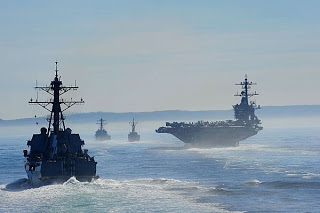
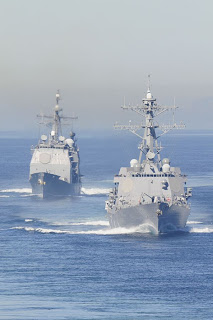
The USS George Washington (CVN 73) and escorts have deployed from Japan. Interesting to note, there were some Japanese Navy vessels deployed over the last 24 hours as well. As you might imagine, the ports in South Korea are largely empty as a great deal of the South Korean Navy has put to sea.

There are no solid numbers, but some news organizations are reporting well over 50 major warships from the United States, Japan, and South Korea currently moving towards the maritime regions surrounding the Korean Peninsula. This would constitute the largest assembly of international naval firefare since the invasion of Iraq in 2003. I'm sure China is pleased to see this massive armada on their lawn.

Asahi Shimbun (Japanese media) is now reporting there were 5 North Korean Mig-23s seen on the North Korean side of the border just prior to artillery fire began, and South Korea was tracking them on the South Korean side with F-15s. Neither the Migs nor F-15s apparently crossed their respective border, nor were involved in the battle at Yeonpyeong island.

There appear to be a few security holes somewhere in the US National Security information loop, because very credible sources have reported the first US ISR on the scene over Yeonpyeong was UAVs launched from the USS Jimmy Carter (SSN 23). While I appreciate the idea that leaking submarine activity might be part of a well orchestrated information campaign against North Korea (North Korea couldn't detect the USS Jimmy Carter short of using a minefield, even if they used every sonar in their entire inventory), I don't think that is actually the reason for the leak.

Inside the loop, information has become nearly impossible as things have gone dark across the Pacific all the way to Diego Garcia, but from talking to civilians today there was a lot of praise for PACOM and specifically ADM Willard, who according to my sources was the first major player among all the players engaged in the events unfolding. There was also quite a bit of good things said all the way around about 7th Fleet today.

The background for the photo in this blog post can be found here.

I do not rule out the use of military power in response to this attack, but do not expect it. If so it will come from South Korea. I think the US will do exactly what they did following the Cheonan attack - shift the pressure China. I think it is pretty clear the inability of China to address North Korean following the Cheonan incident cost China considerable credibility in the region this year. In this case, things are less ambiguous in the public, so China will either step up or be discredited by virtually every nation in the region as irresponsible and unworthy of being a regional leader.

The problem with this approach is the US could turn this into a US-China political game, and South Korea may not see that approach as being in their best interest. I don't think that means they take military action, but there were South Korean homes burning on TV from a military attack from the North all day yesterday. Doing nothing in the eyes of the public is less risky a political response as doing something, although we won't know the cost of doing nothing until the markets close.

As always, the North might do something stupid. One would think not, but I wouldn't have believed they would shell a neighborhood either had you asked me yesterday. Apparently they really will do anything given the time and space - and that's the tough issue. For the record, the crop this year in North Korea was reported to be a disaster, so North Korea is in need of food aid this winter.

Tuesday, November 23, 2024

The Navy View: Korean Peninsula

For those watching events in on the Korean Peninsula, as of yesterday the USS George Washington (CVN 73) was in port, but that ship can get to sea very quickly and may already have sailed.

Also noteworthy, the forward deployed MEU, the Essex ARG, was around Okinawa yesterday. The Peleliu ARG is in the Philippines currently on their way home from deployment.

Should hostilities break out on a larger scale, the US Navy could surge both the USS Ronald Reagan (CVN 76) and the USS Nimitz (68) very quickly. Both ships have conducted training off the west coast this month. At 25 knots it would take less than 10 days before the ships arrived ready for battle.

Already at sea is USS Abraham Lincoln (CVN 72) and USS Harry S. Truman (CVN 75), where both carriers are currently supporting war operations in Afghanistan. These carriers are about 9 days away, or less, depending upon course and speed - starting when they are ordered to move.

While they do not surface often, when the Ohio SSGNs do surface, they tend to do so in the waters near South Korea.

The US Navy maintains a continuous presence in the region, and in different forms is already there.

Tuesday, October 5, 2024

Cheonan Sinking Intel Leak

A South Korean politician has provided a small intel dump regarding the situation just prior to the sinking of the Navy corvette Cheonan.
The Navy corvette Cheonan was warned on the morning it sank on March 26 that a salmon-class North Korean submarine and support ships had disappeared from their bases the day before, a lawmaker claims.

Democratic Party lawmaker Shin Hak-yong on Monday said on the morning of the North's attack on the Cheonan, "warnings were given by the Second Fleet Command that a salmon-class North Korean submarine and support ships had been out to sea for unknown operations. Right before the Cheonan was attacked, all artillery guns on the nearby North Korean coasts were found to be combat-ready. But despite these rapid movements of the North Korean military, neither the Joint Chiefs of Staff nor the Second Fleet Command took appropriate measures."
The article is a very interesting read.

Friday, June 4, 2024

Maritime Mysteries

Right before I went AWOL - back in early February, I got a few tips regarding a ship that had been hijacked by pirates. There were a few people interested in MV Rim - a ship noted for being low on the water while supposedly on the way to a scrap yard.

MV Rim was able to escape yesterday by overcoming their pirate captors when a firefight broke out between rival clans. OK, so we have a ship that apparently wasn't insured, never announced itself to the international community when traveling through pirate waters, was on its way to be scrapped and yet has a load of cargo, and was given a high ransom price despite supposedly being a ship of no value, no insurance, and a small crew. That isn't much to work with...

But then rival pirate gangs break out into violence over this worthless ship? What the hell is going on?

Oh... did I mention the ship was North Korean?

More background here which includes a call to inspect the ship now that it has been released. Interesting, I thought anyway.